
Home>>Signaling Pathways>> Membrane Transporter/Ion Channel>> P2X purinergic receptor>>A 438079 hydrochloride

A 438079 hydrochloride

Catalog No.GC13733

An antagonist of the nucleotide receptor P2X7

Products are for research use only. Not for human use. We do not sell to patients.
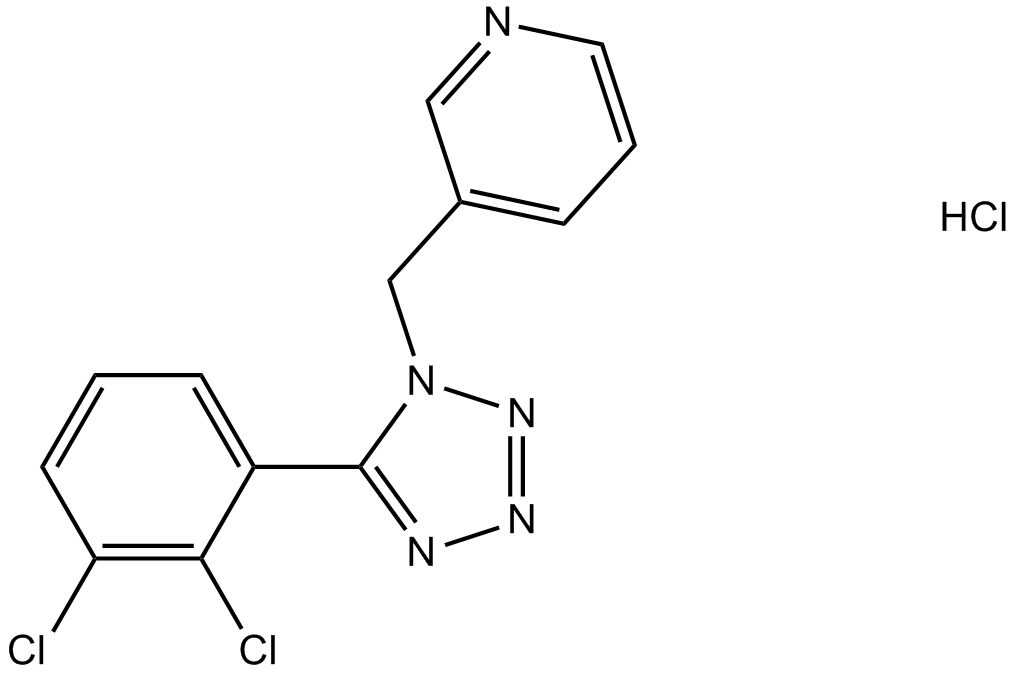
A 438079 hydrochloride Chemical Structure

Cas No.: 899431-18-6

Size Price Stock Qty
10mg
$76.00
In stock
50mg
$315.00
In stock

Tel:(909) 407-4943 Email: sales@glpbio.com


Customer Reviews

Based on customer reviews.

Sample solution is provided at 25 µL, 10mM.

Description of A 438079 hydrochloride

A 438079 hydrochloride is a selective antagonist of P2X7 receptor with IC50 values of 100 and 300 nM in rat and human, respectively [1].

A 438079 is a derivative of the origin compound tetrazole 5 selected out as a novel P2X7 receptor antagonist. In human 1321N1 astrocytoma cells with expressing recombinant human P2X7, A 438079 treatment suppressed the Ca 2+ flux with pIC50 value of 6.9. In the pore formation assay, A 438079 blocked the pore formation of human THP-1 cells and prevented the cells from uptaking the diiodide dye YO-PRO. Moreover, in the spinal nerve ligation model, administration of A 438079 reduced the neuropathic pain induced by the application of a von Frey hair. The ED50 value was 76 μM/kg [2].

References:
1. Nelson D W, Gregg R J, Kort M E, et al. Structure-activity relationship studies on a series of novel, substituted 1-benzyl-5-phenyltetrazole P2X7 antagonists. Journal of medicinal chemistry, 2006, 49(12): 3659-3666.
2. Donnelly-Roberts D L, Jarvis M F. Discovery of P2X7 receptor-selective antagonists offers new insights into P2X7 receptor function and indicates a role in chronic pain states. British journal of pharmacology, 2007, 151(5): 571-579.

Protocol of A 438079 hydrochloride

Kinase experiment:

Human astrocytoma cells, 1321N1, are grown to stably express rat P2X7, human P2X4, P2X2a, P2X2/3, P2X1, P2Y1 and P2Y2 recombinant receptors. Agonist, BzATP, 2,3-O-(4-ben-zoylbenzoyl)-ATP or ATP-induced changes in intracellular Ca2+ concentrations are assessed in all of the cell lines using the Ca2+ chelating dye, Fluo-4, in conjunction with a Fluorometric Imaging Plate Reader. The cells are plated out the day before the experiment onto poly-D-lysine-coated black 96 well plates. After the agonist addition, changes in intracellular Ca2+ concentrations are recorded, per second, for 3 min. Ligands are tested at 11 half-log concentrations from 10-10 to 10-4 M. BzATP or ATP concentrations corresponds to the EC70 values for each receptor to enable comparison of antagonist potencies across the multiple P2 receptor subtypes. A 438079 is added to the cell plate and fluorescence data are collected for 3 min before the addition of agonist, subsequently, data are then collected for another 2 min. The pEC50 or pIC50 values are derived from a single curve fit.

Animal experiment:

To confirm A 438079 reach the brain after systemic administration, P10 rat pups are injected with 5 mg/kg A 438079 and killed either 10 min, 30 min, or 2 h later (n=4 per group). Blood samples are centrifuged at 1000×g for 10 min to isolate the plasma. Samples are analyzed using liquid chromatography-mass spectrometry (LC-MS/MS) by a service provider. Briefly, protein is precipitated from 50 μL aliquots of the individual plasma or brain tissue homogenate, and A 438079 is quantified by LC-MS/MS from a five-point standard curve.

References:

[1]. McGaraughty S, et al. P2X7-related modulation of pathological nociception in rats. Neuroscience. 2007 Jun 8;146(4):1817-28.
[2]. Mesuret G, et al. CNS Neurosci Ther. 2014 Jun;20(6):556-64.
[3]. Marcellino D, et al. On the role of P2X(7) receptors in dopamine nerve cell degeneration in a rat model of Parkinson's disease: studies with the P2X(7) receptor antagonist A-438079. J Neural Transm (Vienna). 2010 Jun;117(6):681-7.
[4]. Martins JP, et al. The role of P2X7 purinergic receptors in inflammatory and nociceptive changes accompanying cyclophosphamide-induced haemorrhagic cystitis in mice. Br J Pharmacol. 2012 Jan;165(1):183-96.

Chemical Properties of A 438079 hydrochloride

Cas No. 899431-18-6 SDF
Chemical Name 3-[[5-(2,3-dichlorophenyl)tetrazol-1-yl]methyl]pyridine;hydrochloride
Canonical SMILES C1=CC(=C(C(=C1)Cl)Cl)C2=NN=NN2CC3=CN=CC=C3.Cl
Formula C13H10Cl3N5 M.Wt 342.61
Solubility ≥ 34.3 mg/mL in DMSO, ≥ 49.8 mg/mL in EtOH with ultrasonic and warming, ≥ 94 mg/mL in Water Storage Store at -20°C
General tips Please select the appropriate solvent to prepare the stock solution according to the solubility of the product in different solvents; once the solution is prepared, please store it in separate packages to avoid product failure caused by repeated freezing and thawing.Storage method and period of the stock solution: When stored at -80°C, please use it within 6 months; when stored at -20°C, please use it within 1 month.
To increase solubility, heat the tube to 37°C and then oscillate in an ultrasonic bath for some time.
Shipping Condition Evaluation sample solution: shipped with blue ice. All other sizes available: with RT, or with Blue Ice upon request.

Complete Stock Solution Preparation Table of A 438079 hydrochloride

Prepare stock solution
1 mg 5 mg 10 mg
1 mM 2.9188 mL 14.5939 mL 29.1877 mL
5 mM 583.8 μL 2.9188 mL 5.8375 mL
10 mM 291.9 μL 1.4594 mL 2.9188 mL
  • Molarity Calculator

  • Dilution Calculator

  • Molecular Weight Calculator

Mass
=
Concentration
x
Volume
x
MW*


**When preparing stock solutions always use the batch-specific molecular weight of the product found on the vial label and MSDS / CoA (available online).

Calculate

In vivo Formulation Calculator (Clear solution) of A 438079 hydrochloride

Step 1: Enter information below (Recommended: An additional animal making an allowance for loss during the experiment)

mg/kg g μL

Step 2: Enter the in vivo formulation (This is only the calculator, not formulation. Please contact us first if there is no in vivo formulation at the solubility Section.)

% DMSO % % Tween 80 % ddH2O
%DMSO %

Calculation results:

Working concentration: mg/ml;

Method for preparing DMSO master liquid: mg drug pre-dissolved in μL DMSO ( Master liquid concentration mg/mL, Please contact us first if the concentration exceeds the DMSO solubility of the batch of drug. )

Method for preparing in vivo formulation: Take μL DMSO master liquid, next addμL PEG300, mix and clarify, next addμL Tween 80, mix and clarify, next add μL ddH2O, mix and clarify.

Method for preparing in vivo formulation: Take μL DMSO master liquid, next add μL Corn oil, mix and clarify.

Note: 1. Please make sure the liquid is clear before adding the next solvent.
2. Be sure to add the solvent(s) in order. You must ensure that the solution obtained, in the previous addition, is a clear solution before proceeding to add the next solvent. Physical methods such as vortex, ultrasound or hot water bath can be used to aid dissolving.
3. All of the above co-solvents are available for purchase on the GlpBio website.

Product Documents

Quality Control & SDS

View current batch:

Reviews

Review for A 438079 hydrochloride

Average Rating: 5 ★★★★★ (Based on Reviews and 30 reference(s) in Google Scholar.)

5 Star
100%
4 Star
0%
3 Star
0%
2 Star
0%
1 Star
0%
Review for A 438079 hydrochloride

GLPBIO products are for RESEARCH USE ONLY. Please make sure your review or question is research based.

Required fields are marked with *

You may receive emails regarding this submission. Any emails will include the ability to opt-out of future communications.