
Brivanib (BMS-540215) (Synonyms: BMS 540215) |
| Catalog No.GC11692 |
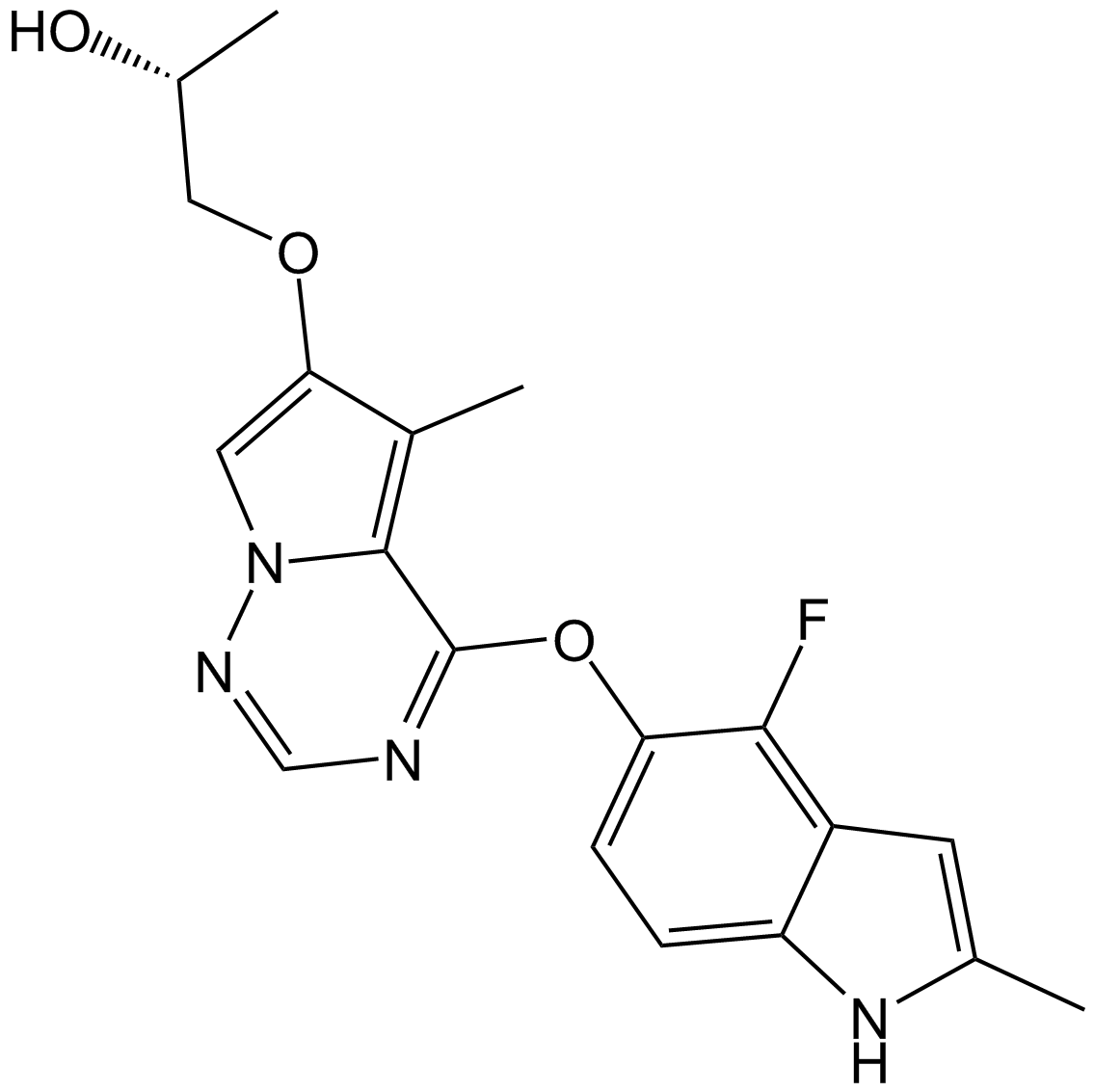
Brivanib (BMS-540215) (BMS-540215) is an ATP-competitive inhibitor against VEGFR2 with an IC50 of 25 nM, and has moderate potency against VEGFR-1 and FGFR-1, but >240-fold against PDGFR-β.
Products are for research use only. Not for human use. We do not sell to patients.
Cas No.: 649735-46-6
Sample solution is provided at 25 µL, 10mM.
Brivanib is an ATP competitive inhibitor of human VEGFR-2 with IC50 value of 25nM [1].
Brivanib is a selective RTK inhibitor that targets signaling via VEGFR2 and 3, and FGFR1, 2 and 3. Targeting both VEGF and FGF signaling pathways inhibits tumor growth in RT2 mice, with VEGF signaling predominating in initiation of tumor angiogenesis, Currently, brivanib therapy is being evaluated in phase III clinical trials in colorectal carcinoma and hepatocellular carcinoma (HCC) and in phase II trials for numerous indications including brivanib second-line therapy following sorafenib failure [2].
Brivanib has moderate potency against VEGFR-1 and FGFR-1 and good selectivity against PDGFR-β. In the preclinical in vivo mouse models, it is also found to be a good inhibitor of Flk-1, the mouse homologue of VEGFR-2 with IC50 value of 89 nM. Brivanib is reported to inhibit the proliferation of human umbilical vein endothelial cells (HUVEC) with potency against VEGF-stimulated HUVECs and FGF-stimulated HUVECs. The IC50 values are 40 nM and 276nM respectively. When tested against human tumor cell lines, Brivanib shows lower antiproliferative potency. In particular, activity was low against the cell line used in the in vivo tumor xenograft mouse efficacy model (H3396) [1].
References:
[1] Rajeev S. Bhide, Zhen-Wei Cai, Yong-Zheng Zhang, Ligang Qian, Donna Wei, Stephanie Barbosa, Louis J. Lombardo, Robert M. Borzilleri, Xiaoping Zheng, Laurence I. Wu, Joel C. Barrish, Soong-Hoon Kim, Kenneth Leavitt, Arvind Mathur, Leslie Leith, Sam Chao, Barri Wautlet, Steven Mortillo, Robert Jeyaseelan Sr., Daniel Kukral, John T. Hunt, Amrita Kamath, Aberra Fura, Viral Vyas, Punit Marathe, Celia D’Arienzo, George Derbin, and Joseph Fargnoli. Discovery and Preclinical Studies of (R)-1-(4-(4-Fluoro-2-methyl-1H-indol-5-yloxy)-5-methylpyrrolo[2,1-f][1,2,4]triazin-6-yloxy)propan-2-ol (BMS-540215), an In Vivo Active Potent VEGFR-2 Inhibitor. Journal of Medicinal Chemistry. 2006, 49 (7): 2143-2146.
[2] Elizabeth Allen, Ian B. Walters, and Douglas Hanahan. Brivanib, a Dual FGF/VEGF Inhibitor, Is Active Both First and Second Line against Mouse Pancreatic Neuroendocrine Tumors Developing Adaptive/Evasive Resistance to VEGF Inhibition. Clinical Cancer Research. 2011 (17): 5299-5310.

|
Cell experiment: |
Viability is measured in LX-2 cells using the Cell Counting Kit-8 (CCK-8). Using 96-well plates with 2,000 cells per well, HSCs are incubated in 10% FBS-supplemented DMEM for 24 hours, followed by starvation in serum-free media. After 24 hours of starvation, brivanib is added at different doses. Two hours later, 5 ng/mL PDGF-BB is added. The cells are incubated for an additional 72 hours and cell viability is measured. Each experiment is performed in three replicates at least four times. |
|
Animal experiment: |
Male mice 4-6 weeks of age are treated 3 times a week with a total of 12 intraperitoneal (i.p.) injections of 150 mL/kg TAA. At the onset of TAA treatment, placebo or brivanib (25 or 50 mg/kg) is administered orally on 5 consecutive days with weekend breaks. The animals are sacrificed 4 weeks after the start of the injections. |
|
References: [1]. Bhide RS, et al. Discovery and preclinical studies of (R)-1-(4-(4-fluoro-2-methyl-1H-indol-5-yloxy)-5- methylpyrrolo[2,1-f][1,2,4]triazin-6-yloxy)propan- 2-ol (BMS-540215), an in vivo active potent VEGFR-2 inhibitor. J Med Chem, 2006, 49 (7), 2143-2146. |
|
| Cas No. | 649735-46-6 | SDF | |
| Synonyms | BMS 540215 | ||
| Chemical Name | (2R)-1-[4-[(4-fluoro-2-methyl-1H-indol-5-yl)oxy]-5-methylpyrrolo[2,1-f][1,2,4]triazin-6-yl]oxypropan-2-ol | ||
| Canonical SMILES | CC1=CC2=C(N1)C=CC(=C2F)OC3=NC=NN4C3=C(C(=C4)OCC(C)O)C | ||
| Formula | C19H19FN4O3 | M.Wt | 370.38 |
| Solubility | ≥ 18.5mg/mL in DMSO | Storage | Store at -20°C |
| General tips | Please select the appropriate solvent to prepare the stock solution according to the
solubility of the product in different solvents; once the solution is prepared, please store it in
separate packages to avoid product failure caused by repeated freezing and thawing.Storage method
and period of the stock solution: When stored at -80°C, please use it within 6 months; when stored
at -20°C, please use it within 1 month. To increase solubility, heat the tube to 37°C and then oscillate in an ultrasonic bath for some time. |
||
| Shipping Condition | Evaluation sample solution: shipped with blue ice. All other sizes available: with RT, or with Blue Ice upon request. | ||
| Prepare stock solution | |||
|
1 mg | 5 mg | 10 mg |
| 1 mM | 2.6999 mL | 13.4996 mL | 26.9993 mL |
| 5 mM | 540 μL | 2.6999 mL | 5.3999 mL |
| 10 mM | 270 μL | 1.35 mL | 2.6999 mL |
Step 1: Enter information below (Recommended: An additional animal making an allowance for loss during the experiment)
Step 2: Enter the in vivo formulation (This is only the calculator, not formulation. Please contact us first if there is no in vivo formulation at the solubility Section.)
Calculation results:
Working concentration: mg/ml;
Method for preparing DMSO master liquid: mg drug pre-dissolved in μL DMSO ( Master liquid concentration mg/mL, Please contact us first if the concentration exceeds the DMSO solubility of the batch of drug. )
Method for preparing in vivo formulation: Take μL DMSO master liquid, next addμL PEG300, mix and clarify, next addμL Tween 80, mix and clarify, next add μL ddH2O, mix and clarify.
Method for preparing in vivo formulation: Take μL DMSO master liquid, next add μL Corn oil, mix and clarify.
Note: 1. Please make sure the liquid is clear before adding the next solvent.
2. Be sure to add the solvent(s) in order. You must ensure that the solution obtained, in the previous addition, is a clear solution before proceeding to add the next solvent. Physical methods such as vortex, ultrasound or hot water bath can be used to aid dissolving.
3. All of the above co-solvents are available for purchase on the GlpBio website.
Quality Control & SDS
- View current batch:
- Purity: >98.00%
- COA (Certificate Of Analysis)
- SDS (Safety Data Sheet)
- Datasheet
Average Rating: 5 (Based on Reviews and 40 reference(s) in Google Scholar.)
GLPBIO products are for RESEARCH USE ONLY. Please make sure your review or question is research based.
Required fields are marked with *


