
Dasatinib (BMS-354825) (Synonyms: BMS 354825, Sprycel) |
| Catalog No.GC15568 |
Dasatinib (BMS-354825) is a highly potent and orally-bioavailable multi-target tyrosine kinase inhibitor with IC₅₀ values of 0.4nM for BCR-ABL, 0.5nM for SRC-family kinases, 100nM for c-KIT, and 180nM for PDGFR-β.
Products are for research use only. Not for human use. We do not sell to patients.
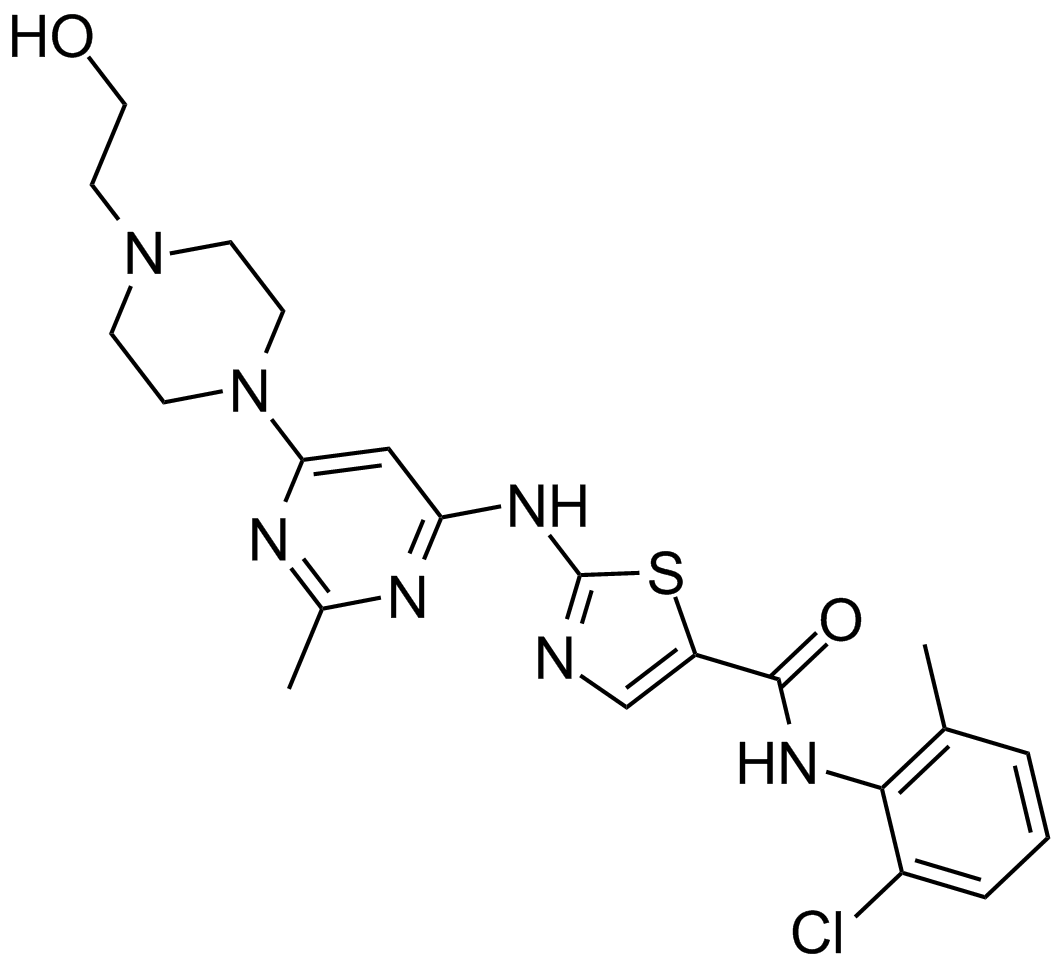
Cas No.: 302962-49-8
Sample solution is provided at 25 µL, 10mM.
Dasatinib (BMS-354825) is a highly potent and orally-bioavailable multi-target tyrosine kinase inhibitor with IC₅₀ values of 0.4nM for BCR-ABL, 0.5nM for SRC-family kinases, 100nM for c-KIT, and 180nM for PDGFR-β[1]. Dasatinib readily crosses the blood–brain barrier and is widely used as a tool compound to investigate oncogenic kinase signaling and central nervous system disorders such as Alzheimer’s disease[2]. In addition, Dasatinib has been reported to ameliorate diabetic kidney disease and aging-related metabolic dysfunction[3-4].
In vitro, treatment of primary keloid dermal fibroblasts with 1–10nM Dasatinib for 24h selectively eliminated SA-β-gal- and p16-positive senescent cells in a dose-dependent manner and concomitantly reduced procollagen and p16 protein expression[5]. Pre-incubation of BV2 microglial cells, primary mouse microglia, and primary astrocytes with 100–250nM Dasatinib for 30min–2h, followed by LPS stimulation (200ng/ml–1µg/ml) for 5.5h, significantly suppressed pro-inflammatory cytokine expression and attenuated the inflammatory response[6].
In vivo, weekly intraperitoneal injections of Dasatinib (5mg/kg) combined with Quercetin (50mg/kg) were administered to C57BL/6J mice starting at 6, 14, or 18 months of age and continuing until 23 months; Dasatinib markedly mitigated age-related intervertebral disc degeneration[7]. In 18-month-old BALB/c mice, Dasatinib (5mg/kg) plus Quercetin (50mg/kg) was given by oral gavage for 3 consecutive days every 2 weeks for 10 weeks. This regimen significantly reduced intestinal senescent cell burden and lowered inflammatory cytokine expression in the small and large intestines, while also reshaping the gut microbiota composition of aged mice [8].
References:
[1] Lombardo LJ, Lee FY, Chen P, et al. Discovery of N-(2-chloro-6-methyl- phenyl)-2-(6-(4-(2-hydroxyethyl)- piperazin-1-yl)-2-methylpyrimidin-4- ylamino)thiazole-5-carboxamide (BMS-354825), a dual Src/Abl kinase inhibitor with potent antitumor activity in preclinical assays. J Med Chem. 2004 Dec 30;47(27):6658-61.
[2] Cann ML, Herring LE, Haar LL, et al. Dasatinib Is Preferentially Active in the Activated B-Cell Subtype of Diffuse Large B-Cell Lymphoma. J Proteome Res. 2019 Jan 4;18(1):522-534.
[3] Hickson LJ, Langhi Prata LGP, Bobart SA, et al. Senolytics decrease senescent cells in humans: Preliminary report from a clinical trial of Dasatinib plus Quercetin in individuals with diabetic kidney disease. EBioMedicine. 2019 Sep;47:446-456.
[4] Islam MT, Tuday E, Allen S, et al. Senolytic drugs, dasatinib and quercetin, attenuate adipose tissue inflammation, and ameliorate metabolic function in old age. Aging Cell. 2023 Feb;22(2):e13767.
[5] Darmawan CC, Hur K, Kusumaningrum N, et al. Dasatinib Attenuates Fibrosis in Keloids by Decreasing Senescent Cell Burden. Acta Derm Venereol. 2023 Apr 6;103:adv4475.
[6] Ryu KY, Lee HJ, Woo H, et al. Dasatinib regulates LPS-induced microglial and astrocytic neuroinflammatory responses by inhibiting AKT/STAT3 signaling. J Neuroinflammation. 2019 Oct 26;16(1):190.
[7] Novais EJ, Tran VA, Johnston SN, et al. Long-term treatment with senolytic drugs Dasatinib and Quercetin ameliorates age-dependent intervertebral disc degeneration in mice. Nat Commun. 2021 Sep 3;12(1):5213.
[8] Saccon TD, Nagpal R, Yadav H, et al. Senolytic Combination of Dasatinib and Quercetin Alleviates Intestinal Senescence and Inflammation and Modulates the Gut Microbiome in Aged Mice. J Gerontol A Biol Sci Med Sci. 2021 Oct 13;76(11):1895-1905.
| Cell experiment [1]: | |
Cell lines | Primary keloid dermal fibroblasts isolated from surgical excision specimens of patients |
Preparation Method | Cells were isolated by mechanical-enzymatic digestion and cultured in DMEM with 10% FBS at 37°C, 5% CO₂. Passages 1–4 were used; cells were serum-starved for 24h before treatment. |
Reaction Conditions | 1, 5, 10nM Dasatinib; 24h exposure. |
Applications | Dasatinib selectively eliminated senescent cells and dose-dependently reduced p16 and procollagen protein levels, while down-regulating profibrotic SASP factors, thereby markedly attenuating the fibrotic phenotype of keloid fibroblasts. |
| Animal experiment [2]: | |
Animal models | C57BL/6 mice |
Preparation Method | From 3 to 8 months of age, mice were gavaged once a month for three consecutive days with either Dasatinib+Quercetin or vehicle. At 8 months, males were bred with untreated young females for 10 days, then euthanized for analysis. |
Dosage form | 5mg/kg Dasatinib + 50mg/kg Quercetin; oral gavage. |
Applications | Dasatinib significantly increased serum testosterone and epididymal sperm concentration, reduced the percentage of morphologically abnormal sperm, yet left sperm motility, seminiferous-tubule histology, fertility rate, litter size, and classic senescence markers (β-galactosidase activity and lipofuscin staining) unchanged. |
References: | |
| Cas No. | 302962-49-8 | SDF | |
| Synonyms | BMS 354825, Sprycel | ||
| Chemical Name | N-(2-chloro-6-methylphenyl)-2-[[6-[4-(2-hydroxyethyl)piperazin-1-yl]-2-methylpyrimidin-4-yl]amino]-1,3-thiazole-5-carboxamide | ||
| Canonical SMILES | CC1=C(C(=CC=C1)Cl)NC(=O)C2=CN=C(S2)NC3=NC(=NC(=C3)N4CCN(CC4)CCO)C | ||
| Formula | C22H26ClN7O2S | M.Wt | 488.01 |
| Solubility | ≥ 24.4mg/mL in DMSO | Storage | Store at -20°C |
| General tips | Please select the appropriate solvent to prepare the stock solution according to the
solubility of the product in different solvents; once the solution is prepared, please store it in
separate packages to avoid product failure caused by repeated freezing and thawing.Storage method
and period of the stock solution: When stored at -80°C, please use it within 6 months; when stored
at -20°C, please use it within 1 month. To increase solubility, heat the tube to 37°C and then oscillate in an ultrasonic bath for some time. |
||
| Shipping Condition | Evaluation sample solution: shipped with blue ice. All other sizes available: with RT, or with Blue Ice upon request. | ||
| Prepare stock solution | |||
|
1 mg | 5 mg | 10 mg |
| 1 mM | 2.0491 mL | 10.2457 mL | 20.4914 mL |
| 5 mM | 409.8 μL | 2.0491 mL | 4.0983 mL |
| 10 mM | 204.9 μL | 1.0246 mL | 2.0491 mL |
Step 1: Enter information below (Recommended: An additional animal making an allowance for loss during the experiment)
Step 2: Enter the in vivo formulation (This is only the calculator, not formulation. Please contact us first if there is no in vivo formulation at the solubility Section.)
Calculation results:
Working concentration: mg/ml;
Method for preparing DMSO master liquid: mg drug pre-dissolved in μL DMSO ( Master liquid concentration mg/mL, Please contact us first if the concentration exceeds the DMSO solubility of the batch of drug. )
Method for preparing in vivo formulation: Take μL DMSO master liquid, next addμL PEG300, mix and clarify, next addμL Tween 80, mix and clarify, next add μL ddH2O, mix and clarify.
Method for preparing in vivo formulation: Take μL DMSO master liquid, next add μL Corn oil, mix and clarify.
Note: 1. Please make sure the liquid is clear before adding the next solvent.
2. Be sure to add the solvent(s) in order. You must ensure that the solution obtained, in the previous addition, is a clear solution before proceeding to add the next solvent. Physical methods such as vortex, ultrasound or hot water bath can be used to aid dissolving.
3. All of the above co-solvents are available for purchase on the GlpBio website.
Quality Control & SDS
- View current batch:
- Purity: >98.00%
- COA (Certificate Of Analysis)
- SDS (Safety Data Sheet)
- Datasheet
Average Rating: 5 (Based on Reviews and 30 reference(s) in Google Scholar.)
GLPBIO products are for RESEARCH USE ONLY. Please make sure your review or question is research based.
Required fields are marked with *
