
5-Azacytidine (Synonyms: Antibiotic U 18496, 5AzaC, Ladakamycin, Mylosar, NSC 102816, NSC 103627, U 18496, WR 183027) |
| Katalog-Nr.GC10946 |
5-Azacytidine(auch als 5-AzaC bekannt), eine Verbindung aus der Klasse der Cytosin-Analoga, ist ein DNA-Methyltransferase(DNMT)-Inhibitor, der eine starke Zytotoxizität gegen Multiple-Myelom(MM)-Zellen ausübt, einschließlich MM.1S, MM.1R, RPMI-8266, RPMI-LR5, RPMI-Dox40 und Patient-eigenes MM. Die IC50-Werte der halbmaximalen Hemmkonzentration sind 1.5 μmol/L, 0.7 μmol/L, 1.1 μmol/L, 2.5 μmol/L, 3.2 μmol/L bzw. 1.5 μmol/L.
Products are for research use only. Not for human use. We do not sell to patients.
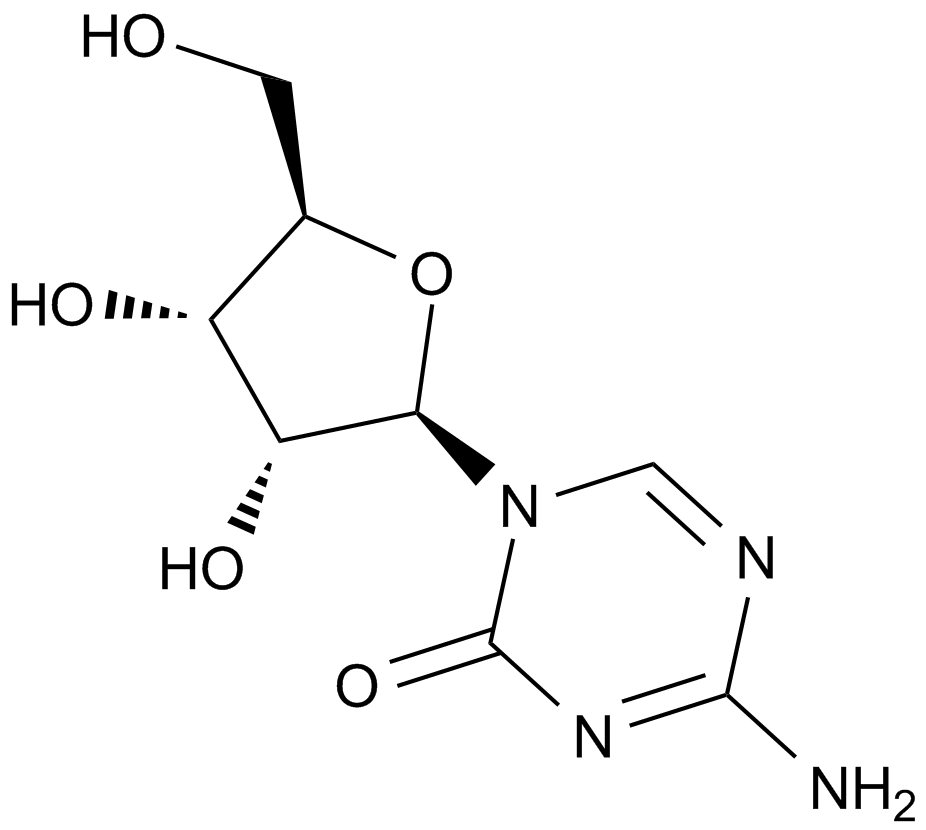
Cas No.: 320-67-2
Sample solution is provided at 25 µL, 10mM.
5-Azacytidine(auch als 5-AzaC bekannt), eine Verbindung aus der Klasse der Cytosin-Analoga, ist ein DNA-Methyltransferase(DNMT)-Inhibitor, der eine starke Zytotoxizität gegen Multiple-Myelom(MM)-Zellen ausübt, einschließlich MM.1S, MM.1R, RPMI-8266, RPMI-LR5, RPMI-Dox40 und Patient-eigenes MM. Die IC50-Werte der halbmaximalen Hemmkonzentration sind 1.5 μmol/L, 0.7 μmol/L, 1.1 μmol/L, 2.5 μmol/L, 3.2 μmol/L bzw. 1.5 μmol/L[1].
5-Azacytidine wird in zelluläre DNA und/oder RNA eingebaut, bindet dann DNMT und bildet eine kovalente Bindung zwischen C6 von 5-Azacytidine und Cystein-Thiolat von DNMTs. Das führt zur Erschöpfung der DNMT-Aktivität in Zellen und zur Demethylierung der zellulären DNA[1].
References:
[1] Kiziltepe T, Hideshima T, Catley L, Raje N, Yasui H, Shiraishi N, Okawa Y, Ikeda H, Vallet S, Pozzi S, Ishitsuka K, Ocio EM, Chauhan D, Anderson KC. 5-Azacytidine, a DNA methyltransferase inhibitor, induces ATR-mediated DNA double-strand break responses, apoptosis, and synergistic cytotoxicity with doxorubicin and bortezomib against multiple myeloma cells. Mol Cancer Ther. 2007 Jun;6(6):1718-27.

| Zellexperiment [1]: | |
Zelllinien | Leukämie-L1210-Zellen |
Vorbereitungsmethode | Die Löslichkeit der Verbindung in DMSO ist > 12.2 mg/mL. Allgemeine Hinweise zur Erhöhung der Konzentration: Erwärmen Sie bitte das Röhrchen 10 Minuten lang bei 37 °C und/oder schütteln Sie es kurz im Ultraschallbad. Die Stammlösung ist bei unter - 20 °C einige Monate haltbar. |
Reaktionsbedingungen | 80 μM; 0 ~ 120 Minuten |
Anwendungen | In Leukämiezellen L1210 zeigte 5-Azacytidine eine stärkere Hemmung der DNA-Synthese als der RNA-Synthese. Nach einer 90-minütigen Vorinkubation war der Einbau von TdR-3H um etwa 74% gehemmt, während der Einbau von UR-3H nur um 32% gehemmt war. |
| Tierversuch [2]: | |
Tiermodelle | BDF1-Mäuse mit lymphatischen Leukämie-Zellen L1210 |
Vorbereitungsmethode | 3 mg/kg; i.p.; q.d. |
Dosierungsform | Bei BDF1-Mäusen mit lymphatischen Leukämie-Zellen L1210 erhöhte 5-Azacytidine die mittlere Überlebenszeit. Außerdem unterdrückte 5-Azacytidine erheblich die Aktivität aller Enzyme im Polyamin-Biosyntheseweg. Zusätzlich hemmte 5-Azacytidine die Akkumulation von Polyaminen bei leukämischen Mäusen. |
Anwendungen | Bitte testen Sie die Löslichkeit aller Verbindungen in Innenräumen. Die tatsächliche Löslichkeit kann geringfügig vom theoretischen Wert abweichen. Das ist auf einen experimentellen Systemfehler zurückzuführen und ist normal. |
References: | |
| Cas No. | 320-67-2 | SDF | |
| Überlieferungen | Antibiotic U 18496, 5AzaC, Ladakamycin, Mylosar, NSC 102816, NSC 103627, U 18496, WR 183027 | ||
| Chemical Name | 4-amino-1-[(2R,3R,4S,5R)-3,4-dihydroxy-5-(hydroxymethyl)oxolan-2-yl]-1,3,5-triazin-2-one | ||
| Canonical SMILES | C1=NC(=NC(=O)N1C2C(C(C(O2)CO)O)O)N | ||
| Formula | C8H12N4O5 | M.Wt | 244.2 |
| Löslichkeit | ≥ 12.21mg/mL in DMSO | Storage | Store at -20°C |
| General tips | Please select the appropriate solvent to prepare the stock solution according to the
solubility of the product in different solvents; once the solution is prepared, please store it in
separate packages to avoid product failure caused by repeated freezing and thawing.Storage method
and period of the stock solution: When stored at -80°C, please use it within 6 months; when stored
at -20°C, please use it within 1 month. To increase solubility, heat the tube to 37°C and then oscillate in an ultrasonic bath for some time. |
||
| Shipping Condition | Evaluation sample solution: shipped with blue ice. All other sizes available: with RT, or with Blue Ice upon request. | ||
| Prepare stock solution | |||
|
1 mg | 5 mg | 10 mg |
| 1 mM | 4.095 mL | 20.475 mL | 40.95 mL |
| 5 mM | 819 μL | 4.095 mL | 8.19 mL |
| 10 mM | 409.5 μL | 2.0475 mL | 4.095 mL |
Step 1: Enter information below (Recommended: An additional animal making an allowance for loss during the experiment)
Step 2: Enter the in vivo formulation (This is only the calculator, not formulation. Please contact us first if there is no in vivo formulation at the solubility Section.)
Calculation results:
Working concentration: mg/ml;
Method for preparing DMSO master liquid: mg drug pre-dissolved in μL DMSO ( Master liquid concentration mg/mL, Please contact us first if the concentration exceeds the DMSO solubility of the batch of drug. )
Method for preparing in vivo formulation: Take μL DMSO master liquid, next addμL PEG300, mix and clarify, next addμL Tween 80, mix and clarify, next add μL ddH2O, mix and clarify.
Method for preparing in vivo formulation: Take μL DMSO master liquid, next add μL Corn oil, mix and clarify.
Note: 1. Please make sure the liquid is clear before adding the next solvent.
2. Be sure to add the solvent(s) in order. You must ensure that the solution obtained, in the previous addition, is a clear solution before proceeding to add the next solvent. Physical methods such as vortex, ultrasound or hot water bath can be used to aid dissolving.
3. All of the above co-solvents are available for purchase on the GlpBio website.
Quality Control & SDS
- View current batch:
- Purity: >98.00%
- COA (Certificate Of Analysis)
- SDS (Safety Data Sheet)
- Datasheet
Average Rating: 5 (Based on Reviews and 30 reference(s) in Google Scholar.)
GLPBIO products are for RESEARCH USE ONLY. Please make sure your review or question is research based.
Required fields are marked with *
