
ABT-888 (Veliparib) |
| Katalog-Nr.GC12422 |
ABT-888 (Veliparib) is an effective inhibitor of PARP1 and PARP2 with Ki values of 5.2 and 2.9nM respectively.
Products are for research use only. Not for human use. We do not sell to patients.
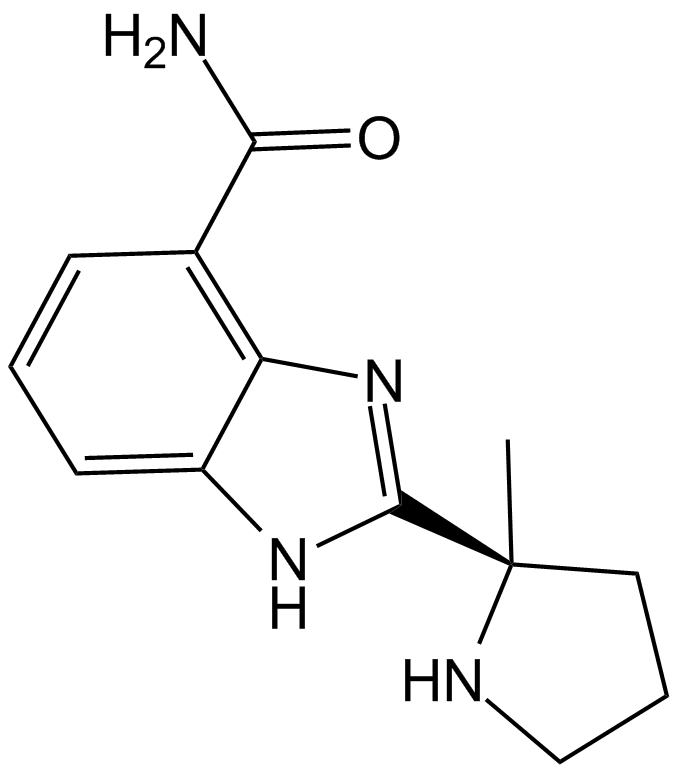
Cas No.: 912444-00-9
Sample solution is provided at 25 µL, 10mM.
ABT-888 (Veliparib) is an effective inhibitor of PARP1 and PARP2 with Ki values of 5.2 and 2.9nM respectively [1]. PARP is involved in DNA repair, and elevated PARP levels can lead to resistance to cytotoxic chemotherapy and radiotherapy [2]. ABT-888 can be used to induce autophagy and apoptosis in tumor cells [3].
In vitro, ABT-888 (0-50μM; 72h) could reduce the cell viability of melanoma cell lines (A375 and A375R) in a dose-dependent manner, reaching the maximum effect within the range of 25-50μM and showing pro-apoptotic activity [4]. Treatment with ABT-888 (10μM; 6h) significantly improved the reduction in cell viability induced by 1000μM sulindac (SM), and decreased the pADPr content (representing PARP-1 activity) in the cells, while ABT-888 did not affect the cell viability after treatment with 100μM SM [5].
In vivo, ABT-888 (25mg/kg/day for 14 days; oral gavage) and carboplatin alone or in combination delayed tumor growth in mice with VC8 xenograft tumor models and reduced tumor mass. The combination therapy was the most effective in slowing tumor growth [6]. The combination (AG014699/PF-02341066 and ABT-888 (5mg/kg/day; five times per week for 26 days; oral)/Foretinib) significantly reduced tumor growth in MDA-MB-231 xenograft tumor model mice, increased tumor cell apoptosis and DNA damage [7].
References:
[1] Donawho CK, Luo Y, Luo Y, et al. ABT-888, an orally active poly(ADP-ribose) polymerase inhibitor that potentiates DNA-damaging agents in preclinical tumor models. Clin Cancer Res. 2007;13(9):2728-2737.
[2] Li X, Delzer J, Voorman R, de Morais SM, Lao Y. Disposition and drug-drug interaction potential of veliparib (ABT-888), a novel and potent inhibitor of poly(ADP-ribose) polymerase. Drug Metab Dispos. 2011;39(7):1161-1169.
[3] Lin F, De Gooijer M C, Roig E M, et al. ABCB1, ABCG2, and PTEN determine the response of glioblastoma to temozolomide and ABT-888 therapy[J]. Clinical cancer research, 2014, 20(10): 2703-2713.
[4] Fratangelo F, Camerlingo R, Carriero M V, et al. Effect of ABT-888 on the apoptosis, motility and invasiveness of BRAFi-resistant melanoma cells[J]. International Journal of Oncology, 2018, 53(3): 1149-1159.
[5] Liu F, Jiang N, Xiao ZY, et al. Effects of poly (ADP-ribose) polymerase-1 (PARP-1) inhibition on sulfur mustard-induced cutaneous injuries in vitro and in vivo. PeerJ. 2016;4:e1890.
[6] Clark C C, Weitzel J N, O'Connor T R. Enhancement of synthetic lethality via combinations of ABT-888, a PARP inhibitor, and carboplatin in vitro and in vivo using BRCA1 and BRCA2 isogenic models[J]. Molecular cancer therapeutics, 2012, 11(9): 1948-1958.
[7] Du Y, Yamaguchi H, Wei Y, et al. Blocking c-Met-mediated PARP1 phosphorylation enhances anti-tumor effects of PARP inhibitors. Nat Med. 2016;22(2):194-201.
| Cell experiment [1]: | |
Cell lines | ESCC cells (A375 and A375R) |
Preparation Method | The cells (3×10³ cells/well) suspended in complete growth medium, were seeded in 96-well plates. After 24h, the medium was replaced with 100µl fresh medium containing the vehicle (0.001% DMSO), the indicated concentrations of ABT-888 or dabrafenib. Following 72h of incubation at 37°C in humidified air with 5% CO2, the suspended cells were removed and the adherent cells were stained with 0.5mg/ml sterile MTT dye solution for 4h at 37°C. The resulting formazan was eluted with 100µl DMSO and measured at a wavelength of 540nm using a microplate reader. For each cell line, data were calculated as a percentage of the absorbance of untreated cells, considered 100%. |
Reaction Conditions | 0-50μM; 72h |
Applications | ABT-888 can reduce the cell viability in melanoma cell lines in a dose-dependent manner, and achieves the maximum effect within the concentration range of 25-50μM. |
| Animal experiment [2]: | |
Animal models | NOD-SCID mice(VC8 heterologous transplanted tumor mouse model) |
Preparation Method | VC8 and VC8+Brca2 CHO cells were injected subcutaneously into 4- to 6-week-old female NOD-SCID mice. Mice with tumors grown for approximately 2 weeks were randomized into 4 groups of 5 mice for each CHO cell xenograft before beginning drug treatment. ABT-888 (25mg/kg) was administrated daily by oral gavage and carboplatin (25mg/kg) intraperitoneally every 5 days. Tumor volumes and mouse mass were measured twice per week. Mice were euthanized when the tumor volume in one of the mice reached 1,500mm3. |
Dosage form | 25mg/kg/day for 14 days; oral gavage |
Applications | ABT-888 and carboplatin, either alone or in combination, delayed tumor growth and reduced tumor mass in the VC8 xenograft tumor model mice. The combination therapy was the most effective in slowing down tumor growth. |
References: | |
| Cas No. | 912444-00-9 | SDF | |
| Chemical Name | 1-[3-[4-amino-3-(4-phenoxyphenyl)pyrazolo[3,4-d]pyrimidin-1-yl]piperidin-1-yl]prop-2-en-1-one | ||
| Canonical SMILES | CC1(CCCN1)C2=NC3=C(C=CC=C3N2)C(=O)N | ||
| Formula | C13H16N4O | M.Wt | 244.3 |
| Löslichkeit | ≥ 6.1mg/mL in DMSO | Storage | Store at -20°C |
| General tips | Please select the appropriate solvent to prepare the stock solution according to the
solubility of the product in different solvents; once the solution is prepared, please store it in
separate packages to avoid product failure caused by repeated freezing and thawing.Storage method
and period of the stock solution: When stored at -80°C, please use it within 6 months; when stored
at -20°C, please use it within 1 month. To increase solubility, heat the tube to 37°C and then oscillate in an ultrasonic bath for some time. |
||
| Shipping Condition | Evaluation sample solution: shipped with blue ice. All other sizes available: with RT, or with Blue Ice upon request. | ||
| Prepare stock solution | |||
|
1 mg | 5 mg | 10 mg |
| 1 mM | 4.0933 mL | 20.4666 mL | 40.9333 mL |
| 5 mM | 818.7 μL | 4.0933 mL | 8.1867 mL |
| 10 mM | 409.3 μL | 2.0467 mL | 4.0933 mL |
Step 1: Enter information below (Recommended: An additional animal making an allowance for loss during the experiment)
Step 2: Enter the in vivo formulation (This is only the calculator, not formulation. Please contact us first if there is no in vivo formulation at the solubility Section.)
Calculation results:
Working concentration: mg/ml;
Method for preparing DMSO master liquid: mg drug pre-dissolved in μL DMSO ( Master liquid concentration mg/mL, Please contact us first if the concentration exceeds the DMSO solubility of the batch of drug. )
Method for preparing in vivo formulation: Take μL DMSO master liquid, next addμL PEG300, mix and clarify, next addμL Tween 80, mix and clarify, next add μL ddH2O, mix and clarify.
Method for preparing in vivo formulation: Take μL DMSO master liquid, next add μL Corn oil, mix and clarify.
Note: 1. Please make sure the liquid is clear before adding the next solvent.
2. Be sure to add the solvent(s) in order. You must ensure that the solution obtained, in the previous addition, is a clear solution before proceeding to add the next solvent. Physical methods such as vortex, ultrasound or hot water bath can be used to aid dissolving.
3. All of the above co-solvents are available for purchase on the GlpBio website.
Quality Control & SDS
- View current batch:
- Purity: >98.00%
- COA (Certificate Of Analysis)
- SDS (Safety Data Sheet)
- Datasheet
Average Rating: 5 (Based on Reviews and 30 reference(s) in Google Scholar.)
GLPBIO products are for RESEARCH USE ONLY. Please make sure your review or question is research based.
Required fields are marked with *


