
Actinomycin D (Synonyms: Cosmegen, Dactinomycin, Meractinomycin, NCI C04682, NSC 3053, Oncostatin K) |
| Katalog-Nr.GC16866 |
Ein DNA-interagierender Transkriptionsblocker mit antikarzinogener Aktivität.
Products are for research use only. Not for human use. We do not sell to patients.
Cas No.: 50-76-0
Sample solution is provided at 25 µL, 10mM.
- Cell Death Differ (2025):1-15.PMID:40683951
- Acta Pharm Sin B 13.2 (2023):598-617.PMID:36873185
- Cancer Res (2024).PMID:39120596
- Cancer Research 84.21 (2024):3602-3616.PMID:39120596
- J Exp Clin Canc Res 41.1 (2022):33.PMID:35073964
- J Exp Clin Canc Res 43.1 (2024):1-22.PMID:39563370
- Environ Int (2025):109346.PMID:39999483
- Environ Pollut 325 (2023):121393.PMID:36878272
- Pharmacol Res 189 (2023):106700.PMID:36796466
- Environ Health Persp 131.9 (2023):097004.PMID:37682722
- Cell Death Dis 13.8 (2022):715.PMID:35977935
- Sci Total Environ (2024):170701.PMID:38325452
- Cell Mol Biol Lett1 27.1 (2022):51.PMID:35761192
- J Biomed Sci 32.1 (2025):8.PMID:39800682
- Cell Death Dis 15.2 (2024):171.PMID:38402183
- Cell Mol Biol Lett 27.1 (2022):51.PMID:35761192
- Cell Commun Signal 22.1 (2024):51.PMID:38233839
- Cell Commun Signal 22.1 (2024):1-14.PMID:38233839
- Cell Chem Biol 29.7 (2022):1218-1231.PMID:35245437
- Brit J Pharmacol (2025).PMID:41022663
- Oncogene (2023):1-13.PMID:38040806
- Environ Pollut (2024):124531.PMID:38996995
- Free Radical Bio Med (2025).PMID:40865778
- Oncogene (2025):1-18.PMID:40571778
- Cell Death Discov 8.1 (2022):279.PMID:35676262
- Cell Death Discov 9.1 (2023):219.PMID:37393317
- Front Immunol 13 (2023):1094556.PMID:36685533
- Int J Biol Sci 17.9 (2021):2294.PMID:34239356
- J cell physiol 238.1 (2023):195-209.PMID:36436184
- Cell Rep 44.10 (2025).PMID:41037404
- iScience 25.7 (2022).PMID:35811843
- Front Cardiovasc Med 8 (2021):633631.PMID:33829047
- J Transl Med 22.1 (2024):1-15.PMID:38982516
- Ecotox Environ Safe 283 (2024):116816.PMID:39096685
- Plos Pathog 20.8 (2024):e1012476.PMID:39159278
- Med Microbiol Immun 214.1 (2025):1-14.PMID:40358757
- Cell Death Discov 11.1 (2025):27.PMID:39870616
- Front Chem 10 (2022):911201.PMID:35755263
- The FEBS Journal.PMID:39434426
- Apoptosis (2023):1-11.PMID:36645573
- Biochem Pharmacol (2025):117174.PMID:40683469
- Hepatol Commun 7.7 (2023).PMID:37314767
- Mbio 16.1 (2025):e01844-24.PMID:39611846
- Redox Rep 29.1 (2024) :2404794.PMID:39314036
- Redox Rep 30.1 (2025):2435241.PMID:39737912
- Cancer Cell Int 24.1 (2024):272.PMID:39097730
- Life Sci (2024):123148.PMID:39447733
- Int J Mol Sci 26.13 (2025):6264.
- J Cell Physiol:e31367.PMID:38988031
- J Cell Mol Med (2023).PMID:38146129
- Biochem Pharmacol (2024):116375.PMID:38906227
- J Leukocyte Biol 110.5 (2021):927-937.PMID:33682190
- Cancer Cell Int 25.1 (2025):122.PMID:40158101
- Andrology-Us 12.3 (2024):643-654.PMID:37644905
- Cell Signal (2025):112152.PMID:41005689
- Thorac Cancer 13.9 (2022):1299-1310.PMID:35411716
- J Ovarian Res 18.1 (2025):162.PMID:40707993
- Cell Signal (2025):112165.PMID:41076169
- Front. Pharmacol. 16 (2025):1520281.PMID:40078278
- J Inflamm Res 18 (2025):2879-2898.
- Hum Mol Genet (2024):ddae040.PMID:38491801
- Kaohsiung J Med Sci (2025):e70031.PMID:40387410
- Mol Carcinogen (2025).PMID:40743298
- Kaohsiung J Med Sci (2025):e70098.PMID:40923717
- J. Biochem. Mol. Toxicol. 39.5 (2025):e70263.PMID:40320861
- Oncol Res 32.6 (2024):1129.PMID:38827325
- J Cancer Res Clin 151.2 (2025):1-12.PMID:39912944
- Biochem Bioph Res Co (2024):150039.PMID:38701556
- Reprod Sci 29.8 (2022):2414-2427.PMID:34981461
- Pathol Res Pract 243 (2023):154317.PMID:36738516
- Mol Med Rep 31.1 (2025):1-12.PMID:39450567
- Pathol Res Pract 243 (2023):154317.PMID:36738516
- Biomark Med (2025):1-12.PMID:40754803
- Exp Lung Res 47.8 (2021):368-381.PMID:34511010
- Int Heart J 64.3 (2023):442-452.PMID:37258120
- Histol Histopathol (2024):18720-18720.PMID:38390782
- Gen Thorac Cardiovas (2025):1-10.PMID:39969669
- Heliyon (2024).
- iScience 24.11 (2021).PMID:34805793
- J Biomed Res 35.6 (2021):411.PMID:34857678
- Histol Histopathol 35.9 (2020):919-927.PMID:32282924
- Appl biol chem 65.1 (2022):81.
- Cancers 14.21 (2022)5218.PMID:36358640
- J Biol Chem (2024):107843.
- Iscience (2024).
- J Neuroimmunol (2023):578265.
- Cell Death Dis 15.1 (2024):97.PMID:38286802
- Cell Biol Toxicol 40.1 (2024):1-18.
- Front Mol Neurosci 13 (2020):64.
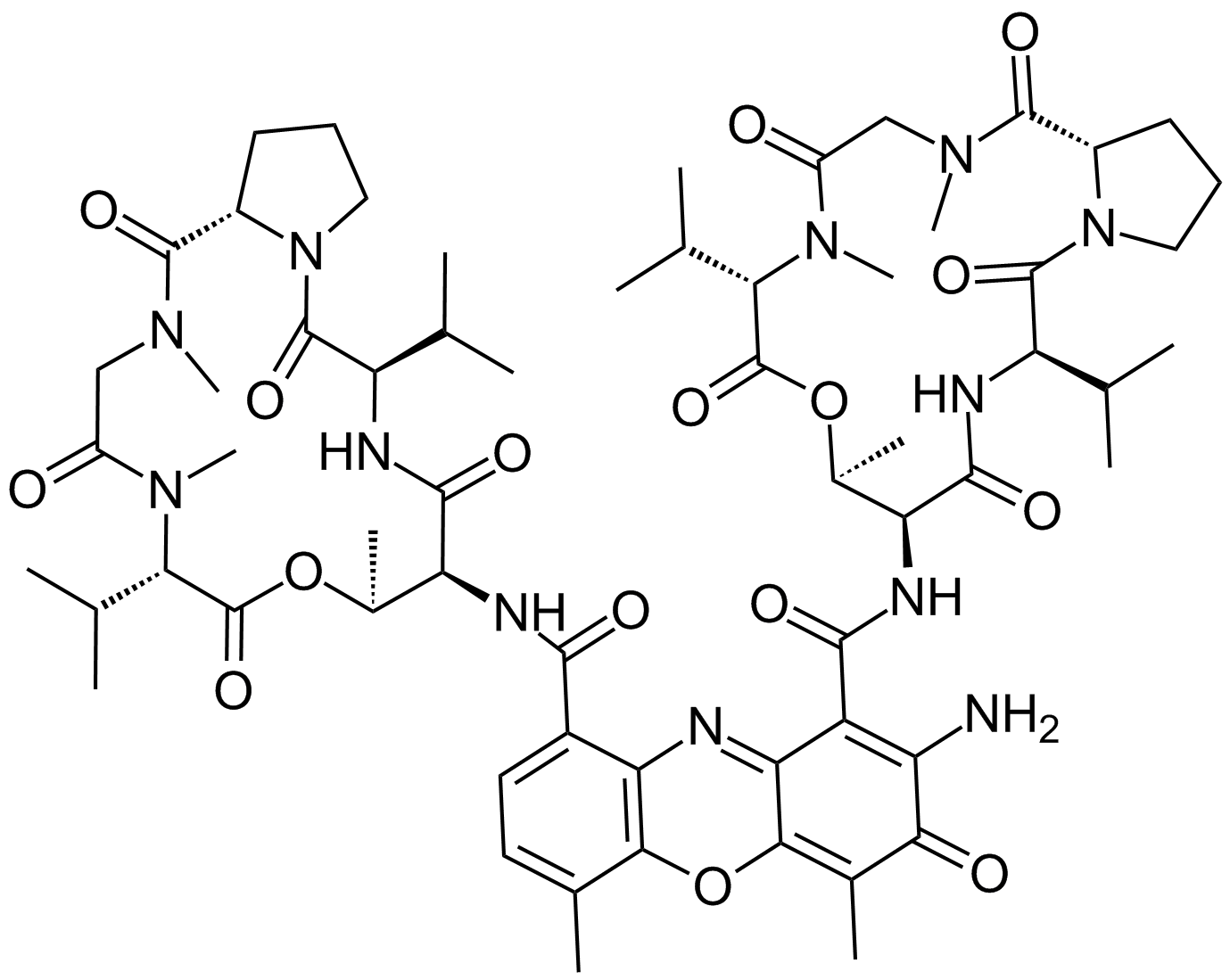
Actinomycin D (dactinomycin) is a natural chromopeptide isolated from Streptomyces species, and has one heterocyclic chromophore and two cyclic pentapeptide lactone rings. [1] It is the first antibiotic showing anti-tumor activity, and has been implemented in the clinical practice for years to treat, such as testicular cancer, and choriocarcinoma.[2]
Actinomycin D intercalates into DNA to inhibit the transcription. It forms a very stable complex with DNA, preventing the unwinding of the DNA double-helix, so as to inhibit the DNA-dependent RNA polymerase activity. Actinomycin D is well implemented in mRNA stability assays to inhibit the synthesis of new mRNA, allowing the assessment of mRNA decay by measuring mRNA abundance following transcription inhibition. [3]
The in vitro experiment suggests that actinomycin D is an potent and effective agent to inhibit the proliferation of SMC by preventing cells from getting into S phase. The LD50 (260 lM) determined by measuring the remaining viable cells at various concentrations of actinomycin D was about five orders greater than that of IC50 (0.4 nM), which was calculated by measuring the percentage of cells in S phase following the treatment of actinomycin D. A dose-dependent inhibition by actinomycin D was found in PCNA, Raf and FAK. However, in contrast to those seen on PCNA, Raf and FAK expression, the phosphorylated Erk was significantly up-regulated by actinomycin D. An in vivo study using rat carotid artery as a model was conducted to evaluate if topically applied actinomycin D onto the arterial adventitia of the artery was effective in suppressing the formation of stenosis following a balloon angioplasty. Topical application of pluronic gel containing 80 nM and 80 μM actinomycin D to surround the adventitia of rat carotid arteries, the thickness of the neointima was significantly reduced (45% and 55%, respectively). [4]
Reference:
[1]. Farber S. Chemotherapy in the treatment of leukemia and Wilms' tumor. JAMA. 1966 Nov 21;198(8):826-36. PMID: 4288581.
[2]. Lewis J.L., Jr. Chemotherapy of gestational choriocarcinoma. Obstet. Gynecol. Surv. 1973;28:7478–7480. doi: 10.1097/00006254-197307000-00006.
[3]. Shyu A. B., Greenberg M. E. and Belasco J. G.(1989). The c-fos transcript is targeted for rapid decay by two distinct mRNA degradation pathways. Genes Dev 3(1): 60-72.
[4]. Wu, C. H., Pan, J. S., Chang, W. C., Hung, J. S., & Mao, S. J. T. (2005). The molecular mechanism of actinomycin D in preventing neointimal formation in rat carotid arteries after balloon injury. Journal of Biomedical Science, 12(3), 503–512. doi:10.1007/s11373-005-6900-5.

| Cell experiment [1]: | |
|
Cell lines |
A10 cells (Vascular SMC) |
|
Preparation Method |
Dissolve actinomycin D in 0.1% DMSO and make 3 different concentration groups: 80 nM, 800 nM, 8 μM. Add various doses of actinomycin D to cultured SMC which have been starved for 24 h and incubate at 37 ℃. Drug treatment is carried out for 18-24 h. In the meantime, a vehicle control containing DMSO is also included. |
|
Reaction Conditions |
80 nM, 800 nM, 8 μM for 18-24h |
|
Applications |
Actinomycin D is a significant polypeptide antibiotic isolated from soil bacteria, Streptomyces. It inhibits DNA repair with IC50 of 0.42 μM and rests the cell cycle at G1 phase with IC50 of 0.4 nM. |
| Animal experiment [2]: | |
|
Animal models |
C57BL/6 wild-type mice with Em-TCL-1 transgenic mice tumor cells |
|
Preparation Method |
The original Em-TCL1a transgenic mice have been backcrossed to C57BL/6 mice for 9 generations. Tumor cells from Em-TCL-1 transgenic mice were engrafted to C57BL/6 wild-type mice. |
|
Dosage form |
0.06 mg/kg, i.p. |
|
Applications |
Actinomycin D was chosen to further investigate as treatment option for CLL patients high-risk features, due to its activity in p53-aberrant CLL cells, known clinical properties, low IC50 and moderate toxicity. The presence of actinomycin D prevents the release of protective factors from the stroma cells. BCL2 mRNA downregulation in CLL is specific for actinomycin D treatment. Actinomycin D leads to tumor regression in this mouse model of CLL, and in two of four mice renewed lymphoma formation was prevented, strongly suggesting a potent role for actinomycin D in CLL treatment in humans. |
|
References: [1]. Wu CH, et al. The molecular mechanism of actinomycin D in preventing neointimal formation in rat carotid arteries after balloon injury. J Biomed Sci. 2005;12(3):503-12. [2]. Merkel O. et al. Actinomycin D induces p53-independent cell death and prolongs survival in high-risk chronic lymphocytic leukemia. Leukemia (2012) 26, 2508–2516. |
|
| Cas No. | 50-76-0 | SDF | |
| Überlieferungen | Cosmegen, Dactinomycin, Meractinomycin, NCI C04682, NSC 3053, Oncostatin K | ||
| Chemical Name | 2-amino-4,6-dimethyl-3-oxo-1-N,9-N-bis[7,11,14-trimethyl-2,5,9,12,15-pentaoxo-3,10-di(propan-2-yl)-8-oxa-1,4,11,14-tetrazabicyclo[14.3.0]nonadecan-6-yl]phenoxazine-1,9-dicarboxamide | ||
| Canonical SMILES | CC1C(C(=O)NC(C(=O)N2CCCC2C(=O)N(CC(=O)N(C(C(=O)O1)C(C)C)C)C)C(C)C)NC(=O)C3=C4C(=C(C=C3)C)OC5=C(C(=O)C(=C(C5=N4)C(=O)NC6C(OC(=O)C(N(C(=O)CN(C(=O)C7CCCN7C(=O)C(NC6=O)C(C)C)C)C)C(C)C)C)N)C | ||
| Formula | C62H86N12O16 | M.Wt | 1255.43 |
| Löslichkeit | ≥ 62.75 mg/mL in DMSO | Storage | Store at -20℃,protected from light |
| General tips | Please select the appropriate solvent to prepare the stock solution according to the
solubility of the product in different solvents; once the solution is prepared, please store it in
separate packages to avoid product failure caused by repeated freezing and thawing.Storage method
and period of the stock solution: When stored at -80°C, please use it within 6 months; when stored
at -20°C, please use it within 1 month. To increase solubility, heat the tube to 37°C and then oscillate in an ultrasonic bath for some time. |
||
| Shipping Condition | Evaluation sample solution: shipped with blue ice. All other sizes available: with RT, or with Blue Ice upon request. | ||
| Prepare stock solution | |||
|
1 mg | 5 mg | 10 mg |
| 1 mM | 796.5 μL | 3.9827 mL | 7.9654 mL |
| 5 mM | 159.3 μL | 796.5 μL | 1.5931 mL |
| 10 mM | 79.7 μL | 398.3 μL | 796.5 μL |
Step 1: Enter information below (Recommended: An additional animal making an allowance for loss during the experiment)
Step 2: Enter the in vivo formulation (This is only the calculator, not formulation. Please contact us first if there is no in vivo formulation at the solubility Section.)
Calculation results:
Working concentration: mg/ml;
Method for preparing DMSO master liquid: mg drug pre-dissolved in μL DMSO ( Master liquid concentration mg/mL, Please contact us first if the concentration exceeds the DMSO solubility of the batch of drug. )
Method for preparing in vivo formulation: Take μL DMSO master liquid, next addμL PEG300, mix and clarify, next addμL Tween 80, mix and clarify, next add μL ddH2O, mix and clarify.
Method for preparing in vivo formulation: Take μL DMSO master liquid, next add μL Corn oil, mix and clarify.
Note: 1. Please make sure the liquid is clear before adding the next solvent.
2. Be sure to add the solvent(s) in order. You must ensure that the solution obtained, in the previous addition, is a clear solution before proceeding to add the next solvent. Physical methods such as vortex, ultrasound or hot water bath can be used to aid dissolving.
3. All of the above co-solvents are available for purchase on the GlpBio website.
Quality Control & SDS
- View current batch:
- Purity: >98.00%
- COA (Certificate Of Analysis)
- SDS (Safety Data Sheet)
- Datasheet
Average Rating: 5 (Based on Reviews and 30 reference(s) in Google Scholar.)
GLPBIO products are for RESEARCH USE ONLY. Please make sure your review or question is research based.
Required fields are marked with *