
Startseite>>Signaling Pathways>> Angiogenesis>> PAR1>>BMS 986120

BMS 986120

Katalog-Nr.GC18717

BMS 986120 ist ein erster oraler und reversibler Antagonist des Protease-aktivierten Rezeptors 4 (PAR4) seiner Klasse mit IC50-Werten von 9,5 nM bzw. 2,1 nM in menschlichem bzw. Affenblut.

Products are for research use only. Not for human use. We do not sell to patients.
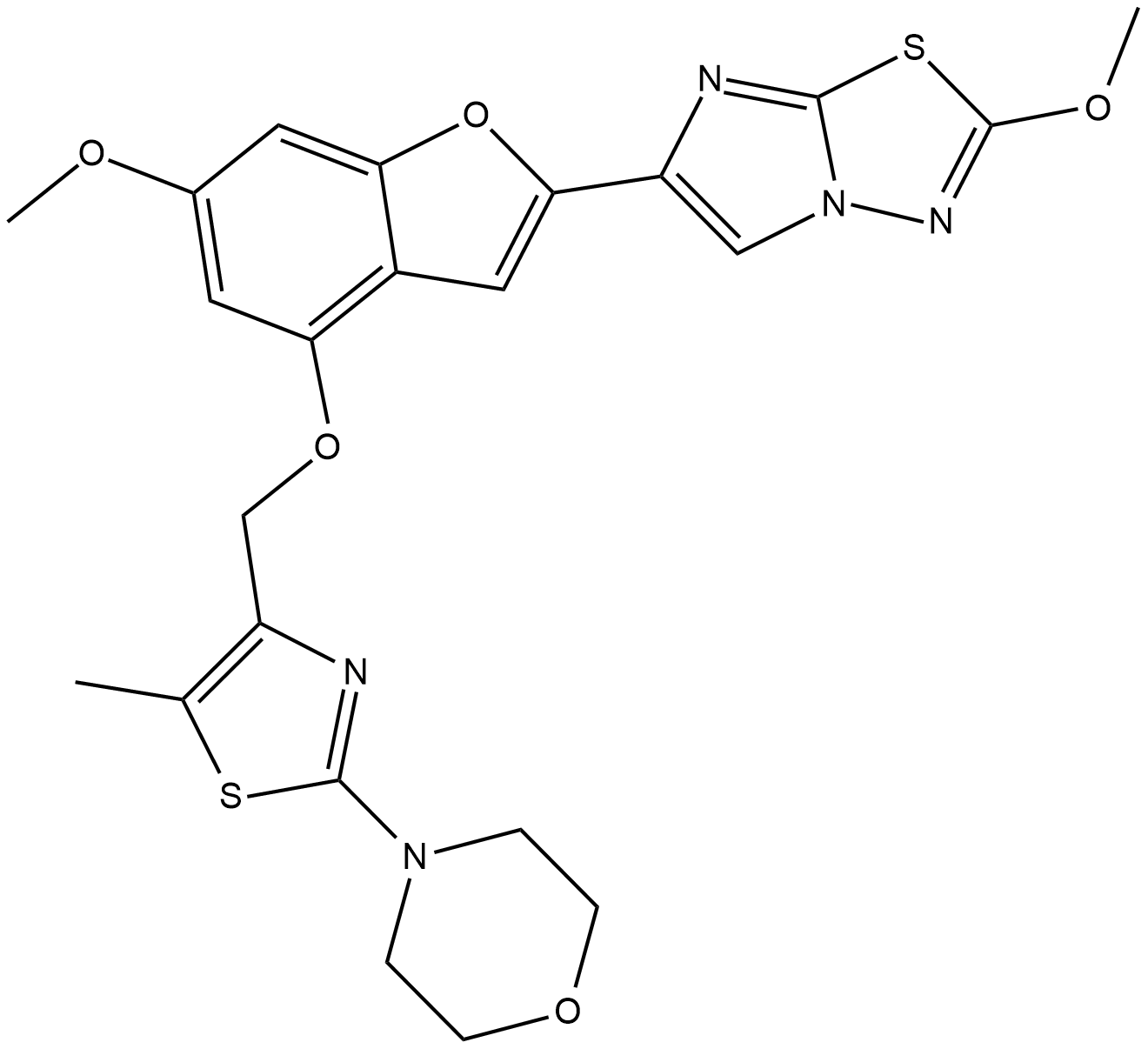
BMS 986120 Chemische Struktur

Cas No.: 1478712-37-6

Größe Preis Lagerbestand Menge
1mg
143,00 $
Auf Lager
5mg
315,00 $
Auf Lager
10mg
495,00 $
Auf Lager

Tel:(909) 407-4943 Email: sales@glpbio.com


Kundenbewertungen

Basiert auf Kundenrezensionen.

Sample solution is provided at 25 µL, 10mM.

Description of BMS 986120

BMS 986120 is a compound specifically targeting protease-activated receptor 4 (PAR4), which comparably inhibited platelet aggregation (PA) induced by activation peptides selective for PAR4 (PAR4-AP) in human and monkey blood in vitro (IC50 of 9.5±2.7 and 2.1±0.4nM, respectively)[1-2]. BMS 986120 demonstrated excellent antithrombotic efficacy and minimal bleeding time prolongation in monkey models relative to the clinically important antiplatelet agent clopidogrel and provides a potential opportunity to improve the standard of care in the treatment of arterial thrombosis[3].

In vitro, when MEG-01 cells were pretreated with 10μM BMS 986120 for 30 minutes, the reduction in circularity induced by protease-activated receptor 1 (PAR1) and PAR4 was found to be completely blocked[4]. The blood was treated with BMS 986120 at concentrations of 0.01, 0.1, and 1μM for 15, 30, and 60 minutes, and BMS 986120 inhibited PAR4‐AP‐induced platelet activation in a concentration- and time-dependent manner[5].

In vivo, BMS 986120, administered to Traumatic brain injury (TBI)-injured mice (1mg/kg, 2mg/kg; intragastrically), was found to significantly ameliorate the TBI-induced neuronal damage in mice[6]. In monkeys, administration of BMS 986120 at a dose of 0.2mg/kg via oral gavage resulted in reversible inhibition of platelet aggregation and reduction of thrombus weight, with effects returning to baseline within 24 hours after the last dose[7].

References:
[1] Holinstat M, Bray PF. Protease receptor antagonism to target blood platelet therapies. Clin Pharmacol Ther. 2016;99(1):72-81.
[2] Pancras C Wong, et al. Abstract 175: A Novel Orally-Active Small-Molecule Antagonist of the Platelet Protease-Activated Receptor-4, BMS-986120, Inhibits Arterial Thrombosis With Limited Impact on Hemostasis in Cynomolgus Monkeys. Stroke. 2018;47:A175.
[3] Priestley ES, Banville J, Deon D, et al. Discovery of Two Novel Antiplatelet Clinical Candidates (BMS-986120 and BMS-986141) That Antagonize Protease-Activated Receptor 4. J Med Chem. 2022;65(13):8843-8854.
[4] Heo Y, Jeon H, Namkung W. PAR4-Mediated PI3K/Akt and RhoA/ROCK Signaling Pathways Are Essential for Thrombin-Induced Morphological Changes in MEG-01 Cells. Int J Mol Sci. 2022;23(2):776.
[5] Berry J, Harper MT. Protease-activated receptor antagonists prevent thrombosis when dual antiplatelet therapy is insufficient in an occlusive thrombosis microfluidic model. Res Pract Thromb Haemost. 2022;6(3):e12703.
[6] Luo J, Wu X, Liu H, et al. Antagonism of Protease-Activated Receptor 4 Protects Against Traumatic Brain Injury by Suppressing Neuroinflammation via Inhibition of Tab2/NF-κB Signaling. Neurosci Bull. 2021;37(2):242-254.
[7] Wong PC, Seiffert D, Bird JE, et al. Blockade of protease-activated receptor-4 (PAR4) provides robust antithrombotic activity with low bleeding. Sci Transl Med. 2017;9(371):eaaf5294.

Protocol of BMS 986120

Cell experiment [1]:

Cell lines

MEG-01 cells

Preparation Method

Cells were stained with calcein-AM (1μg/mL) and pretreated with 10μM of BMS 986120, and then activation peptides selective for protease-activated receptor 1 (PAR1-AP) (100μM), PAR4-AP (100μM), or thrombin (0.1U/mL) were applied for 30 min.

Reaction Conditions

10μM; 30min

Applications

PAR1 and PAR4 activation significantly reduced the circularity of MEG-01 cells, and the reduction in circularity by PAR1 and PAR4 was completely blocked by pretreatment with BMS 986120, respectively.
Animal experiment [2]:

Animal models

Monkey

Preparation Method

In the BMS 986120 study, 32 monkeys were randomly assigned in a blinded fashion to one of four groups, with eight subjects per group: (i) vehicle, (ii) BMS 986120 (0.2mg/kg), (iii) BMS 986120 (0.5mg/kg), and (iv) BMS 986120 (1mg/kg). On the day of the experiment, monkeys were dosed orally by gavage with BMS 986120 or vehicle [40:60 (w/w) d-α-tocopheryl polyethylene glycol 1000 succinate (TPGS)/polyethylene glycol 400 (PEG-400)] at 2ml/kg. Two hours after the last oral dose, blood samples were collected for the measurement of platelet aggregation and concentration of BMS 986120. At the end of the experiment, blood samples were collected for the determination of whole-blood platelet aggregation [agonists: 20μM ADP, collagen (5μg/ml), 18μM PAR1-AP, and 1.56 to 400μM PAR4-AP], clotting times, and plasma concentration of BMS 986120.

Dosage form

0.2mg/kg; 2h, 4h, 24h; orally by gavage

Applications

In blood obtained before oral administration of BMS 986120 (before treatment), all three PAR4-AP concentrations generated maximal aggregation. At 2 and 4 hours after BMS 986120 dosing, the inhibition of platelet aggregation induced by 6.25μM PAR4-AP was near complete, but the aggregation response to 25μM PAR4-AP was unaffected. Consistent with reversible binding to the receptor, the platelet aggregation responses returned to pretreatment baseline by 24 hours in all BMS 986120-treated animals, with drug concentrations dropping below 1nM.

References:
[1] Heo Y, Jeon H, Namkung W. PAR4-Mediated PI3K/Akt and RhoA/ROCK Signaling Pathways Are Essential for Thrombin-Induced Morphological Changes in MEG-01 Cells. Int J Mol Sci. 2022;23(2):776.
[2] Wong PC, Seiffert D, Bird JE, et al. Blockade of protease-activated receptor-4 (PAR4) provides robust antithrombotic activity with low bleeding. Sci Transl Med. 2017;9(371):eaaf5294.

Chemical Properties of BMS 986120

Cas No. 1478712-37-6 SDF
Chemical Name 2-methoxy-6-[6-methoxy-4-[[5-methyl-2-(4-morpholinyl)-4-thiazolyl]methoxy]-2-benzofuranyl]-imidazo[2,1-b]-1,3,4-thiadiazole
Canonical SMILES COC1=CC2=C(C=C(C3=CN4C(SC(OC)=N4)=N3)O2)C(OCC5=C(C)SC(N6CCOCC6)=N5)=C1
Formula C23H23N5O5S2 M.Wt 513.6
Löslichkeit DMSO : 3.33 mg/mL (6.48 mM; ultrasonic and warming and heat to 80°C) Storage Store at -20°C
General tips Please select the appropriate solvent to prepare the stock solution according to the solubility of the product in different solvents; once the solution is prepared, please store it in separate packages to avoid product failure caused by repeated freezing and thawing.Storage method and period of the stock solution: When stored at -80°C, please use it within 6 months; when stored at -20°C, please use it within 1 month.
To increase solubility, heat the tube to 37°C and then oscillate in an ultrasonic bath for some time.
Shipping Condition Evaluation sample solution: shipped with blue ice. All other sizes available: with RT, or with Blue Ice upon request.

Complete Stock Solution Preparation Table of BMS 986120

Prepare stock solution
1 mg 5 mg 10 mg
1 mM 1.947 mL 9.7352 mL 19.4704 mL
5 mM 389.4 μL 1.947 mL 3.8941 mL
10 mM 194.7 μL 973.5 μL 1.947 mL
  • Molaritätsrechner

  • Verdünnung-Rechner

  • Molecular Weight Calculator

Gewicht
=
Konzentration
x
Inhalt
x
MW*


**Bei der Herstellung von Stammlösungen ist immer das chargenspezifische Molekulargewicht von

Berechnen

In vivo Formulation Calculator (Clear solution) of BMS 986120

Step 1: Enter information below (Recommended: An additional animal making an allowance for loss during the experiment)

mg/kg g μL

Step 2: Enter the in vivo formulation (This is only the calculator, not formulation. Please contact us first if there is no in vivo formulation at the solubility Section.)

% DMSO % % Tween 80 % ddH2O
%DMSO %

Calculation results:

Working concentration: mg/ml;

Method for preparing DMSO master liquid: mg drug pre-dissolved in μL DMSO ( Master liquid concentration mg/mL, Please contact us first if the concentration exceeds the DMSO solubility of the batch of drug. )

Method for preparing in vivo formulation: Take μL DMSO master liquid, next addμL PEG300, mix and clarify, next addμL Tween 80, mix and clarify, next add μL ddH2O, mix and clarify.

Method for preparing in vivo formulation: Take μL DMSO master liquid, next add μL Corn oil, mix and clarify.

Note: 1. Please make sure the liquid is clear before adding the next solvent.
2. Be sure to add the solvent(s) in order. You must ensure that the solution obtained, in the previous addition, is a clear solution before proceeding to add the next solvent. Physical methods such as vortex, ultrasound or hot water bath can be used to aid dissolving.
3. All of the above co-solvents are available for purchase on the GlpBio website.

Product Documents

Quality Control & SDS

View current batch:

Bewertungen

Review for BMS 986120

Average Rating: 5 ★★★★★ (Based on Reviews and 37 reference(s) in Google Scholar.)

5 Star
100%
4 Star
0%
3 Star
0%
2 Star
0%
1 Star
0%
Review for BMS 986120

GLPBIO products are for RESEARCH USE ONLY. Please make sure your review or question is research based.

Required fields are marked with *

You may receive emails regarding this submission. Any emails will include the ability to opt-out of future communications.
