
Startseite>>Peptides>>PAR-4 Agonist Peptide, amide TFA (PAR-4-AP (TFA))

PAR-4 Agonist Peptide, amide TFA (PAR-4-AP (TFA)) (Synonyms: PAR-4-AP TFA; AY-NH2 TFA)

Katalog-Nr.GC33599

PAR-4-Agonist-Peptid, Amid TFA (PAR-4-AP (TFA)) (PAR-4-AP TFA; AY-NH2 TFA) ist ein Proteinase-aktivierter Rezeptor-4 (PAR-4)-Agonist, der keine Wirkung hat auf entweder PAR-1 oder PAR-2 und deren Wirkungen durch einen PAR-4-Antagonisten blockiert werden.

Products are for research use only. Not for human use. We do not sell to patients.
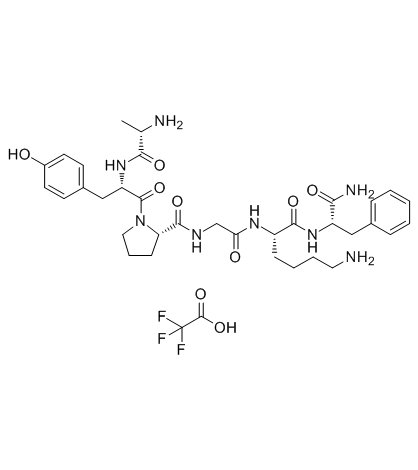
PAR-4 Agonist Peptide, amide TFA (PAR-4-AP (TFA)) Chemische Struktur

Cas No.: 1228078-65-6

Größe Preis Lagerbestand Menge
1 mg
54,00 $
Auf Lager
5 mg
162,00 $
Auf Lager
10 mg
270,00 $
Auf Lager

Tel:(909) 407-4943 Email: sales@glpbio.com


Kundenbewertungen

Basiert auf Kundenrezensionen.

Sample solution is provided at 25 µL, 10mM.

Description of PAR-4 Agonist Peptide, amide TFA (PAR-4-AP (TFA))

PAR-4 agonist peptide, amide TFA (PAR-4-AP (TFA)) is a synthetic peptide primarily used to activate protease-activated receptor 4 (PAR-4) [1]. PAR-4 is a G protein-coupled receptor widely expressed in platelets and other cell types, playing a role in regulating various physiological and pathological processes, including blood coagulation and inflammatory responses [2].

PAR-4 agonist peptide, amide TFA (PAR-4-AP (TFA))(100μM;1-24h) exerts a potential tumor suppressor effect in esophageal squamous cell carcinoma (ESCC) by activating the PAR4 receptor, which inhibits the expression of DNA methyltransferase 1 (DNMT1) and histone deacetylase 2 (HDAC2), while increasing the expression of the tumor suppressor p16 [3]. PAR-4 agonist peptide, amide TFA (PAR-4-AP (TFA)) (30μM;1-24h) inhibits phagocytosis in mouse macrophages and enhances the production of nitric oxide (NO) and reactive oxygen species (ROS), modulating the expression of inflammatory factors and the transcriptional activity of NF-κB [4].

PAR-4 agonist peptide, amide TFA (PAR-4-AP (TFA)) effectively induced sustained bladder hypersensitivity [5-6]. PAR-4 Agonist Peptide, amide TFA (PAR-4-AP (TFA))(100μg; Intracolonic administration) inhibits the inflammatory response in a rat model by downregulating inflammatory mediators in mast cells through the MAPK signaling pathway[7].

References:
[1] Hollenberg MD, Compton SJ. International Union of Pharmacology. XXVIII. Proteinase-activated receptors. Pharmacol Rev. 2002 Jun;54(2):203-17. doi: 10.1124/pr.54.2.203. PMID: 12037136.
[2] Han X, Nieman MT. PAR4 (Protease-Activated Receptor 4): PARticularly Important 4 Antiplatelet Therapy. Arterioscler Thromb Vasc Biol. 2018 Feb;38(2):287-289. doi: 10.1161/ATVBAHA.117.310550. PMID: 29367229; PMCID: PMC5788293.
[3] Wang M, An S, Wang D, Ji H, Guo X, Wang Z. Activation of PAR4 Upregulates p16 through Inhibition of DNMT1 and HDAC2 Expression via MAPK Signals in Esophageal Squamous Cell Carcinoma Cells. J Immunol Res. 2018 Sep 30;2018:4735752. doi: 10.1155/2018/4735752. PMID: 30363984; PMCID: PMC6186345.
[4] Barra A, Freitas KM, Marconato DG, Faria-Pinto P, Lopes MTP, Klein A. Protease-activated receptor 4 plays a role in lipopolysaccharide-induced inflammatory mechanisms in murine macrophages. Naunyn Schmiedebergs Arch Pharmacol. 2021 May;394(5):853-862. doi: 10.1007/s00210-020-02014-w. Epub 2020 Nov 7. PMID: 33159803.
[5] Ye S, Agalave NM, Ma F, D Mahmood DF, Al-Grety A, Khoonsari PE, Svensson CI, Kultima K, Vera PL. Lumbosacral spinal proteomic changes during PAR4-induced persistent bladder pain. Neurosci Lett. 2024 Jan 1;818:137563. doi: 10.1016/j.neulet.2023.137563. Epub 2023 Nov 28. PMID: 38036085; PMCID: PMC10929774.
[6] Kouzoukas DE, Ma F, Meyer-Siegler KL, Westlund KN, Hunt DE, Vera PL. Protease-Activated Receptor 4 Induces Bladder Pain through High Mobility Group Box-1. PLoS One. 2016 Mar 24;11(3):e0152055. doi: 10.1371/journal.pone.0152055. PMID: 27010488; PMCID: PMC4806866.
[7] Hao Y, Niu H, An S, Wang M, Wang Z. Downregulation of iNOS, IL-1β, and P2X7 Expression in Mast Cells via Activation of PAR4 Contributes to the Inhibition of Visceral Hyperalgesia in Rats. J Immunol Res. 2018 May 9;2018:3256908. doi: 10.1155/2018/3256908. PMID: 29854833; PMCID: PMC5966670.

Protocol of PAR-4 Agonist Peptide, amide TFA (PAR-4-AP (TFA))

Cell experiment [1]:

Cell lines

HUVECs/HASMCs

Preparation Method

Human umbilical vein endothelial cells (HUVECs) or human aortic smooth muscle cells (HASMCs) were cultured in DMEM medium containing 10% fetal bovine serum and 1% penicillin-streptomycin until reaching 70-80% confluence. Prior to the addition of non-lipid tissue factor and Ca²⁺, PAR-4 Agonist Peptide, amide TFA (PAR-4-AP (TFA)) was added to the cells and incubated for 15 minutes for pre-treatment. Subsequently, non-lipid tissue factor and Ca²⁺ were added to the cells after pre-treatment to induce thrombin generation, with the reaction conditions set at 37°C. Samples were collected at different time points to monitor thrombin generation.

Reaction Conditions

200µmol/L ; 15mins

Applications

The PAR-4 agonist peptide, amide TFA (PAR-4-AP (TFA)), accelerates thrombin generation and significantly shortens the time to reach half-peak thrombin levels during tissue factor-induced coagulation, thereby enhancing the coagulation response.

Animal experiment [2]:

Animal models

C57BL/6(bladder hyperalgesia model)

Preparation Method

The mice were anesthetized using isoflurane (3% for induction and 1.5% for maintenance) and were transurethrally catheterized with a PE10 catheter (11mm in length). To prepare for the intravesical instillation, urine was drained by gently applying pressure to the lower abdomen. The treatment involved instilling 100 µL of PAR-4 agonist peptide, amide TFA (PAR-4-AP (TFA))(100µM in sterile PBS, pH 7.4) into the bladder. The control group received an equivalent volume of scrambled peptide (YAPGKP-NH2, 100µM in sterile PBS).

Dosage form

The PAR-4 agonist peptide, amide TFA (PAR-4-AP (TFA)) (100µM), was administered via intravesical injection three times at 48-hour intervals, with remained in the bladderfor 1 h.

Applications

PAR-4 agonist peptide, amide TFA (PAR-4-AP (TFA)), effectively induced sustained bladder hypersensitivity in a mouse model.

References:
[1]. Vidwan P, Pathak A, Sheth S, Huang J, Monroe DM, Stouffer GA. Activation of protease-activated receptors 3 and 4 accelerates tissue factor-induced thrombin generation on the surface of vascular smooth muscle cells. Arterioscler Thromb Vasc Biol. 2010 Dec;30(12):2587-96. doi: 10.1161/ATVBAHA.110.211177. Epub 2010 Oct 7. PMID: 20930172; PMCID: PMC3426369.
[2]. Ye S, Agalave NM, Ma F, D Mahmood DF, Al-Grety A, Khoonsari PE, Svensson CI, Kultima K, Vera PL. Lumbosacral spinal proteomic changes during PAR4-induced persistent bladder pain. Neurosci Lett. 2024 Jan 1;818:137563. doi: 10.1016/j.neulet.2023.137563. Epub 2023 Nov 28. PMID: 38036085; PMCID: PMC10929774.

Chemical Properties of PAR-4 Agonist Peptide, amide TFA (PAR-4-AP (TFA))

Cas No. 1228078-65-6 SDF
Überlieferungen PAR-4-AP TFA; AY-NH2 TFA
Canonical SMILES Ala-Tyr-Pro-Gly-Lys-Phe-NH2
Formula C36H49F3N8O9 M.Wt 794.82
Löslichkeit DMSO : ≥ 250 mg/mL (314.54 mM) Storage Store at -20°C
General tips Please select the appropriate solvent to prepare the stock solution according to the solubility of the product in different solvents; once the solution is prepared, please store it in separate packages to avoid product failure caused by repeated freezing and thawing.Storage method and period of the stock solution: When stored at -80°C, please use it within 6 months; when stored at -20°C, please use it within 1 month.
To increase solubility, heat the tube to 37°C and then oscillate in an ultrasonic bath for some time.
Shipping Condition Evaluation sample solution: shipped with blue ice. All other sizes available: with RT, or with Blue Ice upon request.

Complete Stock Solution Preparation Table of PAR-4 Agonist Peptide, amide TFA (PAR-4-AP (TFA))

Prepare stock solution
1 mg 5 mg 10 mg
1 mM 1.2581 mL 6.2907 mL 12.5815 mL
5 mM 251.6 μL 1.2581 mL 2.5163 mL
10 mM 125.8 μL 629.1 μL 1.2581 mL
  • Molaritätsrechner

  • Verdünnung-Rechner

  • Molecular Weight Calculator

Gewicht
=
Konzentration
x
Inhalt
x
MW*


**Bei der Herstellung von Stammlösungen ist immer das chargenspezifische Molekulargewicht von

Berechnen

In vivo Formulation Calculator (Clear solution) of PAR-4 Agonist Peptide, amide TFA (PAR-4-AP (TFA))

Step 1: Enter information below (Recommended: An additional animal making an allowance for loss during the experiment)

mg/kg g μL

Step 2: Enter the in vivo formulation (This is only the calculator, not formulation. Please contact us first if there is no in vivo formulation at the solubility Section.)

% DMSO % % Tween 80 % ddH2O
%DMSO %

Calculation results:

Working concentration: mg/ml;

Method for preparing DMSO master liquid: mg drug pre-dissolved in μL DMSO ( Master liquid concentration mg/mL, Please contact us first if the concentration exceeds the DMSO solubility of the batch of drug. )

Method for preparing in vivo formulation: Take μL DMSO master liquid, next addμL PEG300, mix and clarify, next addμL Tween 80, mix and clarify, next add μL ddH2O, mix and clarify.

Method for preparing in vivo formulation: Take μL DMSO master liquid, next add μL Corn oil, mix and clarify.

Note: 1. Please make sure the liquid is clear before adding the next solvent.
2. Be sure to add the solvent(s) in order. You must ensure that the solution obtained, in the previous addition, is a clear solution before proceeding to add the next solvent. Physical methods such as vortex, ultrasound or hot water bath can be used to aid dissolving.
3. All of the above co-solvents are available for purchase on the GlpBio website.

Product Documents

Quality Control & SDS

View current batch:

Bewertungen

Review for PAR-4 Agonist Peptide, amide TFA (PAR-4-AP (TFA))

Average Rating: 5 ★★★★★ (Based on Reviews and 24 reference(s) in Google Scholar.)

5 Star
100%
4 Star
0%
3 Star
0%
2 Star
0%
1 Star
0%
Review for PAR-4 Agonist Peptide, amide TFA (PAR-4-AP (TFA))

GLPBIO products are for RESEARCH USE ONLY. Please make sure your review or question is research based.

Required fields are marked with *

You may receive emails regarding this submission. Any emails will include the ability to opt-out of future communications.
