
Abrocitinib (PF-04965842) (Synonyms: PF-04965842) |
| カタログ番号GC32023 |
Abrocitinib (PF-04965842)は経口活性で選択性のJanusキナーゼ(JAK)阻害剤であり、JAK1とJAK2に対するIC50値はそれぞれ29nMと803nMである。
Products are for research use only. Not for human use. We do not sell to patients.
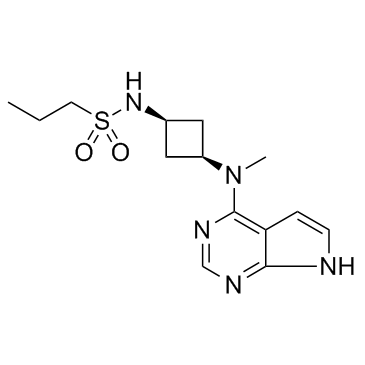
Cas No.: 1622902-68-4
Sample solution is provided at 25 µL, 10mM.
Abrocitinib (PF-04965842)は経口活性で選択性のJanusキナーゼ(JAK)阻害剤であり、JAK1とJAK2に対するIC50値はそれぞれ29nMと803nMである[1]。Abrocitinibは、アメリカ食品医薬品局(FDA)から、アトピー性皮膚炎(AD)の治療薬として承認されている[2]。Abrocitinibは、抗炎症特性をも持ち、線維症と外傷性脳損傷の治療に使われる[3][6]。
体外で、Abrocitinib (1µM)は肝星状細胞(HSC)-T6を24時間培養した結果、Col1a1, Jak1とActa2のRNAレベルを著しく減らし、タイプIαI鎖(COL1A1)、JAK1とアクチンα2(ACTA2)のタンパク質レベルをも減らした。Abrocitinibで処理されたグループでは、アポトーシス細胞の割合も著しく減った[3]。末梢血単核細胞を単離し、結核(TB)抗原で刺激し、Abrocitinib (0, 0.75, and 1.5µM)で24時間培養した。AbrocitinibはTB抗原依存のT細胞活性化を著しく減らし、その後、YFM産生を減らした[4]。Abrocitinib (0.1–1000mM)は37℃で、0.3mg/mLのミクロソームタンパク質HLM-103を培養した結果、Abrocitinib代謝に関与した主な酵素がCYP2C19、CYP2C9、CYP3A4とCYP2B6であったことが分かった。Michaelis-Menten基質阻害モデリングを使い、主な代謝物M1、M2/M3とM4の形成の酵素運動パラメーターを測定した[5]。
体内で、Abrocitinib (体重1kgあたり40mg、毎日)を、肝臓移植後(LT)肝線維症のラットモデルに10日間経口投与した結果、肝線維症のステージ、そしてCOL1A1とACTA2のレベルを減らした[3]。Abrocitinib (10mg/kg)を外傷性脳損傷(TBI)マウスモデルに胃内投与した結果、JAK1/STAT1/NF-κB経路を阻害することで、神経炎症を軽減し、神経保護作用を発揮する。TBIグループに比べ、Abrocitinib処理群では、外傷性病変がより少なく、ニューロン機能がより良く、血液脳関門(BBB)の漏洩はより少なく、頭蓋内血流を改善した[6]。アミトリプチリン(15mg/kg)とフルオキセチン(5mg/kg)を経口投与した30分後に、CYP2C19とCYP3A4の活性を阻害する二つの常用の抗鬱剤であるAbrocitinib (20mg/kg)をSprague-Dawleyラットに経口投与した。結果によると、アミトリプチリンとフルオキセチンがラットでAbrocitinibの血漿濃度を著しく増やせることが示唆された。アミトリプチリンまたはフルオキセチンと併用される場合には、Abrocitinibの用量を調整する必要があるかもしれない[7]。
References:
[1] Nicole Ramsey N, Wajiha Kazmi W, Matthew Phelan M,et al. JAK1 inhibition with Abrocitinib (PF-04965842) decreases allergen-specific basophil and T-cell activation in pediatric peanut allergy. J Allergy Clin Immunol Glob. 2023 Aug;2(3):100103.
[2] McLornan D P, Pope J E, Gotlib J, Harrison C N. Current and future status of JAK inhibitors. Lancet. 2021 Aug 28;398(10302):803-816.
[3] Si Z Y, Zhao S Q, Zhang Z X, et al. Bone marrow mesenchymal stem cells alleviate liver fibrosis after rat liver transplantation through JAK1/STAT5 pathway. Stem Cell Res Ther. 2025 May 1;16(1):217.
[4] Li Y T, Tan X, Nie S, et al. Abrocitinib interferes with the performance of T-SPOT.TB assay for latent tuberculosis reactivation: An in vitro study. J Am Acad Dermatol. 2025 May;92(5):1124-1125.
[5]Bauman J N, Doran A C, Ahmad A K, et al. The Pharmacokinetics, Metabolism, and Clearance Mechanisms of Abrocitinib, a Selective Janus Kinase Inhibitor, in Humans. Drug Metab Dispos. 2022 Aug;50(8):1106-1118.
[6] Li T, Li L, Peng R L, et al. Abrocitinib (PF-04965842) Attenuates Microglia-Mediated Neuroinflammation after Traumatic Brain Injury via Inhibiting the JAK1/STAT1/NF-κB Pathway. Cells. 2022 Nov 13;11(22):3588.
[7] Chen L G, Chen X H, Liu J P, et al. Effects of two commonly used antidepressants amitriptyline and fluoxetine on the pharmacokinetics of abrocitinib in rats. Chem Biol Interact. 2024 Jul 1:397:111041.
| キナーゼ実験 [1]: | |
準備方法 | 37℃で、3mMのMgCl2と0.3mg/mLのミクロソームタンパク質のHLM-103を含有する100mMのリン酸カリウム緩衝液(pH 7.4)に、Abrocitinib (0.1–1000mM)を培養した。NADPH (1.2mM)で反応を始め、その直後に、基質を添加し、15分後、アセトニトリル含有内部標準液(10ng/mL)との培養混合液のアリコートを冷却させることで実験を終わらせた。サンプルを10分間遠心分離(1700g)し、100mLの上清を96のディープウェルのプレートに移した。上清を窒素の気流下で乾燥させ、90%水/10%アセトニトリル100mLで再構成した。酵素運動測定のための培養を三重に実行した。 |
反応条件 | 0.1–1000mM;15分間 |
アプリケーション | ヒト肝臓ミクロソームにおけるAbrocitinibの代謝は、主にCYP2C19、CYP2C9、CYP3A4とCYP2B6を通じて行う。ヒト肝臓ミクロソームで、Abrocitinib代謝からの代謝物1、代謝物2/代謝物3と代謝物4の形成の酵素運動パラメーターと固有クリアランス値を測定した(例:代謝物1に対して、Km, Michaelis定数=143 ± 20mM;代謝の最大速度Vmax:1mgあたり、26.7 ± 2.2pmol/分)。 |
| 細胞実験[2]: | |
細胞株 | マウスBV2小膠細胞 |
準備方法 | 体外の外傷性脳損傷(TBI)の後、マウスBV2小膠細胞をLPSに暴露させ、脳神経炎症を模倣した。小膠細胞分極におけるその効果を評価するため、Abrocitinib (100nM、500nMまたは1µM)を培地に添加し、LPS(10µg/mL)を管理した。処理されたBV2細胞を、更なる免疫蛍光(IF)染色のために、LPS刺激の6時間後に採取した。 |
反応条件 | 100nM、500nMまたは1µM;6時間 |
アプリケーション | Abrocitinibの処理は、炎症誘発のM1小膠細胞表現型を減らし、小膠細胞の分極を抗炎症性のM2表現型へと移行させた。WBとIHC結果によると、AbrocitinibがTBI後、JAK1/STAT1/NF-κBのレベルを制限することで神経保護の役割を果たしたと示した。 |
| 動物実験 [3]: | |
動物モデル | Sprague–Dawley (SD)ラット |
準備方法 | 動物を6匹ずつ、ランダムに、模擬手術群、肝移植(LT)群、LT+BMSC群、LT+Abrocitinib群に分けた。LT 群について、冷蔵保存期間が4 時間の肝臓移植を行った。LT+BMSC群には、LTで、血流再開のあたに、門脈を通じて5×10⁶ BMSCを注射した。LTに加えて、LT+Abrocitinib群にはAbrocitinib (体重1kgあたり40mg、経口、毎日)を10日間投与した。 |
投与形態 | 40mg/kg;経口;10日間、毎日 |
アプリケーション | LT+Abrocitinib群は、LT群と比べて、HE染色で、肝小葉構造異常、線維性結合組織の増殖と炎症細胞浸潤が減少した。LT+Abrocitinib群では、Col1a1, Jak1, Acta2とCasp3のRNAレベルが著しく減った。COL1A1, JAK1, ACTA2とCASP3のタンパク質レベルは、LT+Abrocitinib群で著しく減少した。 |
References: | |
| Cas No. | 1622902-68-4 | SDF | |
| 同義語 | PF-04965842 | ||
| Canonical SMILES | CN([C@H]1C[C@@H](NS(CCC)(=O)=O)C1)C2=C3C(NC=C3)=NC=N2 | ||
| Formula | C14H21N5O2S | M.Wt | 323.41 |
| 溶解度 | DMSO : 125 mg/mL (386.51 mM) | Storage | Store at -20°C |
| General tips | Please select the appropriate solvent to prepare the stock solution according to the
solubility of the product in different solvents; once the solution is prepared, please store it in
separate packages to avoid product failure caused by repeated freezing and thawing.Storage method
and period of the stock solution: When stored at -80°C, please use it within 6 months; when stored
at -20°C, please use it within 1 month. To increase solubility, heat the tube to 37°C and then oscillate in an ultrasonic bath for some time. |
||
| Shipping Condition | Evaluation sample solution: shipped with blue ice. All other sizes available: with RT, or with Blue Ice upon request. | ||
| Prepare stock solution | |||
|
1 mg | 5 mg | 10 mg |
| 1 mM | 3.0921 mL | 15.4603 mL | 30.9205 mL |
| 5 mM | 618.4 μL | 3.0921 mL | 6.1841 mL |
| 10 mM | 309.2 μL | 1.546 mL | 3.0921 mL |
Step 1: Enter information below (Recommended: An additional animal making an allowance for loss during the experiment)
Step 2: Enter the in vivo formulation (This is only the calculator, not formulation. Please contact us first if there is no in vivo formulation at the solubility Section.)
Calculation results:
Working concentration: mg/ml;
Method for preparing DMSO master liquid: mg drug pre-dissolved in μL DMSO ( Master liquid concentration mg/mL, Please contact us first if the concentration exceeds the DMSO solubility of the batch of drug. )
Method for preparing in vivo formulation: Take μL DMSO master liquid, next addμL PEG300, mix and clarify, next addμL Tween 80, mix and clarify, next add μL ddH2O, mix and clarify.
Method for preparing in vivo formulation: Take μL DMSO master liquid, next add μL Corn oil, mix and clarify.
Note: 1. Please make sure the liquid is clear before adding the next solvent.
2. Be sure to add the solvent(s) in order. You must ensure that the solution obtained, in the previous addition, is a clear solution before proceeding to add the next solvent. Physical methods such as vortex, ultrasound or hot water bath can be used to aid dissolving.
3. All of the above co-solvents are available for purchase on the GlpBio website.
Quality Control & SDS
- View current batch:
- Purity: >98.00%
- COA (Certificate Of Analysis)
- SDS (Safety Data Sheet)
- Datasheet
Average Rating: 5 (Based on Reviews and 25 reference(s) in Google Scholar.)
GLPBIO products are for RESEARCH USE ONLY. Please make sure your review or question is research based.
Required fields are marked with *


