
Kamebakaurin |
| Catalog No.GC39093 |
Kamebakaurin, a compound of kaurane diterpenes was isolated from traditional Chinese medicinal plant Isodon excia.
Products are for research use only. Not for human use. We do not sell to patients.
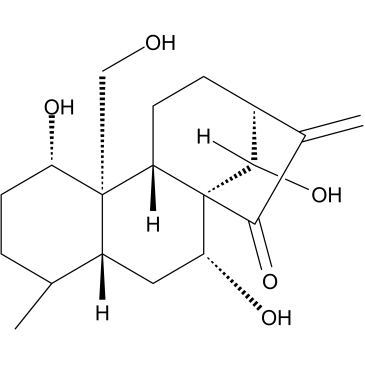
Cas No.: 73981-34-7
Sample solution is provided at 25 µL, 10mM.
Kamebakaurin, a compound of kaurane diterpenes was isolated from traditional Chinese medicinal plant Isodon excia. It is a potent inhibitor of NF-kappaB activation by directly targeting DNA-binding activity of p50[6].
Treated with different concentrations of kamebakaurin (0-30µM;24 h), The activity of HCT116 cells did not decrease significantly, but Kamebakaurin inhibits HIF-1α protein expression in cells [1]. Kamebakaurin (0.1, 1.0, 5 µM) significantly inhibited the LPS-induced production of nitric oxide (NO) in a concentration-dependent fashion in activated microglial cells[2]. Kamebakaurin (0-500ng/ml;4h)dose-dependently attenuated iNOS gene expression in LPS-activated dendritic cells (DCs). Kamebakaurin significantly inhibited the gene expression and protein production of the inflammatory cytokines TNF-α, IL-12, and IL-1β[4].
Kamebakaurin (50 mg/kg;40 days;p.o.) produced significant growth inhibition of HCT116 cells in tumor xenograft model[1]. Kamebakaurin dose-dependently suppressed the inflammation in an adjuvant arthritis model. Oral administration of 20 mg/kg kamebakaurin resulted in the 75% decrease of paw volume[3]. Pretreatment with Kamebakaurin reduced the magnitude of Acetaminophen (N-acetyl-p-aminophenol, APAP)-induced increases in plasma levels of hepatic injury markers, lipid peroxidation, and inflammatory response[5].
References:
[1]. Wang KS, Ma J, et,al. Kamebakaurin inhibits the expression of hypoxia-inducible factor-1α and its target genes to confer antitumor activity. Oncol Rep. 2016 Apr;35(4):2045-52. doi: 10.3892/or.2016.4576. Epub 2016 Jan 19. PMID: 26781327.
[2]. Kim BW, Koppula S, et,al.Anti-neuroinflammatory activity of Kamebakaurin from Isodon japonicus via inhibition of c-Jun NH?-terminal kinase and p38 mitogen-activated protein kinase pathway in activated microglial cells. J Pharmacol Sci. 2011;116(3):296-308. doi: 10.1254/jphs.10324fp. Epub 2011 Jun 25. PMID: 21705843.
[3]. Lee JH, Choi JK, et,al. Anti-inflammatory effect of kamebakaurin in in vivo animal models. Planta Med. 2004 Jun;70(6):526-30. doi: 10.1055/s-2004-827152. PMID: 15241890.
[4]. Kim JY, Kim HS, et,al. Inhibition of TAK1 by kamebakaurin in dendritic cells. Int Immunopharmacol. 2013 Jan;15(1):138-43. doi: 10.1016/j.intimp.2012.11.004. Epub 2012 Nov 15. PMID: 23159603.
[5]. Yoshioka H, Aoyagi Y, et,al. Suppressive effect of kamebakaurin on acetaminophen-induced hepatotoxicity by inhibiting lipid peroxidation and inflammatory response in mice. Pharmacol Rep. 2017 Oct;69(5):903-907. doi: 10.1016/j.pharep.2017.04.004. Epub 2017 Apr 12. PMID: 28624597.
[6]. Lee JH, et,al.Kaurane diterpene, kamebakaurin, inhibits NF-kappa B by directly targeting the DNA-binding activity of p50 and blocks the expression of antiapoptotic NF-kappa B target genes. J Biol Chem. 2002 May 24;277(21):18411-20. doi: 10.1074/jbc.M201368200. Epub 2002 Mar 4. PMID: 11877450.

| Cell experiment [1]: | |
|
Cell lines |
HCT116 cells |
|
Preparation Method |
HCT116 cells were seeded in 96-well plates and incubated overnight. Kamebakaurin was dissolved in DMSO. After 24 h, the cells were pretreated with different concentrations of kamebakaurin for 24 h. Measurement of cell viability by MTT assay. |
|
Reaction Conditions |
0-30µM;24 h |
|
Applications |
Treated with different concentrations of kamebakaurin for 24 h, The activity of HCT116 cells did not decrease significantly. |
| Animal experiment [2]: | |
|
Animal models |
Six weeks old specific-pathogen-free Crj:BALB/c nu/nu female athymic nude mice |
|
Preparation Method |
mice were randomly assigned to three groups, each of which consists of five mice, and then were subcutaneously inoculated with HCT116 cells in the left flank region. Kamebakaurin, dissolved in DMSO, was administered orally every other day for 40 days at a dose of 15 and 50 mg/kg body weight starting from day 10 post cell implantation to mice. |
|
Dosage form |
15 and 50 mg/kg;40 days;p.o. |
|
Applications |
Kamebakaurin (50 mg/kg) produced significant growth inhibition of HCT116 cells in tumor xenograft model. |
|
References: [1]. Wang KS, Ma J, et,al. Kamebakaurin inhibits the expression of hypoxia-inducible factor-1α and its target genes to confer antitumor activity. Oncol Rep. 2016 Apr;35(4):2045-52. doi: 10.3892/or.2016.4576. Epub 2016 Jan 19. PMID: 26781327. |
|
| Cas No. | 73981-34-7 | SDF | |
| Canonical SMILES | O[C@]1([C@@]2(C3=O)[C@](CC[C@H]1C3=C)([H])[C@]4([C@](C(C)(CC[C@@H]4O)C)([H])C[C@H]2O)CO)[H] | ||
| Formula | C20H30O5 | M.Wt | 350.45 |
| Solubility | DMSO : 100 mg/mL (297.25 mM; Need ultrasonic) | Storage | 4°C, protect from light |
| General tips | Please select the appropriate solvent to prepare the stock solution according to the
solubility of the product in different solvents; once the solution is prepared, please store it in
separate packages to avoid product failure caused by repeated freezing and thawing.Storage method
and period of the stock solution: When stored at -80°C, please use it within 6 months; when stored
at -20°C, please use it within 1 month. To increase solubility, heat the tube to 37°C and then oscillate in an ultrasonic bath for some time. |
||
| Shipping Condition | Evaluation sample solution: shipped with blue ice. All other sizes available: with RT, or with Blue Ice upon request. | ||
| Prepare stock solution | |||
|
1 mg | 5 mg | 10 mg |
| 1 mM | 2.8535 mL | 14.2674 mL | 28.5347 mL |
| 5 mM | 570.7 μL | 2.8535 mL | 5.7069 mL |
| 10 mM | 285.3 μL | 1.4267 mL | 2.8535 mL |
Step 1: Enter information below (Recommended: An additional animal making an allowance for loss during the experiment)
Step 2: Enter the in vivo formulation (This is only the calculator, not formulation. Please contact us first if there is no in vivo formulation at the solubility Section.)
Calculation results:
Working concentration: mg/ml;
Method for preparing DMSO master liquid: mg drug pre-dissolved in μL DMSO ( Master liquid concentration mg/mL, Please contact us first if the concentration exceeds the DMSO solubility of the batch of drug. )
Method for preparing in vivo formulation: Take μL DMSO master liquid, next addμL PEG300, mix and clarify, next addμL Tween 80, mix and clarify, next add μL ddH2O, mix and clarify.
Method for preparing in vivo formulation: Take μL DMSO master liquid, next add μL Corn oil, mix and clarify.
Note: 1. Please make sure the liquid is clear before adding the next solvent.
2. Be sure to add the solvent(s) in order. You must ensure that the solution obtained, in the previous addition, is a clear solution before proceeding to add the next solvent. Physical methods such as vortex, ultrasound or hot water bath can be used to aid dissolving.
3. All of the above co-solvents are available for purchase on the GlpBio website.
Quality Control & SDS
- View current batch:
- Purity: >98.00%
- COA (Certificate Of Analysis)
- SDS (Safety Data Sheet)
- Datasheet
Average Rating: 5 (Based on Reviews and 26 reference(s) in Google Scholar.)
GLPBIO products are for RESEARCH USE ONLY. Please make sure your review or question is research based.
Required fields are marked with *


