
>>Signaling Pathways>> Apoptosis>> Other Apoptosis>>17-DMAG (Alvespimycin) HCl

17-DMAG (Alvespimycin) HCl

Catalog No.GC13044

17-DMAG(알베스피마이신) HCl(17-DMAG 염산염; KOS-1022; BMS 826476)은 62&7#177;29nM의 EC50으로 Hsp90에 결합하는 Hsp90의 강력한 억제제입니다.

Products are for research use only. Not for human use. We do not sell to patients.
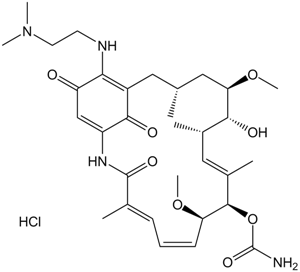
17-DMAG (Alvespimycin) HCl Chemical Structure

Cas No.: 467214-21-7

Size 가격 재고 수량
10mM (in 1mL DMSO)
US$39.00
재고 있음
1mg
US$11.00
재고 있음
5mg
US$22.00
재고 있음
10mg
US$35.00
재고 있음
25mg
US$70.00
재고 있음
100mg
US$175.00
재고 있음
200mg
US$294.00
재고 있음

Tel:(909) 407-4943 Email: sales@glpbio.com


고객 리뷰

Based on customer reviews.

Sample solution is provided at 25 µL, 10mM.

Description of 17-DMAG (Alvespimycin) HCl

17-DMAG (Alvespimycin) HCl is an effective inhibitor of Hsp90, with an IC50 value of 62nM [1]. 17-DMAG (Alvespimycin) HCl binds to the ATP binding motif of Hsp90 and inhibits its protein folding protection activity, resulting in the misfolding and degradation of the target proteins of Hsp90 (such as EGFR, AKT, mutant p53 and IKK) [2]. 17-DMAG (Alvespimycin) HCl has anti-tumor effects and can be used in cancer research such as lung cancer, liver cancer, and colon cancer [3-4].

In vitro, 17-DMAG (Alvespimycin) HCl (50-500nM; 24 or 48h) treatment significantly and dose- and time-dependently led to depletion of the target protein IKK in chronic lymphocytic leukemia (CLL) cells and cysteine aspartate-dependent apoptosis, reducing the binding of NF-κB p50/p65 DNA and the transcription of NF-κB target genes [5]. 17-DMAG (Alvespimycin) HCl (0-1000nM; 24h) treatment inhibits the proliferation of osteosarcoma cells in a dose-dependent manner and inhibits the activation of MET protein and the cell cycle progression [6].

In vivo, 17-DMAG (Alvespimycin) HCl (10mg/kg/day; 5 times per week for 16 days; i.p.) treatment significantly reduces the number of white blood cells in the blood of TCL1-SCID transgenic mouse models and prolongs survival [5]. The treatment with 17-DMAG (Alvespimycin) HCl (5mg/kg/day; 3 times per week; i.p.) reduced the incidence and severity of abdominal aortic aneurysms induced by ANG II in mice, weakened the remodeling of the aortic wall, the inflammatory response and the formation of new blood vessels, and decreased the expression of MMP-2 and MMP-9, the level of MDA and the secretion of MCP-1 [7].

References:
[1] Ge J, Normant E, Porter JR, et al. Design, synthesis, and biological evaluation of hydroquinone derivatives of 17-amino-17-demethoxygeldanamycin as potent, water-soluble inhibitors of Hsp90. J Med Chem. 2006;49(15):4606-4615.
[2] Sun X, Bristol JA, Iwahori S, Hagemeier SR, Meng Q, Barlow EA, Fingeroth JD, Tarakanova VL, Kalejta RF, Kenney SC. Hsp90 inhibitor 17-DMAG decreases expression of conserved herpesvirus protein kinases and reduces virus production in Epstein-Barr virus-infected cells. J Virol. 2013 Sep;87(18):10126-38.
[3] Chang Y J, Huang C Y, Hung C S, et al. Glucose-regulated protein 78 mediates the therapeutic efficacy of 17-DMAG in colon cancer cells[J]. Tumor Biology, 2015, 36(6): 4367-4376. 
[4] Mellatyar H, Talaei S, Pilehvar-Soltanahmadi Y, et al. Targeted cancer therapy through 17-DMAG as an Hsp90 inhibitor: Overview and current state of the art[J]. Biomedicine & Pharmacotherapy, 2018, 102: 608-617.
[5] Hertlein E, Wagner AJ, Jones J, et al. 17-DMAG targets the nuclear factor-kappaB family of proteins to induce apoptosis in chronic lymphocytic leukemia: clinical implications of HSP90 inhibition. Blood. 2010;116(1):45-53.
[6] Kawano M, Tanaka K, Itonaga I, Iwasaki T, Kubota Y, Tsumura H. The anti-oncogenic effect of 17-DMAG via the inactivation of HSP90 and MET pathway in osteosarcoma cells. Oncol Res. 2023 Jul 21;31(5):631-643.
[7] Qi J, Yang P, Yi B, et al. Heat shock protein 90 inhibition by 17-DMAG attenuates abdominal aortic aneurysm formation in mice[J]. American Journal of Physiology-Heart and Circulatory Physiology, 2015, 308(8): H841-H852.

Protocol of 17-DMAG (Alvespimycin) HCl

Kinase experiment [1]:

Preparation Method

Fluorescence polarization (FP)-based competition binding assay:
This assay utilized a boron difluoride dipyrromethene (BODIPY) labeled geldanamycin analogue (BODIPY-AG) as a probe and measured fluorescence polarization upon binding of the probe to a protein. Native human Hsp90 protein (α+β isoforms) is isolated from HeLa cells. BODIPY-AG solution was freshly prepared in FP assay buffer (20mM HEPES-KOH, pH 7.3, 1.0mM EDTA, 100mM KCl, 5.0mM MgCl2, 0.01% NP-40, 0.1mg/mL fresh bovine γ-globulin (BGG), 1.0mM fresh DTT, and protease inhibitor from stock solution in DMSO). Competition curves were obtained by mixing 10μL each of a solution containing BODIPY-AG and Hsp90, and a serial dilution of 17-DMAG (Alvespimycin) HCl freshly prepared in FP assay buffer from stock solution in DMSO. Final concentrations were 10nM BODIPY-AG, 40 or 60nM Hsp90, varying concentration of 17-DMAG (Alvespimycin) HCl (0.10nM~10μM), and ≤ 0.25% DMSO in a 384-well microplate. After 3-hr incubation at 30°C, fluorescence anisotropy (γEx=485nm, γEm=535nm) was measured on an EnVision 2100 multilabel plate reader. The IC50 value of 17-DMAG was obtained from the competition curves.

Reaction Conditions

0.1nM-10μM; 3h

Applications

The IC50 value of 17-DMAG (Alvespimycin) HCl for human Hsp90 is 62nM.
Cell experiment [2]:

Cell lines

CD19-selected B cells from CLL patients

Preparation Method

A total of 1 × 10⁶ CD19-selected B cells from CLL patients were incubated for 24 or 48h in 17-DMAG (Alvespimycin) HCl, or vehicle. Apoptosis was determined by staining with annexin V-fluorescein isothiocyanate and propidium iodide (PI). After exposure to drugs, cells were washed with phosphate-buffered saline and stained in 1 time binding buffer. Cell death was assessed by flow cytometry using a Beckman-Coulter model EPICS XL cytometer. 

Reaction Conditions

50nM-500nM; 24 or 48h

Applications

17-DMAG (Alvespimycin) HCl treatment significantly and dose- and time-dependently induces cysteine aspartate-dependent apoptosis in chronic lymphocytes.
Animal experiment [2]:

Animal models

SCID mice engrafted with TCL1 leukemia cells

Preparation Method

SCID mice were housed in a clean environment and supplied with sterile food and water ad libitum. CD19-selected transformed B cells (1 × 10⁶) from the spleen of a TCL1 transgenic mouse with active leukemia were engrafted by tail vein into an SCID mouse. Ten or 11 mice in each treatment group were treated with dimethyl sulfoxide (vehicle control) or 10mg/kg of 17-DMAG (Alvespimycin) HCl administered by intraperitoneal injection 5 times per week beginning 2 weeks after injection of leukemia cells. Blood was collected at various time points throughout treatment for RNA isolation and assessment of gene expression. 

Dosage form

10mg/kg/day; 5 times per week for 16 days; i.p.

Applications

17-DMAG (Alvespimycin) HCl treatment significantly reduced the number of white blood cells in the blood of TCL1-SCID transplanted mouse models and prolonged their survival period.

References:
[1] Ge J, Normant E, Porter JR, et al. Design, synthesis, and biological evaluation of hydroquinone derivatives of 17-amino-17-demethoxygeldanamycin as potent, water-soluble inhibitors of Hsp90. J Med Chem. 2006;49(15):4606-4615.
[2] Hertlein E, Wagner AJ, Jones J, et al. 17-DMAG targets the nuclear factor-kappaB family of proteins to induce apoptosis in chronic lymphocytic leukemia: clinical implications of HSP90 inhibition. Blood. 2010;116(1):45-53. 

Chemical Properties of 17-DMAG (Alvespimycin) HCl

Cas No. 467214-21-7 SDF
Chemical Name [(3R,5S,6R,7S,8E,10S,11S,12Z,14E)-21-[2-(dimethylamino)ethylamino]-6-hydroxy-5,11-dimethoxy-3,7,9,15-tetramethyl-16,20,22-trioxo-17-azabicyclo[16.3.1]docosa-1(21),8,12,14,18-pentaen-10-yl] carbamate;hydrochloride
Canonical SMILES CC1CC(C(C(C=C(C(C(C=CC=C(C(=O)NC2=CC(=O)C(=C(C1)C2=O)NCCN(C)C)C)OC)OC(=O)N)C)C)O)OC.Cl
Formula C32H48N4O8.HCl M.Wt 653.21
Solubility ≥ 26.2mg/mL in DMSO Storage Store at -20°C
General tips Please select the appropriate solvent to prepare the stock solution according to the solubility of the product in different solvents; once the solution is prepared, please store it in separate packages to avoid product failure caused by repeated freezing and thawing.Storage method and period of the stock solution: When stored at -80°C, please use it within 6 months; when stored at -20°C, please use it within 1 month.
To increase solubility, heat the tube to 37°C and then oscillate in an ultrasonic bath for some time.
Shipping Condition Evaluation sample solution: shipped with blue ice. All other sizes available: with RT, or with Blue Ice upon request.

Complete Stock Solution Preparation Table of 17-DMAG (Alvespimycin) HCl

Prepare stock solution
1 mg 5 mg 10 mg
1 mM 1.5309 mL 7.6545 mL 15.309 mL
5 mM 306.2 μL 1.5309 mL 3.0618 mL
10 mM 153.1 μL 765.5 μL 1.5309 mL
  • Molarity Calculator

  • Dilution Calculator

  • Molecular Weight Calculator

Mass
=
Concentration
x
Volume
x
MW*


**When preparing stock solutions always use the batch-specific molecular weight of the product found on the vial label and MSDS / CoA (available online).

Calculate

In vivo Formulation Calculator (Clear solution) of 17-DMAG (Alvespimycin) HCl

Step 1: Enter information below (Recommended: An additional animal making an allowance for loss during the experiment)

mg/kg g μL

Step 2: Enter the in vivo formulation (This is only the calculator, not formulation. Please contact us first if there is no in vivo formulation at the solubility Section.)

% DMSO % % Tween 80 % ddH2O
%DMSO %

Calculation results:

Working concentration: mg/ml;

Method for preparing DMSO master liquid: mg drug pre-dissolved in μL DMSO ( Master liquid concentration mg/mL, Please contact us first if the concentration exceeds the DMSO solubility of the batch of drug. )

Method for preparing in vivo formulation: Take μL DMSO master liquid, next addμL PEG300, mix and clarify, next addμL Tween 80, mix and clarify, next add μL ddH2O, mix and clarify.

Method for preparing in vivo formulation: Take μL DMSO master liquid, next add μL Corn oil, mix and clarify.

Note: 1. Please make sure the liquid is clear before adding the next solvent.
2. Be sure to add the solvent(s) in order. You must ensure that the solution obtained, in the previous addition, is a clear solution before proceeding to add the next solvent. Physical methods such as vortex, ultrasound or hot water bath can be used to aid dissolving.
3. All of the above co-solvents are available for purchase on the GlpBio website.

Product Documents

Quality Control & SDS

View current batch:

리뷰

Review for 17-DMAG (Alvespimycin) HCl

Average Rating: 5 ★★★★★ (Based on Reviews and 7 reference(s) in Google Scholar.)

5 Star
100%
4 Star
0%
3 Star
0%
2 Star
0%
1 Star
0%
Review for 17-DMAG (Alvespimycin) HCl

GLPBIO products are for RESEARCH USE ONLY. Please make sure your review or question is research based.

Required fields are marked with *

You may receive emails regarding this submission. Any emails will include the ability to opt-out of future communications.
