
RK-24466 (KIN 001-51) (Synonyms: Lymphocyte-specific Protein Tyrosine Kinase, RK-24466) |
| Catalog No.GC31701 |
RK-24466 (KIN 001-51) (KIN 001-51) is a potent and selective Lck inhibitor; inhibits Lck (64-509) and LckCD isoforms with IC50s of less than 1 and 2 nM, respectively.
Products are for research use only. Not for human use. We do not sell to patients.
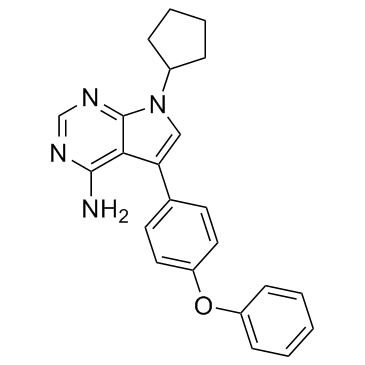
Cas No.: 213743-31-8
Sample solution is provided at 25 µL, 10mM.
RK-24466 (KIN 001-51) is a potent and selective Lck inhibitor; inhibits Lck (64-509) and LckCD isoforms with IC50s of less than 1 and 2 nM, respectively.
RK-24466 is selective for Lck over a range of receptor, non-receptor tyrosine kinases and seronine/threonine kinases. RK-24466 are potent inhibitors of IL2 production in Jurkat cells stimulated with anti-CD3 antibody, being at least 100-fold more potent than PP1. RK-24466 displays remarkable cellular selectivity[1]. RK-24466 significantly inhibits both VSMC proliferation and migration. RK-24466 suppresses VSMC proliferation and migration via down-regulating the protein kinase B (Akt) and extracellular signal regulated kinase (ERK) pathways, and it significantly decreases the expression of proliferating cell nuclear antigen (PCNA) and cyclin D1 and, the phosphorylation of retinoblastoma protein (pRb)[2].
RK-24466 inhibits T-cell receptor stimulated (a-CD3 mAb) IL-2 production in mice at low doses (ED50=4 mg/kg) after ip administration. However, efficacy is greatly reduced after oral administration (ED50=25 mg/kg) which is presumed to reflect poor intestinal absorption in the latter regimen. Inhibition of antigen specific T-cell immune responses is also seen for RK-24466. After administration of RK-24466 twice daily (100 mg/kg po) for 3 days during the in vivo priming phase, a 70% inhibition of IFNγ production is seen upon subsequent antigen-specific (KLH) challenge of lymphocytes from the draining lymph nodes in vitro[3]. RK-24466 suppresses the migration of VSMCs from endothelium-removed aortic rings, as well as neointima formation following rat carotid balloon injury[2].
[1]. Arnold LD, et al. Pyrrolo[2,3-d]pyrimidines containing an extended 5-substituent as potent and selective inhibitors of lck I. Bioorg Med Chem Lett. 2000 Oct 2;10(19):2167-70. [2]. Seo HH, et al. 7-cyclopentyl-5-(4-phenoxyphenyl)-7H-pyrrolo[2,3-d] pyrimidin-4-ylamine inhibits the proliferation and migration of vascular smooth muscle cells by suppressing ERK and Akt pathways. Eur J Pharmacol. 2017 Mar 5;798:35-42. [3]. Burchat AF, et al. Pyrrolo[2,3-d]pyrimidines containing an extended 5-substituent as potent and selective inhibitorsof lck II. Bioorg Med Chem Lett. 2000 Oct 2;10(19):2171-4.

Cell experiment: | To examine the concentration-dependent effect of the RK-24466, VSMCs are cultured in 10% FBS-supplemented DMEM containing either vehicle (DMSO 2%, v/v) or increasing concentrations of the RK-24466 (1 to 10 μM) for 24 h, and cellular proliferation is determined by using CCK-8[2]. |
Animal experiment: | Rats: For the RK-24466 treated group, RK-24466 at a final blood concentration of 5 μM is intravenously injected through femoral vein. At 14d after BI, the rats are anesthetized, and the carotid arteries are excised. The entire length of the right carotid artery is balloon injured. The left carotid artery serves as an uninjured intra-animal control. To assess the neointima formation, H&E stained section is imaged, and the intima to media thickness ratio is measured[2]. |
References: [1]. Arnold LD, et al. Pyrrolo[2,3-d]pyrimidines containing an extended 5-substituent as potent and selective inhibitors of lck I. Bioorg Med Chem Lett. 2000 Oct 2;10(19):2167-70. | |
| Cas No. | 213743-31-8 | SDF | |
| Synonyms | Lymphocyte-specific Protein Tyrosine Kinase, RK-24466 | ||
| Canonical SMILES | NC1=C2C(N(C3CCCC3)C=C2C4=CC=C(OC5=CC=CC=C5)C=C4)=NC=N1 | ||
| Formula | C23H22N4O | M.Wt | 370.45 |
| Solubility | DMSO : 45 mg/mL (121.47 mM);Water : < 0.1 mg/mL (insoluble) | Storage | Store at -20°C |
| General tips | Please select the appropriate solvent to prepare the stock solution according to the
solubility of the product in different solvents; once the solution is prepared, please store it in
separate packages to avoid product failure caused by repeated freezing and thawing.Storage method
and period of the stock solution: When stored at -80°C, please use it within 6 months; when stored
at -20°C, please use it within 1 month. To increase solubility, heat the tube to 37°C and then oscillate in an ultrasonic bath for some time. |
||
| Shipping Condition | Evaluation sample solution: shipped with blue ice. All other sizes available: with RT, or with Blue Ice upon request. | ||
| Prepare stock solution | |||
|
1 mg | 5 mg | 10 mg |
| 1 mM | 2.6994 mL | 13.4971 mL | 26.9942 mL |
| 5 mM | 539.9 μL | 2.6994 mL | 5.3988 mL |
| 10 mM | 269.9 μL | 1.3497 mL | 2.6994 mL |
Step 1: Enter information below (Recommended: An additional animal making an allowance for loss during the experiment)
Step 2: Enter the in vivo formulation (This is only the calculator, not formulation. Please contact us first if there is no in vivo formulation at the solubility Section.)
Calculation results:
Working concentration: mg/ml;
Method for preparing DMSO master liquid: mg drug pre-dissolved in μL DMSO ( Master liquid concentration mg/mL, Please contact us first if the concentration exceeds the DMSO solubility of the batch of drug. )
Method for preparing in vivo formulation: Take μL DMSO master liquid, next addμL PEG300, mix and clarify, next addμL Tween 80, mix and clarify, next add μL ddH2O, mix and clarify.
Method for preparing in vivo formulation: Take μL DMSO master liquid, next add μL Corn oil, mix and clarify.
Note: 1. Please make sure the liquid is clear before adding the next solvent.
2. Be sure to add the solvent(s) in order. You must ensure that the solution obtained, in the previous addition, is a clear solution before proceeding to add the next solvent. Physical methods such as vortex, ultrasound or hot water bath can be used to aid dissolving.
3. All of the above co-solvents are available for purchase on the GlpBio website.
Quality Control & SDS
- View current batch:
- Purity: >98.50%
- COA (Certificate Of Analysis)
- SDS (Safety Data Sheet)
- Datasheet
Average Rating: 5 (Based on Reviews and 34 reference(s) in Google Scholar.)
GLPBIO products are for RESEARCH USE ONLY. Please make sure your review or question is research based.
Required fields are marked with *


