
SCH 79797 dihydrochloride |
| Catalog No.GC10291 |
SCH 79797 dihydrochloride is an efficient and selective non-peptide proteinase-activated receptor 1 (PAR1) antagonist, with an IC50 of 70nM and a Ki of 35nM.
Products are for research use only. Not for human use. We do not sell to patients.
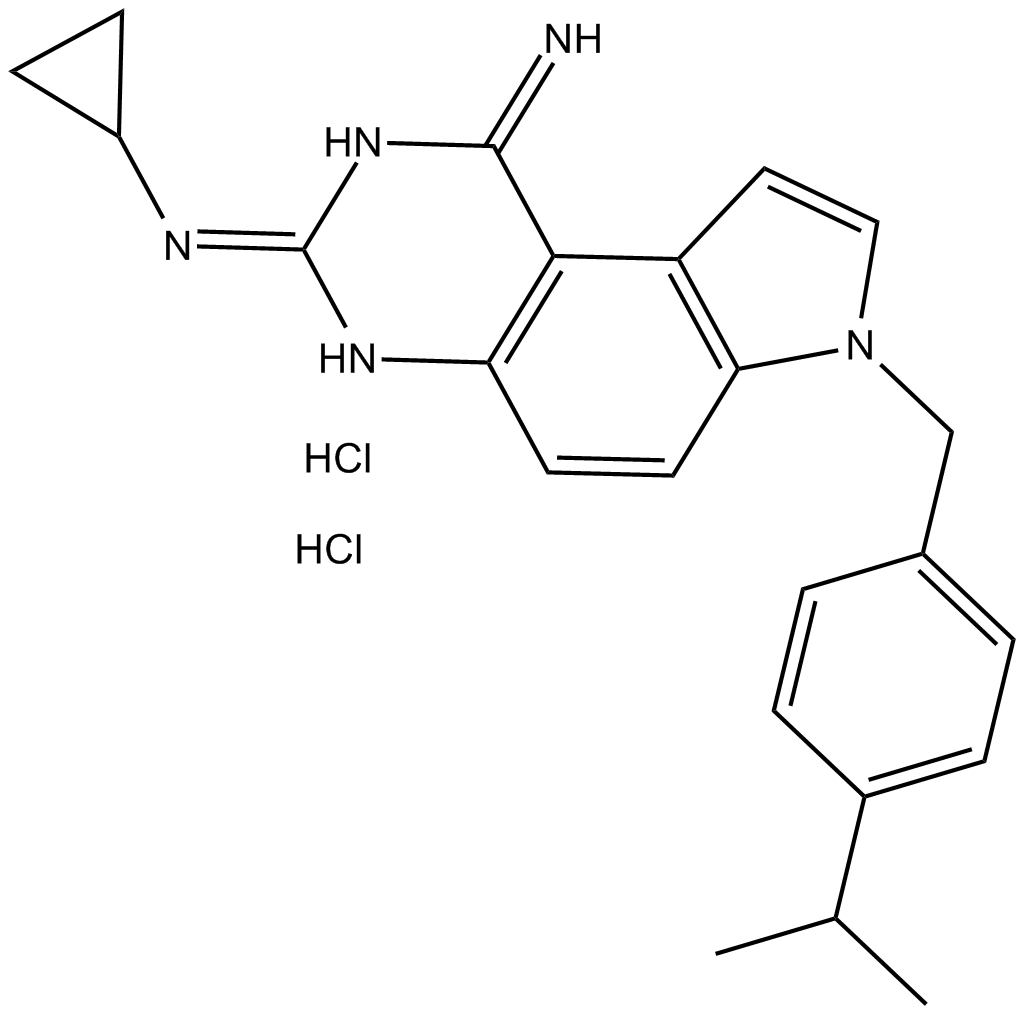
Cas No.: 1216720-69-2
Sample solution is provided at 25 µL, 10mM.
SCH 79797 dihydrochloride is an efficient and selective non-peptide proteinase-activated receptor 1 (PAR1) antagonist, with an IC50 of 70nM and a Ki of 35nM [1]. PAR1 is critically involved in the co-activation of coagulation and inflammatory responses [2]. SCH 79797 dihydrochloride has anti-proliferative and pro-apoptotic effects, and it can effectively prevent the activation of PAR 1 in vascular smooth muscle cells, endothelial cells, and astrocytes [3].
In vitro, SCH 79797 dihydrochloride (0-200nM) can interfere with the growth of various human and mouse cell lines in a concentration-dependent manner. The ED50 values of SCH 79797 dihydrochloride for inhibiting the growth of NIH3T3, HEK293 and A375 cells were 75nM, 81nM and 116nM, respectively. In NIH 3T3 cells, SCH 79797 dihydrochloride inhibits serum-stimulated p44/p42 mitogen-activated protein kinase (MAPK) activation at low concentrations and induces apoptosis at high concentrations [3]. Through metabolomics analysis of Escherichia coli NCM3722 treated with SCH 79797 dihydrochloride (13.9μg/mL) for 15 minutes, the level of DHFR substrate 7,8-dihydrofolate (DHF) in the cells increased approximately 10-fold, while the levels of folate metabolites downstream of DHF significantly decreased [4].
In vivo, by intravenously injecting SCH 79797 dihydrochloride (2.5, 10, 25, 50, 100, and 250μg/kg) 15 minutes before ischemia in rats, SCH 79797 dihydrochloride dose-dependently reduced myocardial necrosis after complete rat heart I/R, with the optimal dose being 25μg/kg [5]. By continuous subcutaneous injection of SCH 79797 dihydrochloride (25μg/kg/d) for 4 weeks, the thickness of the interventricular septum and left ventricular posterior wall of Ren-Tg mice, as well as the area of cardiac fibrosis and mononuclear cell/macrophage deposition, were significantly reduced. At the same time, SCH 79797 dihydrochloride inhibited the increased mRNA expression levels of PAR-1, TNF-α, TGF-β1, and COL 3A 1 in the mouse heart [6].
References:
[1] Ahn HS, Foster C, Boykow G, Stamford A, Manna M, Graziano M. Inhibition of cellular action of thrombin by N3-cyclopropyl-7-[[4-(1-methylethyl)phenyl]methyl]-7H-pyrrolo[3, 2-f]quinazoline-1,3-diamine (SCH 79797), a nonpeptide thrombin receptor antagonist. Biochem Pharmacol. 2000 Nov 15;60(10):1425-34.
[2] Schoergenhofer C, Schwameis M, Gelbenegger G, et al. Inhibition of protease-activated receptor (PAR1) reduces activation of the endothelium, coagulation, fibrinolysis and inflammation during human endotoxemia[J]. Thrombosis and haemostasis, 2018, 118(07): 1176-1184.
[3] Di Serio C, Pellerito S, Duarte M, Massi D, Naldini A, Cirino G, Prudovsky I, Santucci M, Geppetti P, Marchionni N, Masotti G, Tarantini F. Protease-activated receptor 1-selective antagonist SCH79797 inhibits cell proliferation and induces apoptosis by a protease-activated receptor 1-independent mechanism. Basic Clin Pharmacol Toxicol. 2007 Jul;101(1):63-9.
[4] Martin JK 2nd, Sheehan JP, Bratton BP, et al. A Dual-Mechanism Antibiotic Kills Gram-Negative Bacteria and Avoids Drug Resistance. Cell. 2020;181(7):1518-1532.e14.
[5] Strande JL, Hsu A, Su J, Fu X, Gross GJ, Baker JE. SCH 79797, a selective PAR1 antagonist, limits myocardial ischemia/reperfusion injury in rat hearts. Basic Res Cardiol. 2007 Jul;102(4):350-8.
[6] Yokono Y, Hanada K, Narita M, et al. Blockade of PAR‐1 signaling attenuates cardiac hypertrophy and fibrosis in renin‐overexpressing hypertensive mice[J]. Journal of the American Heart Association, 2020, 9(12): e015616.
| Cell experiment [1]: | |
|
Cell lines |
NIH 3T3、HEK 293 and A375 cells |
|
Preparation Method |
All cell lines were seeded at a low density (4×10^4 cells per well) in 6-well plate clusters. The next day, the cells were washed three times with PBS and then starved in serum-free DMEM medium for 24h. The next day, the medium was replaced with DMEM medium supplemented with 10% FBS, which contained gradually increasing concentrations of SCH 79797 dihydrochloride or a separate solvent (DMSO). When the cells were stimulated by growth factors, they were starved in serum-free DMEM medium for 24h; the next day, 25ng/ml of FGF2 or 30ng/ml of PDGF was added to the medium. When using FGF2 for stimulation, heparin (10U/ml) was added to the medium. When studying the effect of cell density on SCH79797-mediated growth inhibition, proliferation experiments were conducted according to the above method. Three independent growth experiments for each cell type were performed to calculate the ED50. |
|
Reaction Conditions |
0-200nM; 1-9 days |
|
Applications |
The ED50 for growth inhibition was 75nM, 81nM and 116nM for NIH 3T3, HEK 293 and A375 cells. Starting from a concentration of 200nM, SCH 79797 dihydrochloride induced a significant amount of cell death within the first 3 days in all cultures. |
| Animal experiment [2]: | |
|
Animal models |
Male Sprague Dawley rats with myocardial I/R injury |
|
Preparation Method |
The experiment employed a live-anesthetized rat model. The experiment followed the routine surgical operation procedures and the infarction area was measured. For the study of the infarction area, 6 rats were selected. They first underwent 30 minutes of local ischemia, followed by 180 minutes of reperfusion. In another series of experiments (a total of 6 rats), intravenous injection of SCH 79797 dihydrochloride was initiated 15 minutes before or after the onset of ischemia, and lasted for 1 minute. |
|
Dosage form |
2.5, 10, 25, 50, 100, and 250μg/kg;i.v. |
|
Applications |
SCH 79797 dihydrochloride administered immediately before or during ischemia reduced myocardial necrosis after I/R in intact rats. This response was dose-dependent, with the optimal dose being 25μg/kg. |
|
References: |
|
| Cas No. | 1216720-69-2 | SDF | |
| Chemical Name | (Z)-N-(1-imino-7-(4-isopropylbenzyl)-1H-pyrrolo[3,2-f]quinazolin-3(2H,4H,7H)-ylidene)cyclopropanamine dihydrochloride | ||
| Canonical SMILES | CC(C1=CC=C(CN2C=CC3=C2C=CC(N/C4=N/C5CC5)=C3C(N4)=N)C=C1)C.Cl.Cl | ||
| Formula | C23H25N5.2HCl | M.Wt | 444.41 |
| Solubility | DMF: 5 mg/ml,DMSO: 11 mg/ml,DMSO:PBS(pH 7.2) (1:2): 0.33 mg/ml,Ethanol: 1 mg/ml | Storage | Store at 2-8°C, protect from light |
| General tips | Please select the appropriate solvent to prepare the stock solution according to the
solubility of the product in different solvents; once the solution is prepared, please store it in
separate packages to avoid product failure caused by repeated freezing and thawing.Storage method
and period of the stock solution: When stored at -80°C, please use it within 6 months; when stored
at -20°C, please use it within 1 month. To increase solubility, heat the tube to 37°C and then oscillate in an ultrasonic bath for some time. |
||
| Shipping Condition | Evaluation sample solution: shipped with blue ice. All other sizes available: with RT, or with Blue Ice upon request. | ||
| Prepare stock solution | |||
|
1 mg | 5 mg | 10 mg |
| 1 mM | 2.2502 mL | 11.2509 mL | 22.5017 mL |
| 5 mM | 450 μL | 2.2502 mL | 4.5003 mL |
| 10 mM | 225 μL | 1.1251 mL | 2.2502 mL |
Step 1: Enter information below (Recommended: An additional animal making an allowance for loss during the experiment)
Step 2: Enter the in vivo formulation (This is only the calculator, not formulation. Please contact us first if there is no in vivo formulation at the solubility Section.)
Calculation results:
Working concentration: mg/ml;
Method for preparing DMSO master liquid: mg drug pre-dissolved in μL DMSO ( Master liquid concentration mg/mL, Please contact us first if the concentration exceeds the DMSO solubility of the batch of drug. )
Method for preparing in vivo formulation: Take μL DMSO master liquid, next addμL PEG300, mix and clarify, next addμL Tween 80, mix and clarify, next add μL ddH2O, mix and clarify.
Method for preparing in vivo formulation: Take μL DMSO master liquid, next add μL Corn oil, mix and clarify.
Note: 1. Please make sure the liquid is clear before adding the next solvent.
2. Be sure to add the solvent(s) in order. You must ensure that the solution obtained, in the previous addition, is a clear solution before proceeding to add the next solvent. Physical methods such as vortex, ultrasound or hot water bath can be used to aid dissolving.
3. All of the above co-solvents are available for purchase on the GlpBio website.
Quality Control & SDS
- View current batch:
- Purity: >98.00%
- COA (Certificate Of Analysis)
- SDS (Safety Data Sheet)
- Datasheet
Average Rating: 5 (Based on Reviews and 39 reference(s) in Google Scholar.)
GLPBIO products are for RESEARCH USE ONLY. Please make sure your review or question is research based.
Required fields are marked with *


