
Home>>Signaling Pathways>> Antibody-drug Conjugate/ADC Related>> ADC Cytotoxin>>SJG-136 (NSC-694501)

SJG-136 (NSC-694501) (Synonyms: NSC-694501)

Catalog No.GC34086

SJG-136 (NSC-694501) is a DNA cross-linking agent, with an XL50 of 45 nM for pBR322 DNA. SJG-136 (NSC-694501) has potent antitumor activity.

Products are for research use only. Not for human use. We do not sell to patients.
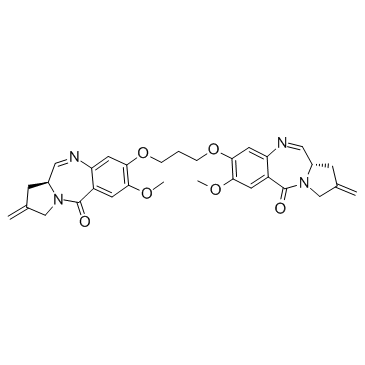
SJG-136 (NSC-694501) Chemical Structure

Cas No.: 232931-57-6

Size Price Stock Qty
10mM (in 1mL DMSO)
$540.00
In stock
2mg
$243.00
In stock
5mg
$441.00
In stock

Tel:(909) 407-4943 Email: sales@glpbio.com


Customer Reviews

Based on customer reviews.

Sample solution is provided at 25 µL, 10mM.

Description of SJG-136 (NSC-694501)

SJG-136 is a DNA cross-linking agent, with an XL50 of 45 nM for pBR322 DNA; SJG-136 has potent antitumor activity.

SJG-136 (dimer 5) is a DNA cross-linking agent, with an XL50 (concentration of agent required for 50% cross-linking of pBR322 DNA) of 45 nM for pBR322 DNA. SJG-136 is cytotoxic to ovarian cell lines, such as A2780 (IC50, 22.5 pM), A2780cisR (IC50, 24 pM), CH1 (IC50, 0.12 nM), CH1cisR (IC50, 0.6 nM), and SKOV-3 (IC50, 9.1 nM)[1]. SJG-136 (SG2000) also reduces the viability of a panel of canine cancer cells, with GI50 values ranging from 0.33 - >100 nM after a 1 h exposure, and <0.03 - 17.33 nM following continuous exposure[2].

SJG-136 shows more potent antitumor effect against CMeC-1 tumour at 0.30 mg/kg than 0.15 mg/kg either as a single dose or administered once a week for three weeks via dosed intravenously in mice. SJG-136-induced H2AX phosphorylation shows good correspondence, but less sensitivity, than measurement of foci[2].

[1]. Gregson SJ, et al. Design, synthesis, and evaluation of a novel pyrrolobenzodiazepine DNA-interactive agent with highly efficient cross-linking ability and potent cytotoxicity. J Med Chem. 2001 Mar 1;44(5):737-48. [2]. Mellinas-Gomez M, et al. Activity of the DNA minor groove cross-linking agent SG2000 (SJG-136) against canine tumours. BMC Vet Res. 2015 Aug 19;11:215.

Protocol of SJG-136 (NSC-694501)

Cell experiment:

In vitro cytotoxicity is evaluated using the human ovarian carcinoma cell lines SKOV-3, A2780, and CH1, together with the cisplatin-resistant counterparts of the A2780 and CH1 lines (A2780cisR and CH1cisR, respectively). Viable cells are seeded in growth medium (160 μL) into 96-well microtiter plates and allowed to attach overnight. SJG-136 is dissolved in DMSO (to give a 20 mM concentration in each case) immediately prior to adding to the cells in quadruplicate wells. Final drug concentrations in the wells ranged from 100 μM to 2.5 nM as follows: 100, 25, 10, 2.5, 1 μM, and 250, 100, 25, 10, 2.5 nM. This is achieved by diluting the drugs in growth medium and then adding 40 μL to the existing well volume of 160 μL to give the final concentrations stated above. After 4 days (96 h), the medium is removed and the remaining cells are fixed using 10% trichloroacetic acid on ice for 30 min. Wells are then washed 3−4 times with tap water and air-dried overnight, and 100 μL of 0.4% sulforhodamine B (dissolved in 1% glacial HOAc) is added to each well. Staining is allowed to continue for 10−15 min; the wells are then washed 3−4 times with 1% acetic acid and air-dried, and Tris base (100 μL of 10 mM) is added to each one. The plates are then shaken and absorbance readings taken at 540 nm using a plate reader. From plots of concentration versus percentage absorbance (compared to 8 untreated wells), IC50 values are calculated using the Quattro-Pro software package[1].

Animal experiment:

A homogenous suspension of 5 × 10⁶ exponentially growing canine melanoma cells in serum free RPMI 1640 tissue culture medium is injected subcutaneously into CD1 Nu/Nu immunocompromised female mice. The mice are divided into five groups of ten mice, with equivalent mean tumour volumes for each group. SJG-136 is given intravenously into the tail vein to four of these groups and vehicle control is administered to the fifth group. SJG-136 injections are prepared in 0.9 % NaCl and 1 % DMSO vehicle. Animals are weighed prior to the injection to determine the volume of SJG-136 required (0.1 mL/10 g body weight) which is given IV in the tail vein. Control group mice are given an IV injection of the vehicle solution; mice in groups one and two are given a single treatment of SJG-136, 0.15 mg/kg and 0.30 mg/kg respectively; mice in groups four and five are given 0.15 mg/kg and 0.30 mg/kg respectively, every seven days for a total of three treatments[2].

References:

[1]. Gregson SJ, et al. Design, synthesis, and evaluation of a novel pyrrolobenzodiazepine DNA-interactive agent with highly efficient cross-linking ability and potent cytotoxicity. J Med Chem. 2001 Mar 1;44(5):737-48.
[2]. Mellinas-Gomez M, et al. Activity of the DNA minor groove cross-linking agent SG2000 (SJG-136) against canine tumours. BMC Vet Res. 2015 Aug 19;11:215.

Chemical Properties of SJG-136 (NSC-694501)

Cas No. 232931-57-6 SDF
Synonyms NSC-694501
Canonical SMILES O=C1N2[C@@H](CC(C2)=C)C=NC3=CC(OCCCOC4=C(OC)C=C(C(N(CC(C5)=C)[C@@H]5C=N6)=O)C6=C4)=C(OC)C=C31
Formula C31H32N4O6 M.Wt 556.61
Solubility DMSO: ≥ 100 mg/mL (179.66 mM) Storage Store at -20°C
General tips Please select the appropriate solvent to prepare the stock solution according to the solubility of the product in different solvents; once the solution is prepared, please store it in separate packages to avoid product failure caused by repeated freezing and thawing.Storage method and period of the stock solution: When stored at -80°C, please use it within 6 months; when stored at -20°C, please use it within 1 month.
To increase solubility, heat the tube to 37°C and then oscillate in an ultrasonic bath for some time.
Shipping Condition Evaluation sample solution: shipped with blue ice. All other sizes available: with RT, or with Blue Ice upon request.

Complete Stock Solution Preparation Table of SJG-136 (NSC-694501)

Prepare stock solution
1 mg 5 mg 10 mg
1 mM 1.7966 mL 8.983 mL 17.9659 mL
5 mM 359.3 μL 1.7966 mL 3.5932 mL
10 mM 179.7 μL 898.3 μL 1.7966 mL
  • Molarity Calculator

  • Dilution Calculator

  • Molecular Weight Calculator

Mass
=
Concentration
x
Volume
x
MW*


**When preparing stock solutions always use the batch-specific molecular weight of the product found on the vial label and MSDS / CoA (available online).

Calculate

In vivo Formulation Calculator (Clear solution) of SJG-136 (NSC-694501)

Step 1: Enter information below (Recommended: An additional animal making an allowance for loss during the experiment)

mg/kg g μL

Step 2: Enter the in vivo formulation (This is only the calculator, not formulation. Please contact us first if there is no in vivo formulation at the solubility Section.)

% DMSO % % Tween 80 % ddH2O
%DMSO %

Calculation results:

Working concentration: mg/ml;

Method for preparing DMSO master liquid: mg drug pre-dissolved in μL DMSO ( Master liquid concentration mg/mL, Please contact us first if the concentration exceeds the DMSO solubility of the batch of drug. )

Method for preparing in vivo formulation: Take μL DMSO master liquid, next addμL PEG300, mix and clarify, next addμL Tween 80, mix and clarify, next add μL ddH2O, mix and clarify.

Method for preparing in vivo formulation: Take μL DMSO master liquid, next add μL Corn oil, mix and clarify.

Note: 1. Please make sure the liquid is clear before adding the next solvent.
2. Be sure to add the solvent(s) in order. You must ensure that the solution obtained, in the previous addition, is a clear solution before proceeding to add the next solvent. Physical methods such as vortex, ultrasound or hot water bath can be used to aid dissolving.
3. All of the above co-solvents are available for purchase on the GlpBio website.

Product Documents

Quality Control & SDS

View current batch:

Reviews

Review for SJG-136 (NSC-694501)

Average Rating: 5 ★★★★★ (Based on Reviews and 19 reference(s) in Google Scholar.)

5 Star
100%
4 Star
0%
3 Star
0%
2 Star
0%
1 Star
0%
Review for SJG-136 (NSC-694501)

GLPBIO products are for RESEARCH USE ONLY. Please make sure your review or question is research based.

Required fields are marked with *

You may receive emails regarding this submission. Any emails will include the ability to opt-out of future communications.