
Sulamserod (RS-100302) (Synonyms: RS-100302) |
| Catalog No.GC34033 |
Sulamserod (RS-100302) is a 5-HT4 receptor antagonist, with antiarrhythmic activities.
Products are for research use only. Not for human use. We do not sell to patients.
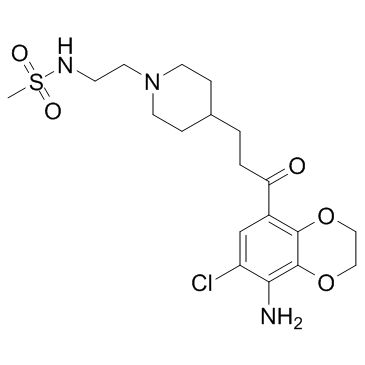
Cas No.: 219757-90-1
Sample solution is provided at 25 µL, 10mM.
Sulamserod is a 5-HT4 receptor antagonist, with antiarrhythmic activities.
Sulamserod (30 mg/kg) prolongs mean ERP (11568 versus 14667 ms, P,0.01) and wavelength (8.360.9 versus 9.960.8 cm, P,0.01), reduces dispersion of ERP (1565 versus 861 ms, P,0.01), and minimally slows conduction velocity (7264 versus 6765 cm/s, P,0.01) in pigs. Sulamserod produces no ventricular electrophysiological effects. Sulamserod terminates atrial flutter in 6 of 8 animals and atrial fibrillation in 8 of 9 animals and prevents reinduction of sustained tachycardia in all animals[1].
[1]. Rahme MM, et al. Electrophysiological and antiarrhythmic effects of the atrial selective 5-HT(4) receptor antagonist RS-100302 in experimental atrial flutter and fibrillation. Circulation. 1999 Nov 9;100(19):2010-7.

Animal experiment: | After completion of baseline electrophysiological measurements and induction of sustained AFL or AF, the 5-HT4 receptor antagonist RS-100302 is administered in a dose of 30 μg/kg over 10 minutes. This dose of RS-100302 is previously determined to maximally inhibit 5-HT-induced tachycardia in pigs. After completion of drug infusion, each animal is monitored for 20 minutes to observe arrhythmia response. If AFL or AF does not terminate spontaneously within 20 minutes after completion of drug infusion, sinus rhythm is restored by burst pacing or DC cardioversion, respectively. Electrophysiological measurements are then repeated as during control, and a venous blood sample is drawn for plasma levels of RS-100302. Attempts are then made to reinduce AFL or AF as performed at control. Reinduced arrhythmias are defined as sustained if lasting >10 minutes, nonsustained if lasting >30 seconds but <10 minutes, or none if lasting <30 seconds. Sustained arrhythmias are terminated after 10 minutes by burst pacing or DC cardioversion. Cisapride is then administered at a dose of 0.1 mg/kg over 10 minutes, after which electrophysiological measurements are repeated. Attempts are again made to reinduce AFL or AF, and the same definitions as those used after RS-100302 infusion regarding sustained, nonsustained, or no arrhythmias are applied. The study is then terminated, and animals are euthanized by an overdose of pentobarbital (150 mg/kg)[1]. |
References: [1]. Rahme MM, et al. Electrophysiological and antiarrhythmic effects of the atrial selective 5-HT(4) receptor antagonist RS-100302 in experimental atrial flutter and fibrillation. Circulation. 1999 Nov 9;100(19):2010-7. | |
| Cas No. | 219757-90-1 | SDF | |
| Synonyms | RS-100302 | ||
| Canonical SMILES | CS(=O)(NCCN1CCC(CCC(C2=C3OCCOC3=C(N)C(Cl)=C2)=O)CC1)=O | ||
| Formula | C19H28ClN3O5S | M.Wt | 445.96 |
| Solubility | Soluble in DMSO | Storage | Store at -20°C |
| General tips | Please select the appropriate solvent to prepare the stock solution according to the
solubility of the product in different solvents; once the solution is prepared, please store it in
separate packages to avoid product failure caused by repeated freezing and thawing.Storage method
and period of the stock solution: When stored at -80°C, please use it within 6 months; when stored
at -20°C, please use it within 1 month. To increase solubility, heat the tube to 37°C and then oscillate in an ultrasonic bath for some time. |
||
| Shipping Condition | Evaluation sample solution: shipped with blue ice. All other sizes available: with RT, or with Blue Ice upon request. | ||
| Prepare stock solution | |||
|
1 mg | 5 mg | 10 mg |
| 1 mM | 2.2424 mL | 11.2118 mL | 22.4235 mL |
| 5 mM | 448.5 μL | 2.2424 mL | 4.4847 mL |
| 10 mM | 224.2 μL | 1.1212 mL | 2.2424 mL |
Step 1: Enter information below (Recommended: An additional animal making an allowance for loss during the experiment)
Step 2: Enter the in vivo formulation (This is only the calculator, not formulation. Please contact us first if there is no in vivo formulation at the solubility Section.)
Calculation results:
Working concentration: mg/ml;
Method for preparing DMSO master liquid: mg drug pre-dissolved in μL DMSO ( Master liquid concentration mg/mL, Please contact us first if the concentration exceeds the DMSO solubility of the batch of drug. )
Method for preparing in vivo formulation: Take μL DMSO master liquid, next addμL PEG300, mix and clarify, next addμL Tween 80, mix and clarify, next add μL ddH2O, mix and clarify.
Method for preparing in vivo formulation: Take μL DMSO master liquid, next add μL Corn oil, mix and clarify.
Note: 1. Please make sure the liquid is clear before adding the next solvent.
2. Be sure to add the solvent(s) in order. You must ensure that the solution obtained, in the previous addition, is a clear solution before proceeding to add the next solvent. Physical methods such as vortex, ultrasound or hot water bath can be used to aid dissolving.
3. All of the above co-solvents are available for purchase on the GlpBio website.
Quality Control & SDS
- View current batch:
- Purity: >98.00%
- COA (Certificate Of Analysis)
- SDS (Safety Data Sheet)
- Datasheet
Average Rating: 5 (Based on Reviews and 13 reference(s) in Google Scholar.)
GLPBIO products are for RESEARCH USE ONLY. Please make sure your review or question is research based.
Required fields are marked with *


