


GLPBIO's Bst DNA Polymerase, Large Fragment, also known as Bacillus stearothermophilus (Bst) DNA Polymerase I Large Fragment, possesses 5'→3' DNA polymerase activity but lacks 3'→5' and 5'→3' exonuclease activities. Bst DNA Polymerase, Large Fragment exhibits strong strand displacement and can be used in isothermal nucleic acid amplification reactions, such as loop-mediated isothermal amplification (LAMP) and rolling-circle amplification (RCA).
The isothermal amplification temperature mediated by Bst DNA Polymerase, Large Fragment is generally between 50-68°C, typically 65°C. Compared to Bst DNA Polymerase 2.0, this product does not incorporate dUTP into synthesized DNA strands during isothermal amplification.
Bst DNA Polymerase has 5'→3' exonuclease activity, while Bst DNA Polymerase, Large Fragment lacks this 5'→3' exonuclease activity through a deletion mutation.
Activity definition: One unit is defined as the amount of enzyme that will incorporate 10 nmol of dNTP into acid-insoluble material in 30 minutes at 65°C.
For the enzyme activity of Bst DNA Polymerase, Large Fragment produced by GLPBIO, refer to Figure 1.
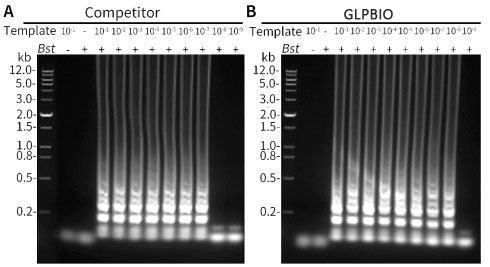
Figure 1. Bst DNA Polymerase, Large Fragment in loop-mediated isothermal amplification. This product or Bst DNA Polymerase, Large Fragment from N Company was used in a 25µl system with different amounts (10-1, 10-2, 10-3, 10-4, 10-5, 10-6, 10-7, 10-8, 10-9 ng) of the CaMV35 promoter of tobacco mosaic virus as a template, 8U of Bst DNA Polymerase, Large Fragment (abbreviated as Bst in Figure 1), and primers: 1.6µM FIP/BIP, 0.2µM F3/B3, 0.4µM LoopF/B, 1.4mM Each dNTP was added to 1X Bst Reaction Buffer supplemented with MgSO4to a final concentration of 8 mM. The reaction was incubated at 65°C for 1 hour, inactivated by heating at 80°C for 20 minutes, and then analyzed by 1.5% agarose gel electrophoresis. As shown in the figure, this product exhibits slightly better or at least equivalent enzyme activity compared to that of Competitor N. M, DNA marker.
Source: The large fragment of Bacillus stearothermophilus DNA Polymerase I was obtained by recombinant expression and purification in Escherichia coli.
Purity: No DNA endonuclease or exonuclease activity.
Applications: DNA isothermal amplification including loop-mediated isothermal amplification (LAMP), helicase isothermal gene amplification (HDA), multiple displacement amplification (MDA), whole genome amplification (WGA), sequencing of GC-rich DNA, rapid sequencing of nanogram-level DNA templates, and library construction and sequencing.
Enzyme Storage Solution: 10mM Tris-HCl (pH 7.5), 50mM KCl, 0.1mM EDTA, 1mM DTT, 0.1% Triton X-100, 50% (v/v) glycerol.
10X Bst Reaction Buffer: 200mM Tris-HCl, 100mM KCl, 100mM (NH4)2SO4, 20mM MgSO4, 1% Triton X-100, pH 8.8 at 25°C.
Inactivation or Inhibition: Heat at 80°C for 20 minutes.
Storage Conditions:
Store at -20°C.
Precautions:
Bst DNA Polymerase, Large Fragment does not have 3'→5' exonuclease activity.
Isothermal amplification reaction temperatures should not exceed 70°C, as this will inactivate the enzyme.
Bst DNA Polymerase, Large Fragment should not be used for thermal cycle sequencing or PCR.
Always include a negative control without template DNA in each isothermal amplification experiment.
This product is for scientific research use only by professionals. It is not intended for clinical diagnosis or treatment, for food or pharmaceutical use, or for storage in residential settings.
For your safety and well-being, please wear a lab coat and disposable gloves when handling.