Ultra High Sensitivity ECL Kit |
| Catalog No.GK10008 |
말린 무를 산화시켜 생성된 화학반응으로 발광하는 루미놀을 기반으로 한 키트로, 염기성 인산효소(HRP)로 표지된 항체 및 그와 관련된 항원을 검출할 수 있습니다.
Products are for research use only. Not for human use. We do not sell to patients.
Sample solution is provided at 25 µL, 10mM.
- Sci China Life Sci (2025):1-17.PMID:39821828
- Plant Physiol 198.1 (2025):kiaf181.PMID:40366207
- Cell Death Dis 15.11 (2024):820.PMID:39532848
- Int J Biol Macromol (2024):133865.PMID:39019356
- Clin Transl Med 14.7 (2024).PMID:39039912
- Int J Biol Macromol (2024):130355.PMID:38395281
- Npj-Precis-Oncol-9.1-(2025):285.PMID:40817404
- Free Radical Biol. Med. (2025).
- Cell Rep 44.10 (2025).PMID:41037404
- Front Cell Dev Biol 10 (2022):850708.PMID:35592246
- J Med Chem 66.18 (2023):13103-13115.PMID:37724909
- Acta Pharmacol Sin (2025):1-15.PMID:39984622
- Biomed Pharmacother 174 (2024):116557.PMID:38583337
- Transl Stroke Res (2024):1-20.PMID:38485864
- Biomacromolecules (2025).PMID:40207885
- Food Funct (2024).PMID:38031758
- Front Pharmacol 13 (2022):1002269.PMID:36339623
- Front Oncol 12 (2022):858598.PMID:35321435
- J Agric Food Chem 70.50 (2022):15763-15775.PMID:36472370
- Front Immunol 16 (2025):1588926.PMID:41112299
- Food Funct (2023).PMID:38031758
- Neural Regen Res 19.9 (2024):2050-2056.PMID:38227535
- J. Agric. Food. Chem. (2025).PMID:40071895
- Int J Mol Med 55.4 (2025):1-16.PMID:39918010
- Nutrients 14.20 (2022):4421.PMID:36297105
- Int Immunopharmacol 118 (2023):110131.PMID:37023700
- Phytother Res (2025).PMID:40754926
- Biochem Pharmacol (2025):117060.PMID:40562119
- Int Immunopharmacol 132 (2024):111962.PMID:38565042
- Front Oncol 12 (2022):858598.PMID:35321435
- Int J Mol Med 55.3 (2025):1-17.
- Int Immunopharmacol 113 (2022):109326.PMID:36252487
- Int Immunopharmacol 132 (2024):111962.PMID:38565042
- Cell Signal (2024):111097.PMID:38355078
- Int Immunopharmacol 142 (2024):113055.PMID:39243556
- Aging (Albany NY) 16.1 (2024):169.PMID:38175693
- Life Sci (2025):123369.PMID:39778763
- Nutrients 16.21 (2024):3785.PMID:39519618
- Bioorg Chem (2024):107812.PMID:39260158
- Aging 16.1 (2024):169-190.PMID:38175693
- Mbio (2024):e02665-24.PMID:39601562
- Biochem Pharmacol (2024):116690.PMID:39617209
- Int Immunopharmacol 142 (2024):113055.PMID:39243556
- Bioorg Chem (2024):107686.PMID:39097730
- Int Immunopharmacol 141 (2024):112918.PMID:39159558
- Sci Rep Uk 13.1 (2023):14339.PMID:37658227
- J Ethnopharmacol (2025):120147. PMID:40517916
- Int Immunopharmacol 167 (2025):115663.PMID:41082840
- Front-Pharmacol-16-(2025):1642515.PMID:40989841
- Bioorg Chem 119 (2022):105469.PMID:34915285
- J Ethnopharmacol (2025):120147.PMID:40517916
- BBA-Mol Cell Res 1869.10 (2022):119323.PMID:35793738
- J Ethnopharmacol 298 (2022):115661.PMID:36002086
- Nutrients 17.13 (2025):2128.
- Toxicology (2022):153336.PMID:36126895
- Int Immunopharmacol 162 (2025):115066.PMID:40580744
- Molecules 28.13 (2023):4984.PMID:37446646
- Bioorg Chem (2025):108329.
- J Ethnopharmacol (2024):118685.PMID:39127116
- Eur J Pharmacol 949 (2023):175725.PMID:37068578
- Front Pharmacol 16 (2025):1576108.PMID:40276603
- Sci Rep-Uk 14.1 (2024):29647.PMID:39609585
- Med Oncol 42.9 (2025):379.PMID:40715657
- Poultry Sci (2025):104753.
- Eur J Pharmacol (2024):177002.PMID:39293571
- Aging (Albany NY) 16.18 (2024):12574.PMID:39237304
- Microbiol Spectr 13.4 (2025):e02561-24.PMID:39945529
- Journal of Inflammation Research (2025):11451-11461.PMID:40860941
- Microorganisms 13.4 (2025):890.
- Front Pharmacol 16 (2025):1562839.PMID:40183104
- Tissue Eng Regen Med (2024):1-8.PMID:39485618
- Sci Rep-Uk 14.1 (2024):1-11.PMID:39609585
- Microbiol Spectr (2025):e02561-24.PMID:39945529
- Cell Signal (2025):111954.PMID:40588013
- Front Oncol 14 (2024):1471109.PMID:39582546
- J Inflamm 22.1 (2025):1-24.PMID:40551105
- TISSUE ENG REGEN MED 22.1 (2025):105-112.PMID:39485618
- Curr Med Chem (2025).PMID:40696546
- Mol Immunol 157 (2023):176-185.PMID:37044043
- Eur J Pharmacol 916 (2022):174729.PMID:34973190
- Bmc Cancer 23.1 (2023):662.PMID:37452291
- Poultry Sci 103.1 (2024):103247.PMID:37980731
- Oncol Rep 49.6 (2023):1-13.PMID:37083067
- Mol Immunol 157 (2023):176-185.PMID:37044043
- J Cancer 15.5 (2024):1429.PMID:38356720
- Metabolites 14.2 (2024):117.PMID:38393010
- Pharm Biol 61.1 (2023):1446-1453.PMID:37675874
- J Inflamm Res (2024):11275-11289.PMID:39720696
- Bioengineered 12.2 (2021):11664-11676.PMID:34872453
- Cardiovasc Drug Ther (2025):1-12.PMID:40402391
- World J Surg Oncol 23.1 (2025):371.PMID:41088273
- Bioengineered 12.1 (2021):7508-7518.PMID:34608841
- Front-Vet-Sci-12-(2025):1672417.PMID:41064262
- Exp Physiol 107.6 (2022):562-574.PMID:35365954
- J Neuropath Exp Neur (2025):nlaf025.PMID:40213876
- Histol Histopathol:18814.PMID:39385610
- Curr Issues Mol Biol 47.5 (2025):372.
- Bioengineered 13.1 (2022):1518-1529.PMID:34986734
- Front Genet 16 (2025):1615018.PMID:41070228
- Pathol Res Pract (2025):156247.PMID:41045764
- J Orthop Surg Res 18.1 (2023):86.PMID:36737821
- Curr Issues Mol Biol 47.5 (2025):372.
- Anal Biochem 682 (2023):115339.PMID:37805041
- Mol Cell Biochem 477.7 (2022):2001-2013.PMID:35394639
- Exp Physiol 107.6 (2022):562-574.PMID:35365954
- Mol Med Rep 24.6 (2021):1-9.PMID:34713293
- Tissue Cell 80 (2023):102001.PMID:36565506
- Dna Cell Biol (2024).PMID:39133103
- Mol Biol Rep 52.1 (2025):212.PMID:39921807
- Brit J Nutr (2025):1-8.PMID:39670658
- Brit J Nutr (2024):1-24.PMID:39670658
- Transplant Direct 11.7 (2025):e1829.PMID:40590007
- Folia Histochem Cyto 61.1 (2023):47-55.PMID:36880682
- Curr Eye Res 49.2 (2024):180-187.PMID:38014534
- Exp Ther Med 28.6 (2024):1-6.PMID:35990977
- Cytotechnology (2024):1-13.PMID:37787035
- J Gastrointest Canc 56.1 (2025):1-21.PMID:40208395
- Theriogenology (2024).PMID:39116655
- CURR MOL MED (2025).PMID:40045860
- Bmc Nephrol 24.1 (2023):314.PMID:37884904
- J Int Med Res 49.3 (2021).PMID:33730930
- Open Life Sci 18.1 (2023):20220570.PMID:36852401
- Am J Transl Res 17.1 (2025):512.PMID:39959193
- Bmc Vet Res 20.1 (2024):357.PMID:39127630
- Poultry Sci 101.10 (2022):102024.PMID:35986948
- Exp Ther Med 27.5 (2024):1-16.
- Nutrients 16.21 (2024):3785.
- Oncol Lett 28.1 (2024):1-13.
- Nutrients 16.13 (2024):2159.
- Heliyon (2024).
- Biochem Bioph Res Co 570 (2021):26-34.PMID:34271433
- Clin Transl Med 14.7 (2024):e1777.
- Nano Today 58 (2024):102411.
- Cells 10.10 (2021):2776.PMID:34685756
- Exp Ther Med 24.3 (2022):1-10.PMID:35978933
- Front Med-Lausanne 11 (2024):1442071.
- Nutrients 15.17 (2023):3799.PMID:37686830
- Carbohyd Polym 306 (2023):120601.PMID:36746570
- Chem-Biol Interact 365 (2022):110080.PMID:35926579
- Front Vet Sci 11 (2024):1486347.
- Scienceasia 48.5 (2022).
- J Hazard Mater (2023):133038.
- Acta Materia Medica 3.3 (2024):289-304.
- Carbohyd Polym (2023):121709.
- Front Immunol 15 (2024):1449975.
- bioRxiv (2022):2022-06.
- Exp Ther Med 25.4 (2023):1-13.PMID:37021067
- Mediat Inflamm 2022 (2022).PMID:36262544
- Int J Biol Macromol (2023):128819.PMID:38104691
- J Inflamm Res (2023):617-637.PMID:36820147
- Biomed Eng Commun 3.4 (2024):19.
- Int J Mol Sci 24.19 (2023):14595.PMID:37834044
- J Inorg Biochem (2024):112515.
- Nat Prod Commun 18.8 (2023):1934578X231194127.
- Nutrients 14.17 (2022):3477.PMID:36079733
- Cell Signal 82 (2021):109966.PMID:33639217
The core principle of ECL reagent detection is the luminescence of the oxidation reaction: Luminol (lumino) is the main component of the luminescence substrate. Under alkaline conditions, it is catalyzed by H2O2 to generate 3-amino ozone. The excited state intermediate of phthalic acid emits photons when it returns to the ground state. The maximum emission wavelength is 425 nm. The photon signal can be captured by X-ray film or CCD imager.
The GlpBio Ultra High Sensitivity ECL kit can oxidize luminol in the presence of HRP and peroxide to detect within the femtogram range of antigens. This reaction produces prolonged chemiluminescence, which can be seen on X-ray film or digital imaging systems. The GlpBio Ultra High Sensitivity ECL kit can produce a powerful, long-lived signal. Coupled with a very low background level, it can extend the exposure time to detect low-abundance proteins.
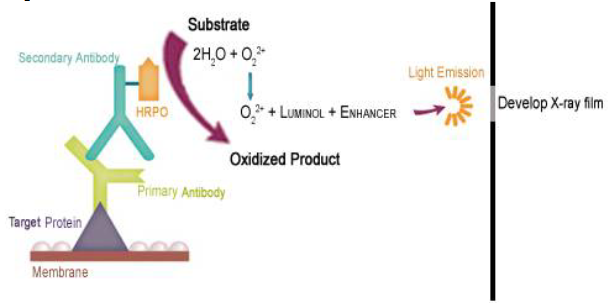
1. Rinse the Western blot membrane after incubation with HRP-labeled antibody.
2. Mix ECL-A solution and ECL-B solution in equal volume ratios to obtain ECL working solution (prepared for use now). About 3-5 ml ECL working solution is needed for every 5cm x 8cm blotting membrane. Note: The suction heads for liquid A and B must be separated.
3. Soak up the liquid on the surface of the blotting membrane on absorbent paper and spread it flat on the plastic membrane.
4. Drop the prepared ECL working solution evenly on the surface of the blotting membrane, and after reacting for about 2 minutes, remove the ECL working solution.
5. Sandwich the blotting film between two layers of plastic film, press X-ray film or put it into the luminescence imager to take pictures.
Precautions:
1. Do not expose the ultra-sensitive ECL chemiluminescence working fluid to sunlight or strong light, otherwise it will be inactivated. It is recommended to protect the working fluid Store in a brown bottle and avoid prolonged exposure to the sun. Laboratory light has little effect on the working fluid.
2. When using the biotin/avidin system, avoid using skimmed milk powder as a blocking liquid, because skimmed milk powder contains a variety of endogenous sources Sex biotin is prone to produce non-specific signals.
3. Use sufficient washing buffer, blocking solution, antibody diluent and substrate working solution to cover the blotting membrane to ensure that the blotting membrane is in a wet state. Using a large amount of blocking solution and washing solution can reduce the generation of non-specific signals.
4. Sodium azide is an inhibitor of HRP enzyme, which will interfere with the reaction system, so avoid using sodium azide as a buffer in the buffer. preservative.
5. After the blotting membrane is incubated with ECL chemiluminescence working solution, the fluorescence emitted within 5-30 minutes is the strongest, and then the fluorescence will follow The extension of time weakened. When the fluorescence of the protein dots is weak, the exposure time can be extended appropriately.
| Components | 200ml | 1000ml |
| Solution A | 100 mL | 100 mL × 5 |
| Solution B | 100 mL | 100 mL × 5 |
| Applications |
Excellent sensitivity-antigen detection from picogram to low femtogram level.
Higher signal-to-noise ratio-precise luminescent substrate, lower background. More beneficial to save antibodies-optimized substrate system, higher antibody binding force. Excellent cost performance-higher performance, lower price. Excellent stability-new oxidant, stable storage for 1 year at room temperature. |
| Shipping | Ship with blue ice |
| Storage Conditions | Store at 4°C, protect away from light, and keep it stable for 1 year. |
| Usage | For research use only! Not for use on humans. |
- View current batch:
-
Related Biological Data

G3BP1 determines IRP2 stability to regulate sodium arsenite-induced ferroptosis.G3BP1 KO cells were treated with 10 μM MG132 for the indicated time. IRP2 was analyzed by immunoblotting. WT cells without any treatment were used as control. The relative level of IRP2 normalized to β-actin was shown in the right histogram.
The protein bands were visualized by adding chemiluminescence reagents (GK10008, GLPBIO).
J Hazard Mater (2023): 133038. PMID: 38118197 IF: 13.6006 -
Related Biological Data

CRP2 promoted osteoblast differentiation in OP mice. (A) The detection of osteogenic markers in the femur using WB (n = 3).
Chemiluminescent detection was performed to collected the visual bands using enhanced chemiluminescence detection reagents (GKl0008; GLPBIO; USA).
Carbohydrate Polymers (2023): 121709. PMID: 38220343 IF: 11.2003 -
Related Biological Data

EuOCP3 treatment reduced JNK phosphorylation,while increasing ERK phosphorylation, thus activating the Nrf2 pathway and downstream factor expression (n = 3).
Protein signals were detected with Ultra-High Sensitivity ECL kits (GK10008; GLPBIO, CA, USA) using a chemiluminescence image analysis system.
Carbohydrate Polymers (2023): 120601. PMID: 36746570 IF: 10.7237 -
Related Biological Data

Western blotting results of IMPDH1 and IMPDH2 proteins expression were found in UCA1 knockdown cells or UCA1 overexpression cells.
Protein concentration was determined by BCA and then separated into 10% SDS-PAGE gels with antibodies for bound protein and ECL blotting system(GLPbio#GK10008) to detect the bands.
Int J Biol Sci 19.8 (2023): 2599. PMID: 37215997 IF: 9.2003 -
Related Biological Data

Proteomics, bioinformatics analysis and biological validation of hematopoietic dysfunction mice.RGP1 (G) increased the expression of IL-16, CD4, Rac2, Hcls1, and Annexin A1 in spleen (n = 3) of mice with hematopoietic dysfunction.
The Ultra High Sensitivity Electrochemiluminescence kit (GK10008; GlpBio) was used to detect the expression of proteins using a gel imaging system.
Int J Biol Macromol (2024): 130355. PMID: 38395281 IF: 8.1996 -
Related Biological Data

BEP2 promotes the expression of CX3CR1 and suppresses microglial activation, accompanied by the re-increase in TGF-β1 levels.The content of CX3CR1, Iba-1 and TGF-β1 in the brain by western blot (n = 3).
After blocking with a rapid closure solution for 60min, the membrane was consecutively incubated with primary and secondary antibodies successively, followed by treatment using Ultra-High Sensitivity electrochemiluminescence immunoassay kits (GK10008; GLPBIO, CA, USA), and detected using an automated chemiluminescence image analysis system.
Int J Biol Macromol (2023): 128819. PMID: 38104691 IF: 8.1996
Average Rating: 5 (Based on Reviews and 30 reference(s) in Google Scholar.)
GLPBIO products are for RESEARCH USE ONLY. Please make sure your review or question is research based.
Required fields are marked with *