


13,14-dihydro-15-keto Prostaglandin E2 (Synonyms: 13,14-dihydro-15-keto PGE2) |
| رقم الكتالوجGC41413 |
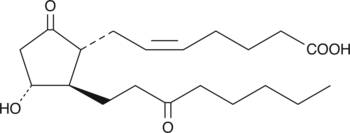
13,14-dihydro-15-keto Prostaglandin E2 (13,14-dihydro-15-keto PGE2) is the primary metabolite of PGE2 in plasma.
Products are for research use only. Not for human use. We do not sell to patients.
Cas No.: 363-23-5
Sample solution is provided at 25 µL, 10mM.
;)
,-1-7$$$37316672.jpg');)
;)
;)
$$$36806353.jpg');)
;33(7)%EF%BC%9A546-561$$$37156877.jpg');)
;)
;)
;)
%201124-1138.$$$35908550.jpg');)
%20766-780.$$$37100057.jpg');)
%20418-432.$$$36893736.jpg');)
%EF%BC%9A-240-255.$$$35108512.jpg');)
533-545$$$36543525.jpg');)
%201-13.$$$36600053.jpg');)
;)
13,14-dihydro-15-keto Prostaglandin E2 (13,14-dihydro-15-keto PGE2) is the primary metabolite of PGE2 in plasma.[1] Endogenous or infused PGE2 is rapidly metabolized by the enzymes 15-hydroxy PGDH and 15-oxo-PG δ13-reductase to form 13,14-dihydro-15-keto PGE2. 13,14-dihydro-15-keto PGE2 accumulates to detectable levels; plasma levels in humans are between 10-100 pg/ml.[1][2] It undergoes further metabolism and chemical decomposition, giving it a relatively short half-life. In dogs, the plasma half-life of 13,14-dihydro-15-keto PGE2 is about 9 minutes.[3] In humans the metabolite has a similar short half-life, making it a poor choice of analytes for assays designed to measure total PGE2 biosynthesis. [4][5]
Reference:
[1]. Hamberg, M., and Samuelsson, B. On the metabolism of prostaglandins E1 and E2 in man. J. Biol. Chem. 246(22), 6713-6721 (1971).
[2]. Fitzpatrick, F.A., Aguirre, R., Pike, J.E., et al. The stability of 13,14-dihydro-15 keto-PGE2. Prostaglandins 19(6), 917-931 (1980).
[3]. Bothwell, W., Verburg, M., Wynalda, M., et al. A radioimmunoassay for the unstable pulmonary metabolites of prostaglandin E1 and E2: An indirect index of their in vivo disposition and pharmacokinetics. J. Pharmacol. Exp. Ther. 220(2), 229-235 (1982).
[4]. Leonhardt, A., Krauss, M., Gieler, U., et al. In vivo formation of prostaglandin E1 and prostaglandin E2 in atopic dermatitis. Br. J. Dermatol. 136(3), 337-340 (1997).
[5]. Granström, E., Hamberg, M., Hansson, G., et al. Chemical instability of 15-keto-13,14-dihydro-PGE2: The reason for low assay reliability. Prostaglandins 19(6), 933-945 (1980).


Average Rating: 5 (Based on Reviews and 21 reference(s) in Google Scholar.)
GLPBIO products are for RESEARCH USE ONLY. Please make sure your review or question is research based.
Required fields are marked with *