

Acrylodan |
رقم الكتالوجGC61505
 One-Click Copy Product Info
|

الأكريلودان ، المتفاعل مع الثيول ، حساس للديناميكيات البيئية المحلية ثنائية القطب داخل جيب الربط المحيط بـ Cys34
Products are for research use only. Not for human use. We do not sell to patients.
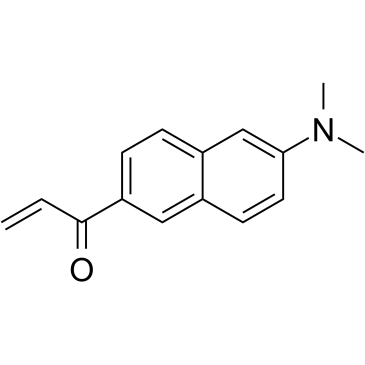
Cas No.: 86636-92-2
Sample solution is provided at 25 µL, 10mM.
_1-3.$$$39978408@51.jpg');)
_1-9.$$$38538795@65.jpg');)
_1-9.$$$39112701@51.jpg');)
_1-7.$$$37316672@70.jpg');)
_366-372.$$$36198801@70.jpg');)
.$$$38565142@65.jpg');)
_1867-1883.$$$33248023@67.jpg');)
_eads6055.$$$39977546@45.jpg');)
_eadm9805.$$$40080571@45.jpg');)
_eadj3020.$$$39666821@45.jpg');)
_1-20.$$$39757301@28.jpg');)
_1-24.$$$38898113@28.jpg');)
_273-287.$$$36806353@46.jpg');)
_1-16.$$$37156877@44.jpg');)
_1-19.$$$37460805@44.jpg');)
_1291-1307.$$$34518654@46.jpg');)
Acrylodan, reacted with thiols, is sensitive to the local environmental dipolarity and dynamics within the binding pocket surrounding Cys34[1][2].
Guidelines (Following is our recommended protocol. This protocol only provides a guideline, and should be modified according to your specific needs).Purification and Labeling of Act1: 1.20-fold molar excess of acrylodan (Anaspec) was added to the polymerized actin and incubated on ice overnight. 2.The labeled actin is centrifuged (2 h, 4 °C, 100,000 × g) then the pellet was resuspended in 10 mm Tris, pH 7.5, 0.5 mm β-mercaptoethanol, 0.2 mm CaCl2, 50 μm ATP and dialyzed against the same buffer for 70 h at 4 °C. 3.The supernatant was collected and the actin concentration and degree of labeling were calculated using the extinction coefficient 26,600 M-1 cm-1 for actin at 290 nm, 18,500 M-1 cm-1 or acrylodan at 385 nm, and 71,000 M-1 cm-1 for Alexa Fluor 488 at 494 nm. 4.Acrylodan-labeled Act1 (AcrylAct1NAT) is dramatically different than that of EDTA-unfolded AcrylAct1 (AcrylAct1I3), which has a very similar emission spectrum to CCT-bound AcrylAct1.
[1]. Sarah F Stuart, et al. A two-step mechanism for the folding of actin by the yeast cytosolic chaperonin. J Biol Chem. 2011 Jan 7;286(1):178-84. [2]. K Flora, et al. Unfolding of acrylodan-labeled human serum albumin probed by steady-state and time-resolved fluorescence methods. Biophys J. 1998 Aug;75(2):1084-96.
| Cas No. | 86636-92-2 | SDF | |
| Canonical SMILES | C=CC(C1=CC=C2C=C(C=CC2=C1)N(C)C)=O | ||
| Formula | C15H15NO | M.Wt | 225.29 |
| الذوبان | DMSO : 50 mg/mL (221.94 mM; Need ultrasonic) | Storage | Store at -20°C |
| General tips | Please select the appropriate solvent to prepare the stock solution according to the
solubility of the product in different solvents; once the solution is prepared, please store it in
separate packages to avoid product failure caused by repeated freezing and thawing.Storage method
and period of the stock solution: When stored at -80°C, please use it within 6 months; when stored
at -20°C, please use it within 1 month. To increase solubility, heat the tube to 37°C and then oscillate in an ultrasonic bath for some time. |
||
| Shipping Condition | Evaluation sample solution: shipped with blue ice. All other sizes available: with RT, or with Blue Ice upon request. | ||
| Prepare stock solution | |||

|
1 mg | 5 mg | 10 mg |
| 1 mM | 4.4387 mL | 22.1936 mL | 44.3872 mL |
| 5 mM | 887.7 μL | 4.4387 mL | 8.8774 mL |
| 10 mM | 443.9 μL | 2.2194 mL | 4.4387 mL |
Step 1: Enter information below (Recommended: An additional animal making an allowance for loss during the experiment)
 g
μL
g
μL
Step 2: Enter the in vivo formulation (This is only the calculator, not formulation. Please contact us first if there is no in vivo formulation at the solubility Section.)
Calculation results:
Working concentration: mg/ml;
Method for preparing DMSO master liquid: mg drug pre-dissolved in μL DMSO ( Master liquid concentration mg/mL, Please contact us first if the concentration exceeds the DMSO solubility of the batch of drug. )
Method for preparing in vivo formulation: Take μL DMSO master liquid, next addμL PEG300, mix and clarify, next addμL Tween 80, mix and clarify, next add μL saline, mix and clarify.
Method for preparing in vivo formulation: Take μL DMSO master liquid, next add μL Corn oil, mix and clarify.
Note: 1. Please make sure the liquid is clear before adding the next solvent.
2. Be sure to add the solvent(s) in order. You must ensure that the solution obtained, in the previous addition, is a clear solution before proceeding to add the next solvent. Physical methods such as vortex, ultrasound or hot water bath can be used to aid dissolving.
3. All of the above co-solvents are available for purchase on the GlpBio website.
Quality Control & SDS
- View current batch:
- Purity: >98.00% Appearance: A solid
- COA (Certificate of Analysis)
- SDS (Safety Data Sheet)
- Datasheet
Average Rating: 5 (Based on Reviews and 3 reference(s) in Google Scholar.)