

BAY-3827 |
رقم الكتالوجGC67772
 One-Click Copy Product Info
|

BAY-3827 is a potent and selective AMP-activated protein kinase (AMPK) inhibitor with IC50 values of 1.4nM at low ATP concentration (10µM) and 15nM at high ATP concentration (2mM).
Products are for research use only. Not for human use. We do not sell to patients.
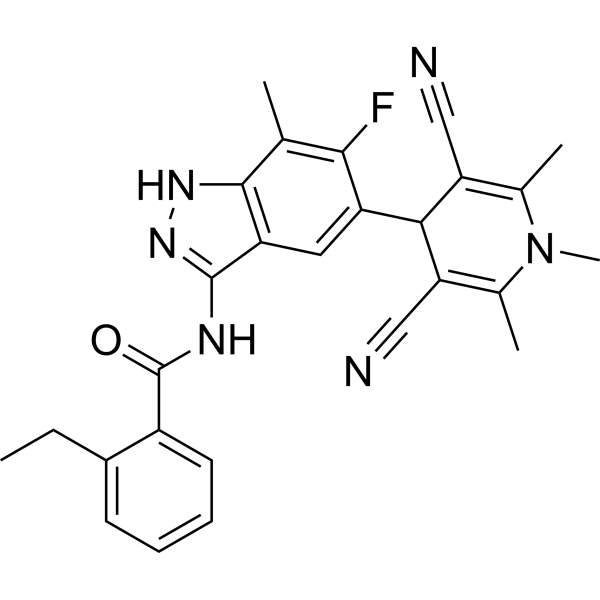
Cas No.: 2377576-35-5
Sample solution is provided at 25 µL, 10mM.
_1-3.$$$39978408@51.jpg');)
_1-9.$$$38538795@65.jpg');)
_1-9.$$$39112701@51.jpg');)
_1-7.$$$37316672@70.jpg');)
_366-372.$$$36198801@70.jpg');)
.$$$38565142@65.jpg');)
_1867-1883.$$$33248023@67.jpg');)
_eads6055.$$$39977546@45.jpg');)
_eadm9805.$$$40080571@45.jpg');)
_eadj3020.$$$39666821@45.jpg');)
_1-20.$$$39757301@28.jpg');)
_1-24.$$$38898113@28.jpg');)
_273-287.$$$36806353@46.jpg');)
_1-16.$$$37156877@44.jpg');)
_1-19.$$$37460805@44.jpg');)
_1291-1307.$$$34518654@46.jpg');)
BAY-3827 is a potent and selective AMP-activated protein kinase (AMPK) inhibitor with IC50 values of 1.4nM at low ATP concentration (10µM) and 15nM at high ATP concentration (2mM)[1]. AMPK is a global sensor of cellular energy levels and a key regulator of nutrient metabolism[2]. BAY-3827 inhibits the phosphorylation of acetyl-CoA carboxylase (ACC)[3].
In vitro, treatment of human prostate cancer cell lines (LNCaP, VCaP cells) with BAY-3827 (1nM) for 24h or 48h downregulated the expression of multiple genes involved in lipid metabolism, such as LIPE, PRKAR2B, AKT3, and CPT1 family members[4]. Pretreatment of cardiac fibroblasts (HCFs) with BAY-3827 (500nM) for 1h effectively eliminated the phosphorylation of intracellular acetyl-CoA carboxylase (ACC) induced by SGLT2i[5]. Treatment of corneal epithelial cells infected with Pseudomonas aeruginosa (PA) with BAY-3827 (10µM) significantly reduced the levels of inflammatory markers IL-6 and IL-8 in the cells[6].
In vivo, stereotactic injection of BAY-3827 (5µL, 100µM) into neurotrophic tyrosine kinase receptor 1 (NTRK1) knockdown mice exacerbated the impairment of working memory and reference memory, and exacerbated depressive-like behavior[7].
References:
[1] Lemos C, Schulze V K, Baumgart S J, et al. The potent AMPK inhibitor BAY-3827 shows strong efficacy in androgen-dependent prostate cancer models[J]. Cellular Oncology, 2021, 44(3): 581-594.
[2] He L, Zhou X, Huang N, et al. AMPK regulation of glucose, lipid and protein metabolism: mechanisms and nutritional significance[J]. Current Protein and Peptide Science, 2017, 18(6): 562-570.
[3] Strang J E, Astridge D D, Nguyen V T, et al. Small molecule modulators of AMP-activated protein kinase (AMPK) activity and their potential in cancer therapy[J]. Journal of Medicinal Chemistry, 2025, 68(3): 2238-2254.
[4] Lemos C, Schulze V K, Baumgart S J, et al. The Potent and Selective AMPK Inhibitor BAY-3827 Shows Strong Efficacy in Androgen-Dependent Prostate Cancer Models[J]. 2020.
[5] Baufays C, Cumps J, Dufeys C, et al. Comparison of the Effects of Sodium-Glucose Cotransporter 2 Inhibitors on Cardiac Fibroblast Properties[J]. International Journal of Molecular Sciences, 2025, 26(20): 10098.
[6] Cao D W, Ramachandran R A, Robertson D M. AMPK modulates mitochondrial homeostasis during Pseudomonas aeruginosa infection in corneal epithelial cells[J]. Investigative Ophthalmology & Visual Science, 2024, 65(7): 1971-1971.
[7] Yang K, Wu J, Li S, et al. NTRK1 knockdown induces mouse cognitive impairment and hippocampal neuronal damage through mitophagy suppression via inactivating the AMPK/ULK1/FUNDC1 pathway[J]. Cell Death Discovery, 2023, 9(1): 404.
| Cell experiment [1]: | |
Cell lines | LNCaP、VCaP cells |
Preparation Method | LNCaP and VCaP cells were treated with 1nM R1881, enzalutamide or BAY-3827, as indicated for 24 or 48h. RNA was extracted using the RNeasy Plus Mini kit. Synthesis of cDNA was performed with the SuperScript® III First Strand Synthesis SuperMix for qRT-PCR. Analysis was performed using the RT2 Proler™ PCR Array Human AMPK Signaling 330231. |
Reaction Conditions | 1nM; 24, 48h |
Applications | BAY-3827 regulates the expression of several genes involved in lipid metabolism such as LIPE, PRKAR2B, AKT3 and CPT1 family members. |
| Animal experiment [2]: | |
Animal models | C57BL/6J mice |
Preparation Method | 24 mice were divided randomly into the control group, the sh-NC group, the sh-NTRK1 group, and the sh-NTRK1+BAY-3827 group (n=6 in each group). The mice in the control group, the sh-NC group, and the shNTRK1 group were treated as described in the “Mouse transfection through brain stereotactic injection” section. BAY-3827, a selective inhibitor of AMPK, dispersed in PBS to prepare a concentration of 100µM. Next, the mice in the sh-NTRK1+BAY-3827 group were administered a brain stereotactic injection of BAY-3827 (5µL per mouse). After 1h, the mice were injected with the lentivirus carrying shRNA-NTRK1. All mice were then maintained for two weeks. |
Dosage form | 5µL, 100µM; brain stereotactic injection |
Applications | The treatment with BAY-3827 exacerbated the mouse depressive-like behavior induced by NTRK1 knockdown. |
References: | |
| Cas No. | 2377576-35-5 | SDF | |
| Formula | C27H25FN6O | M.Wt | 468.53 |
| الذوبان | DMSO : 25 mg/mL (53.36 mM; ultrasonic and warming and heat to 60°C) | Storage | 4°C, protect from light |
| General tips | Please select the appropriate solvent to prepare the stock solution according to the
solubility of the product in different solvents; once the solution is prepared, please store it in
separate packages to avoid product failure caused by repeated freezing and thawing.Storage method
and period of the stock solution: When stored at -80°C, please use it within 6 months; when stored
at -20°C, please use it within 1 month. To increase solubility, heat the tube to 37°C and then oscillate in an ultrasonic bath for some time. |
||
| Shipping Condition | Evaluation sample solution: shipped with blue ice. All other sizes available: with RT, or with Blue Ice upon request. | ||
| Prepare stock solution | |||

|
1 mg | 5 mg | 10 mg |
| 1 mM | 2.1343 mL | 10.6717 mL | 21.3434 mL |
| 5 mM | 426.9 μL | 2.1343 mL | 4.2687 mL |
| 10 mM | 213.4 μL | 1.0672 mL | 2.1343 mL |
Step 1: Enter information below (Recommended: An additional animal making an allowance for loss during the experiment)
 g
μL
g
μL
Step 2: Enter the in vivo formulation (This is only the calculator, not formulation. Please contact us first if there is no in vivo formulation at the solubility Section.)
Calculation results:
Working concentration: mg/ml;
Method for preparing DMSO master liquid: mg drug pre-dissolved in μL DMSO ( Master liquid concentration mg/mL, Please contact us first if the concentration exceeds the DMSO solubility of the batch of drug. )
Method for preparing in vivo formulation: Take μL DMSO master liquid, next addμL PEG300, mix and clarify, next addμL Tween 80, mix and clarify, next add μL saline, mix and clarify.
Method for preparing in vivo formulation: Take μL DMSO master liquid, next add μL Corn oil, mix and clarify.
Note: 1. Please make sure the liquid is clear before adding the next solvent.
2. Be sure to add the solvent(s) in order. You must ensure that the solution obtained, in the previous addition, is a clear solution before proceeding to add the next solvent. Physical methods such as vortex, ultrasound or hot water bath can be used to aid dissolving.
3. All of the above co-solvents are available for purchase on the GlpBio website.
Quality Control & SDS
- View current batch:
- Purity: >98.00% Appearance: A solid
- COA (Certificate of Analysis)
- SDS (Safety Data Sheet)
- Datasheet
Average Rating: 5 (Based on Reviews and 30 reference(s) in Google Scholar.)