

BAY1125976 |
رقم الكتالوجGC19484
 One-Click Copy Product Info
|

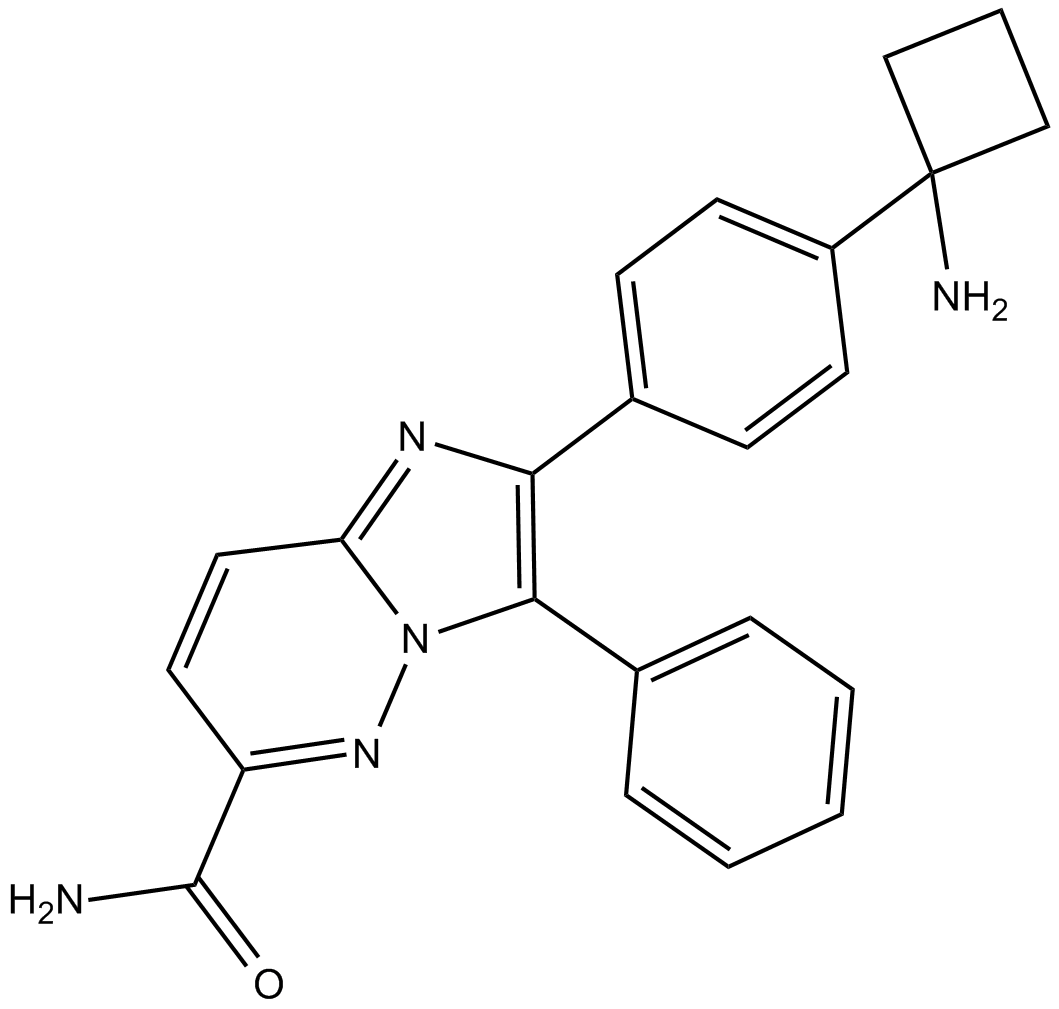
BAY1125769 هو مثبط انتقائي Akt1 / Akt2 ؛ يثبط نشاط Akt1 و Akt2 بقيم IC50 البالغة 5.2 نانومتر و 18 نانومتر عند 10 ميكرومتر ATP ، على التوالي.
Products are for research use only. Not for human use. We do not sell to patients.
Cas No.: 1402608-02-9
Sample solution is provided at 25 µL, 10mM.
_1-3.$$$39978408@51.jpg');)
_1-9.$$$38538795@65.jpg');)
_1-9.$$$39112701@51.jpg');)
_1-7.$$$37316672@70.jpg');)
_366-372.$$$36198801@70.jpg');)
.$$$38565142@65.jpg');)
_1867-1883.$$$33248023@67.jpg');)
_eads6055.$$$39977546@45.jpg');)
_eadm9805.$$$40080571@45.jpg');)
_eadj3020.$$$39666821@45.jpg');)
_1-20.$$$39757301@28.jpg');)
_1-24.$$$38898113@28.jpg');)
_273-287.$$$36806353@46.jpg');)
_1-16.$$$37156877@44.jpg');)
_1-19.$$$37460805@44.jpg');)
_1291-1307.$$$34518654@46.jpg');)
BAY1125976 is a selective allosteric Akt1/Akt2 inhibitor; inhibits Akt1 and Akt2 activity with IC50 values of 5.2 nM and 18 nM at 10 μM ATP, respectively.
BAY 1125976 is equally potent against Akt1 (IC50=5.2 nM at 10 μM ATP and 44 nM at 2 mM ATP) and Akt2 (IC50=18 nM at 10 μM ATP and 36 nM at 2 mM ATP) isoforms and up to 86 fold less potent against Akt3 (IC50=427 nM at 10 μM ATP). It inhibits the Akt1 and Akt2 by binding into an allosteric binding pocket formed by kinase and PH domain. It inhibits cell proliferation in a broad panel of human cancer cell lines, particularly in breast and prostate cancer cell lines expressing estrogen or androgen receptors. It effectively blocks Akt signaling by inhibiting the phosphorylation of Akt and the downstream effectors, including eukaryotic translation initiation factor 4E binding protein 1 (4E-BP1), glycogen synthase kinase 3 beta (GSK3s), proline-rich Akt substrate 40 kDa (PRAS40), S6 ribosomal protein (S6RP), and 70 kDa ribosomal protein S6 kinase 1 (70S6K)[1].
BAY 1125976 targets tumors displaying activation of the PI3K/Akt/mTOR pathway. BAY 1125976 exhibits strong in vivo efficacy in both cell line and patient-derived xenograft models such as the KPL4 breast cancer model (PIK3CAH1074R mutant), the MCF7 and HBCx-2 breast cancer models, and the AktE17K mutant driven prostate cancer (LAPC-4) and anal cancer (AXF 984) models[1].
Reference:
[1]. Politz O, et al. BAY 1125976, a selective allosteric AKT1/2 inhibitor, exhibits high efficacy on AKT signaling-dependent tumor growth in mouse models. Int J Cancer. 2017 Jan 15;140(2):449-459.
|
Kinase experiment: |
PEG/water (60/40), pH 4.0, is used as a vehicle for BAY 1125976. The selectivity of BAY 1125976 is assessed using two different kinase panels: the 230 kinase panel; and the 468 kinase panel. In the 230 kinase panel, kinase activity is determined after incubation with 10 μM BAY 1125976. An additional incubation with 1 μM and 0.1 μM BAY 1125976 is performed for the kinases where 10 μM BAY 1125976 shows an inhibition over 70%. All tests are performed at 10 μM ATP. The 468-kinase panel covered AGC, CAMK, CMGC, CK1, STE, TK, TKL, lipid, and atypical kinase families. The profiling is performed by combining the test compound with DNA-tagged kinase and immobilized ligands. The final kinase concentrations are measured by quantitative PCR[1]. |
|
Animal experiment: |
Mice: Female NMRI (nu/nu) mice s.c. injected with 3 x 10⁶/100 μL KPL-4 breast cancer cells are used to study the mode-of-action of BAY 1125976. The treatment is started when tumors reaches 232-358 mm3 in size and the mice receive a single oral dose of 25 or 50 mg/kg BAY 1125976. For determination of plasma concentration-time profiles, blood is drawn from the animals at different time points after compound administration[1]. |
|
References: [1]. Politz O, et al. BAY 1125976, a selective allosteric AKT1/2 inhibitor, exhibits high efficacy on AKT signaling-dependent tumor growth in mouse models. Int J Cancer. 2017 Jan 15;140(2):449-459. |
|
| Cas No. | 1402608-02-9 | SDF | |
| Canonical SMILES | O=C(C1=NN2C(C=C1)=NC(C3=CC=C(C4(N)CCC4)C=C3)=C2C5=CC=CC=C5)N | ||
| Formula | C₂₃H₂₁N₅O | M.Wt | 383.45 |
| الذوبان | DMF: 5mg/mL,DMF:PBS (pH 7.2) (1:3): 0.25mg/mL,DMSO: DMSO : 25 mg/mL (65.20 mM) | Storage | Store at -20°C |
| General tips | Please select the appropriate solvent to prepare the stock solution according to the
solubility of the product in different solvents; once the solution is prepared, please store it in
separate packages to avoid product failure caused by repeated freezing and thawing.Storage method
and period of the stock solution: When stored at -80°C, please use it within 6 months; when stored
at -20°C, please use it within 1 month. To increase solubility, heat the tube to 37°C and then oscillate in an ultrasonic bath for some time. |
||
| Shipping Condition | Evaluation sample solution: shipped with blue ice. All other sizes available: with RT, or with Blue Ice upon request. | ||
| Prepare stock solution | |||

|
1 mg | 5 mg | 10 mg |
| 1 mM | 2.6079 mL | 13.0395 mL | 26.079 mL |
| 5 mM | 521.6 μL | 2.6079 mL | 5.2158 mL |
| 10 mM | 260.8 μL | 1.304 mL | 2.6079 mL |
Step 1: Enter information below (Recommended: An additional animal making an allowance for loss during the experiment)
 g
μL
g
μL
Step 2: Enter the in vivo formulation (This is only the calculator, not formulation. Please contact us first if there is no in vivo formulation at the solubility Section.)
Calculation results:
Working concentration: mg/ml;
Method for preparing DMSO master liquid: mg drug pre-dissolved in μL DMSO ( Master liquid concentration mg/mL, Please contact us first if the concentration exceeds the DMSO solubility of the batch of drug. )
Method for preparing in vivo formulation: Take μL DMSO master liquid, next addμL PEG300, mix and clarify, next addμL Tween 80, mix and clarify, next add μL saline, mix and clarify.
Method for preparing in vivo formulation: Take μL DMSO master liquid, next add μL Corn oil, mix and clarify.
Note: 1. Please make sure the liquid is clear before adding the next solvent.
2. Be sure to add the solvent(s) in order. You must ensure that the solution obtained, in the previous addition, is a clear solution before proceeding to add the next solvent. Physical methods such as vortex, ultrasound or hot water bath can be used to aid dissolving.
3. All of the above co-solvents are available for purchase on the GlpBio website.
Quality Control & SDS
- View current batch:
- Purity: >99.50% Appearance: A solid
- COA (Certificate of Analysis)
- SDS (Safety Data Sheet)
- Datasheet
Average Rating: 5 (Based on Reviews and 23 reference(s) in Google Scholar.)