

CC-401 hydrochloride |
رقم الكتالوجGC14197
 One-Click Copy Product Info
|

A potent, specific pan-JNK inhibitor
Products are for research use only. Not for human use. We do not sell to patients.
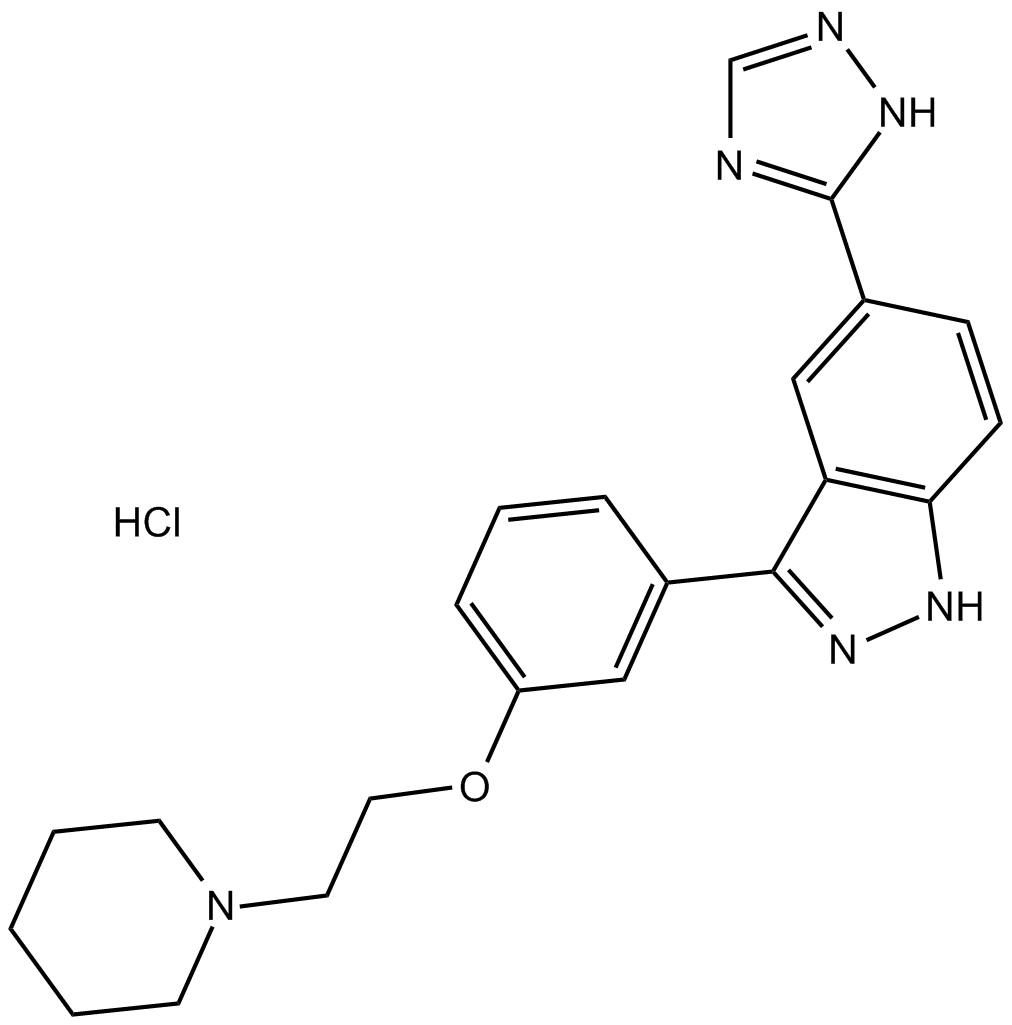
Cas No.: 1438391-30-0
Sample solution is provided at 25 µL, 10mM.
_1-3.$$$39978408@51.jpg');)
_1-9.$$$38538795@65.jpg');)
_1-9.$$$39112701@51.jpg');)
_1-7.$$$37316672@70.jpg');)
_366-372.$$$36198801@70.jpg');)
.$$$38565142@65.jpg');)
_1867-1883.$$$33248023@67.jpg');)
_eads6055.$$$39977546@45.jpg');)
_eadm9805.$$$40080571@45.jpg');)
_eadj3020.$$$39666821@45.jpg');)
_1-20.$$$39757301@28.jpg');)
_1-24.$$$38898113@28.jpg');)
_273-287.$$$36806353@46.jpg');)
_1-16.$$$37156877@44.jpg');)
_1-19.$$$37460805@44.jpg');)
_1291-1307.$$$34518654@46.jpg');)
CC-401 hydrochloride is a potent inhibitor of all three forms of JNK with Ki of 25 to 50 nM.
CC-401 has at least 40-fold selectivity for JNK compared with other related kinases, including p38, extracellular signal-regulated kinase (ERK), inhibitor of κB kinase (IKK2), protein kinase C, Lck, zeta-associated protein of 70 kDa (ZAP70). In cell-based assays, 1 to 5 μM CC-401 provides specific JNK inhibition. CC-401, a small molecule that is a specific inhibitor of all three JNK isoforms. CC-401 competitively binds the ATP binding site in JNK, resulting in inhibition of the phosphorylation of the N-terminal activation domain of the transcription factor c-Jun. The specificity of this inhibitor is tested in vitro using osmotic stress of the HK-2 human tubular epithelial cell line. CC-401 inhibits sorbitol-induced phosphorylation of c-Jun in a dosage-dependent manner. However, CC-401 does not prevent sorbitol-induced phosphorylation of JNK, p38, or ERK[1].
The staining of p-JNK is moderately induced in bevazicumab and Oxaliplatin treatments as compared to control, and in the CC-401-treated samples p-cJun content is significantly lower, consistent with effective JNK inhibition. DNA damage is modestly elevated in combined treatments with CC-401[2]. CC-401 treatment from days 7 to 24 slows the progression of proteinuria, which is significantly reduced compared to the no-treatment and vehicle groups at days 14 and 21. However, there is still an increase in the degree of proteinuria at day 21 in CC-401-treated rats compared to proteinuria at day 5. The vehicle and no-treatment groups developed renal impairment at day 24 as shown by an increase in serum creatinine. This is prevented by CC-401 treatment[3].
Reference:
[1]. Ma FY, et al. A pathogenic role for c-Jun amino-terminal kinase signaling in renal fibrosis and tubular cell apoptosis. J Am Soc Nephrol. 2007 Feb;18(2):472-84.
[2]. Vasilevskaya IA, et al. Inhibition of JNK Sensitizes Hypoxic Colon Cancer Cells to DNA-Damaging Agents. Clin Cancer Res. 2015 Sep 15;21(18):4143-52.
[3]. Ma FY, et al. Blockade of the c-Jun amino terminal kinase prevents crescent formation and halts established anti-GBM glomerulonephritis in the rat. Lab Invest. 2009 Apr;89(4):470-84.
Cell experiment: | Human HK-2 proximal tubular epithelial cells are cultured in DMEM/F12 media supplemented with 10% FCS, 10 ng/mL EGF, and 10 μg/mL bovine pituitary extract. For Western blot studies, cells are seeded into six-well plates and allowed to adhere overnight, and medium is changed to DMEM/F12 supplemented with only 0.5% FCS for 24 h, by which time cells are confluent. CC-401 is prepared in citric acid (pH 5.5) and added to the confluent cells 1 h before the addition of 300 mM sorbitol, and cells are harvested 30 min later using urea-RIPA buffer. Three experiments are performed, each with two replicates per condition. For ELISA experiments, HK-2 cells are seeded into 24-well plates, allowed to adhere overnight, cultured in DMEM/F12 with 0.5% FCS for 24 h, and then incubated with CC-401 or vehicle for 60 min before stimulation with 1 μM Angiotensin II (AngII). Supernatants are harvested 48 h later and assayed for TGF-β1 content using a commercial ELISA kit. Three experiments are performed, each using six replicates per condition[1]. |
Animal experiment: | Mice[2] To assess the efficacy of JNK signaling inhibition by CC-401 in anti-angiogenic and Oxaliplatin combination therapy in a mouse xenograft model, adult (8-10 weeks of age) female severe combined immunodeficient mice (C.B.17 SCID) are used. To generate tumors, HT29 cells (1×10⁶ cells) are injected subcutaneously into the left flank of the mice. When the tumors reached approximately 200 mm3, mice are divided into eight groups (eight mice per group) for treatment with Bevacizumab, Oxaliplatin, CC401, and the appropriate combinations of Bevacizumab, Oxaliplatin and CC-401. Mice in the Bevacizumab treatment group receive 5 mg/kg of Bevacizumab by intraperitoneal injection every 3 days for 21 days. The Oxaliplatin treatment group is injected intraperitoneally with 5 mg/kg Oxaliplatin per week for 2 weeks. The CC-401 treatment group is injected intraperitoneally 25 mg/kg for every 3 days. The combination treatment groups receive Bevacizumab (every 3 days, 5 mg/kg), Oxaliplatin (weekly for 2 weeks, 5 mg/kg), and CC-401 (every 3 days, 25 mg/kg). The control group receive saline intraperitoneally. Tumor volume and body weight are measured every 3 days. Tumor volume is calculated. Tumor growth delay is calculated as the difference in the time for control and treated tumors to grow from 200 to 800 mm3. For tumor growth delay calculations, mice are continued to receive treatments till the tumor volume reached 800 mm3. For immunohistochemistry mice are sacrificed after treatments on day 9 for tumor processing and staining. Rats[3] Female WKY rats (180-220 g) are used. Groups of 9 or 10 rats are immunized by subcutaneous injection of 5 mg of sheep IgG in Freund's complete adjuvant followed 5 days later (termed day 0) by a tail vein injection of sheep anti-rat GBM serum. In this study, CC-401 (200 mg/kg/b.i.d. by oral gavage) or vehicle (sodium citrate) treatment is initiated in groups of 9 or 10 rats at 7 days after anti-GBM serum administration and continued twice daily thereafter until animals are killed at day 24. Additional groups of rats without treatment are killed at day 7 or day 24 after anti-GBM serum injection as controls. Animals are housed in metabolic cages for 22 hours to collect urine on days 5, 14, and 21. Blood is collected at the time of death. Analysis of serum creatinine and urinary protein are performed. |
References: [1]. Ma FY, et al. A pathogenic role for c-Jun amino-terminal kinase signaling in renal fibrosis and tubular cell apoptosis. J Am Soc Nephrol. 2007 Feb;18(2):472-84. | |
| Cas No. | 1438391-30-0 | SDF | |
| Chemical Name | 3-[3-(2-piperidin-1-ylethoxy)phenyl]-5-(1H-1,2,4-triazol-5-yl)-1H-indazole hydrochloride | ||
| Canonical SMILES | C1CCN(CC1)CCOC2=CC=CC(=C2)C3=NNC4=C3C=C(C=C4)C5=NC=NN5.Cl | ||
| Formula | C22H25ClN6O | M.Wt | 424.93 |
| الذوبان | Soluble in DMSO | Storage | Store at -20°C |
| General tips | Please select the appropriate solvent to prepare the stock solution according to the
solubility of the product in different solvents; once the solution is prepared, please store it in
separate packages to avoid product failure caused by repeated freezing and thawing.Storage method
and period of the stock solution: When stored at -80°C, please use it within 6 months; when stored
at -20°C, please use it within 1 month. To increase solubility, heat the tube to 37°C and then oscillate in an ultrasonic bath for some time. |
||
| Shipping Condition | Evaluation sample solution: shipped with blue ice. All other sizes available: with RT, or with Blue Ice upon request. | ||
| Prepare stock solution | |||

|
1 mg | 5 mg | 10 mg |
| 1 mM | 2.3533 mL | 11.7666 mL | 23.5333 mL |
| 5 mM | 470.7 μL | 2.3533 mL | 4.7067 mL |
| 10 mM | 235.3 μL | 1.1767 mL | 2.3533 mL |
Step 1: Enter information below (Recommended: An additional animal making an allowance for loss during the experiment)
 g
μL
g
μL
Step 2: Enter the in vivo formulation (This is only the calculator, not formulation. Please contact us first if there is no in vivo formulation at the solubility Section.)
Calculation results:
Working concentration: mg/ml;
Method for preparing DMSO master liquid: mg drug pre-dissolved in μL DMSO ( Master liquid concentration mg/mL, Please contact us first if the concentration exceeds the DMSO solubility of the batch of drug. )
Method for preparing in vivo formulation: Take μL DMSO master liquid, next addμL PEG300, mix and clarify, next addμL Tween 80, mix and clarify, next add μL saline, mix and clarify.
Method for preparing in vivo formulation: Take μL DMSO master liquid, next add μL Corn oil, mix and clarify.
Note: 1. Please make sure the liquid is clear before adding the next solvent.
2. Be sure to add the solvent(s) in order. You must ensure that the solution obtained, in the previous addition, is a clear solution before proceeding to add the next solvent. Physical methods such as vortex, ultrasound or hot water bath can be used to aid dissolving.
3. All of the above co-solvents are available for purchase on the GlpBio website.
Quality Control & SDS
- View current batch:
- Purity: >99.50% Appearance: A solid
- COA (Certificate of Analysis)
- SDS (Safety Data Sheet)
- Datasheet
Average Rating: 5 (Based on Reviews and 30 reference(s) in Google Scholar.)