

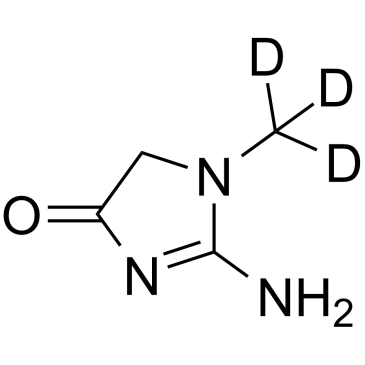
Creatinine-D3 |
رقم الكتالوجGC39366
 One-Click Copy Product Info
|

الكرياتينين D3 (NSC13123-D3) هو ديوتيريوم يسمى الكرياتينين
Products are for research use only. Not for human use. We do not sell to patients.
Cas No.: 143827-20-7
Sample solution is provided at 25 µL, 10mM.
_1-3.$$$39978408@51.jpg');)
_1-9.$$$38538795@65.jpg');)
_1-9.$$$39112701@51.jpg');)
_1-7.$$$37316672@70.jpg');)
_366-372.$$$36198801@70.jpg');)
.$$$38565142@65.jpg');)
_1867-1883.$$$33248023@67.jpg');)
_eads6055.$$$39977546@45.jpg');)
_eadm9805.$$$40080571@45.jpg');)
_eadj3020.$$$39666821@45.jpg');)
_1-20.$$$39757301@28.jpg');)
_1-24.$$$38898113@28.jpg');)
_273-287.$$$36806353@46.jpg');)
_1-16.$$$37156877@44.jpg');)
_1-19.$$$37460805@44.jpg');)
_1291-1307.$$$34518654@46.jpg');)
Creatinine-D3 is a deuterium-labeled creatinine compound. Creatinine-D3 serves as an internal standard for accurate quantitative analysis of creatinine via GC- or LC-mass spectrometry. Creatinine-D3 can be applied in research related to renal function assessment, muscle mass measurement, and aging metabolism studies[1-4].
References:
[1] Allen PJ. Creatine metabolism and psychiatric disorders: Does creatine supplementation have therapeutic value? Neurosci Biobehav Rev. 2012 May;36(5):1442-62.
[2] Zhang Q, Qin Z, Wang Q, et al. Pharmacokinetic profiling of ZCL-278, a cdc42 inhibitor, and its effectiveness against chronic kidney disease. Biomed Pharmacother. 2024 Oct;179:117329.
[3] Hu C, Zhang JQ, Zhuang XY, et al. The hidden potential of solasonine: Targeting non-small cell lung cancer (NSCLC) metastasis through GATM and Smad2 pathways. Phytomedicine. 2025 Apr;139:156455.
[4] Xu C, Zhang M, Zhang S, et al. Simultaneous determination of choline, L-carnitine, betaine, trimethylamine, trimethylamine N-oxide, and creatinine in plasma, liver, and feces of hyperlipidemic rats by UHPLC-MS/MS. J Chromatogr B Analyt Technol Biomed Life Sci. 2024 Aug 1;1243:124210.
Metabolic Tracing of Deuterated Creatinine in Cells by Mass Spectrometry[1]
This protocol is adapted from research data and provided for reference only. Adjustments may be necessary based on specific experimental requirements.
1. Reagent and Cell Preparation: Dissolve Creatinine-D3 in cell culture medium to prepare working solutions at the required concentrations (0, 20, 180μM), and sterilize by filtering through a 0.22μm membrane. Culture the cells in cell culture plates.
2. Creatinine-D3 Treatment: Replace the cell culture medium with serum-free medium, and add Creatinine-D3 working solutions at concentrations of 0μM, 20μM, and 180μM, respectively. Incubate the cells in a cell culture incubator for 24 hours.
3. Sample Preparation and Metabolite Extraction: After treatment, discard the culture medium and gently wash the cells once with ice-cold phosphate-buffered saline (PBS). Add 80% methanol/water solution to lyse the cells and extract intracellular metabolites on ice. Collect the extracts, centrifuge if necessary, and take the supernatant for subsequent analysis.
4. Liquid Chromatography-High Resolution Mass Spectrometry (LC-HRMS) Analysis: Separate the samples using an ultra-high performance liquid chromatography (UHPLC) system equipped with a T3 chromatographic column. Mobile phase A is 0.1% formic acid in water, and mobile phase B is 0.1% formic acid in acetonitrile. Metabolites are detected using an electrospray ionization (ESI) source in positive ion mode. The mass spectrometry scanning parameters are set as follows: Full MS/data-dependent MS2 (Full MS/dd-MS2) mode, primary scan resolution 70,000, secondary scan resolution 17,500, scanning mass range m/z 70-1050.
5. Data Processing and Tracing Analysis: Precisely measure the mass spectral peaks of intracellular Creatinine-D3 and its metabolite Creatine-D3 by high-resolution mass spectrometry. Trace the process of exogenous Creatinine-D3 uptake by cells and its conversion to Creatine-D3.
Precautions:
(1) Mass spectrometry analysis has high sensitivity and is suitable for detecting trace metabolite conversions within cells.
(2) For your safety and health, please wear a lab coat and disposable gloves during operation.
References:
[1] Fang J, Huang X, Guo C, et al. Creatinine promotes adipose tissue wasting in chronic kidney disease via creatine and futile creatine cycle. Mol Metab. 2025 Aug;98:102191.
| Cas No. | 143827-20-7 | SDF | |
| Canonical SMILES | O=C1N=C(N)N(C([2H])([2H])[2H])C1 | ||
| Formula | C4H4D3N3O | M.Wt | 116.14 |
| الذوبان | PBS (pH 7.2): 10 mg/ml | Storage | Store at -20°C |
| General tips | Please select the appropriate solvent to prepare the stock solution according to the
solubility of the product in different solvents; once the solution is prepared, please store it in
separate packages to avoid product failure caused by repeated freezing and thawing.Storage method
and period of the stock solution: When stored at -80°C, please use it within 6 months; when stored
at -20°C, please use it within 1 month. To increase solubility, heat the tube to 37°C and then oscillate in an ultrasonic bath for some time. |
||
| Shipping Condition | Evaluation sample solution: shipped with blue ice. All other sizes available: with RT, or with Blue Ice upon request. | ||
| Prepare stock solution | |||

|
1 mg | 5 mg | 10 mg |
| 1 mM | 8.6103 mL | 43.0515 mL | 86.103 mL |
| 5 mM | 1.7221 mL | 8.6103 mL | 17.2206 mL |
| 10 mM | 861 μL | 4.3051 mL | 8.6103 mL |
Step 1: Enter information below (Recommended: An additional animal making an allowance for loss during the experiment)
 g
μL
g
μL
Step 2: Enter the in vivo formulation (This is only the calculator, not formulation. Please contact us first if there is no in vivo formulation at the solubility Section.)
Calculation results:
Working concentration: mg/ml;
Method for preparing DMSO master liquid: mg drug pre-dissolved in μL DMSO ( Master liquid concentration mg/mL, Please contact us first if the concentration exceeds the DMSO solubility of the batch of drug. )
Method for preparing in vivo formulation: Take μL DMSO master liquid, next addμL PEG300, mix and clarify, next addμL Tween 80, mix and clarify, next add μL saline, mix and clarify.
Method for preparing in vivo formulation: Take μL DMSO master liquid, next add μL Corn oil, mix and clarify.
Note: 1. Please make sure the liquid is clear before adding the next solvent.
2. Be sure to add the solvent(s) in order. You must ensure that the solution obtained, in the previous addition, is a clear solution before proceeding to add the next solvent. Physical methods such as vortex, ultrasound or hot water bath can be used to aid dissolving.
3. All of the above co-solvents are available for purchase on the GlpBio website.
Quality Control & SDS
- View current batch:
- Purity: >98.00% Appearance: A solid
- COA (Certificate of Analysis)
- SDS (Safety Data Sheet)
- Datasheet
Average Rating: 5 (Based on Reviews and 24 reference(s) in Google Scholar.)