

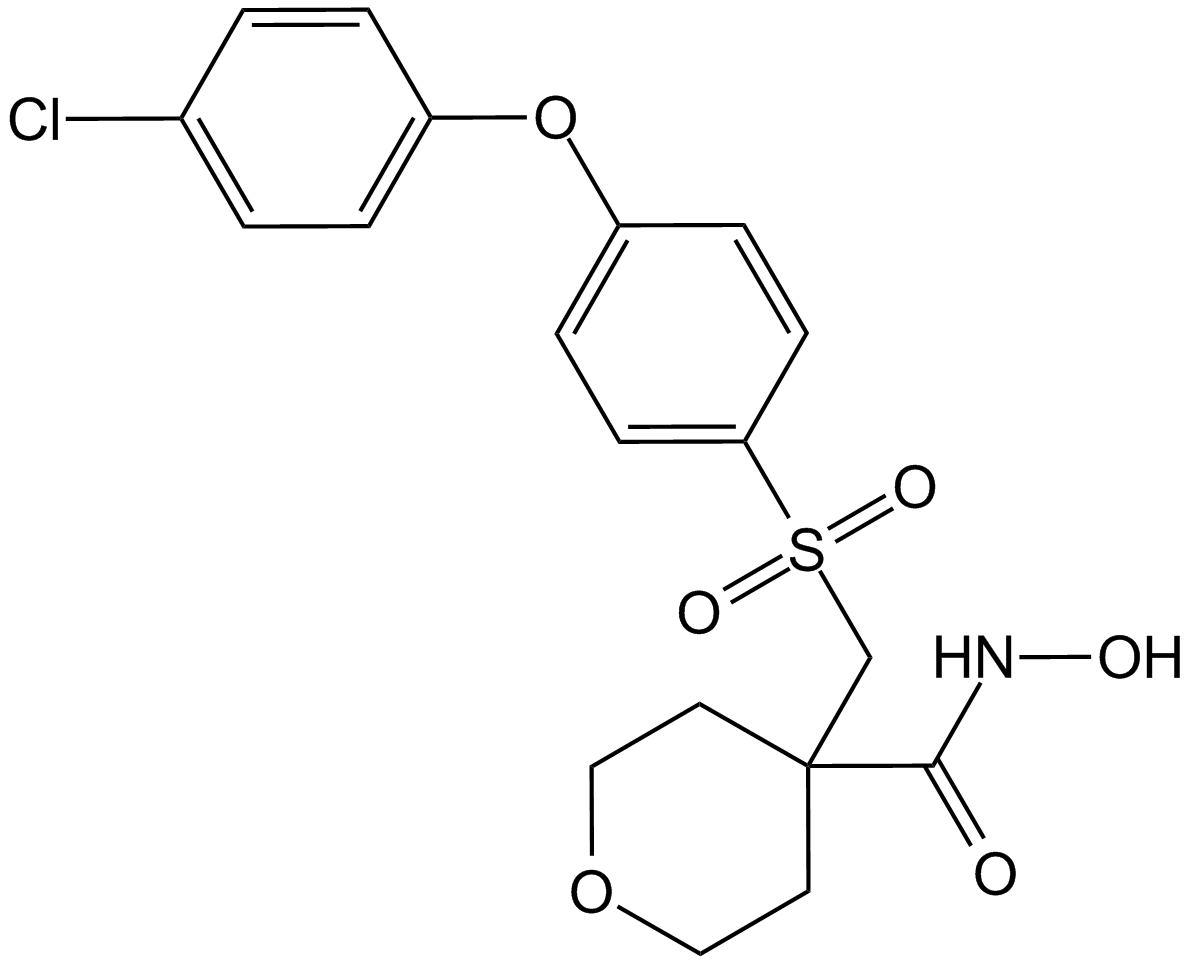
CTS-1027 (Synonyms: Ro 113-0830, RS 130830) |
رقم الكتالوجGC18144
 One-Click Copy Product Info
|

An inhibitor of MMPs
Products are for research use only. Not for human use. We do not sell to patients.
Cas No.: 193022-04-7
Sample solution is provided at 25 µL, 10mM.
_1-3.$$$39978408@51.jpg');)
_1-9.$$$38538795@65.jpg');)
_1-9.$$$39112701@51.jpg');)
_1-7.$$$37316672@70.jpg');)
_366-372.$$$36198801@70.jpg');)
.$$$38565142@65.jpg');)
_1867-1883.$$$33248023@67.jpg');)
_eads6055.$$$39977546@45.jpg');)
_eadm9805.$$$40080571@45.jpg');)
_eadj3020.$$$39666821@45.jpg');)
_1-20.$$$39757301@28.jpg');)
_1-24.$$$38898113@28.jpg');)
_273-287.$$$36806353@46.jpg');)
_1-16.$$$37156877@44.jpg');)
_1-19.$$$37460805@44.jpg');)
_1291-1307.$$$34518654@46.jpg');)
CTS-1027 is a selective inhibitor of MMP with IC50 value of 0.4 nM for MMP 2 and 0.6 nM for MMP13 [1].
MMPs (matrix metalloproteinase) are zinc-dependent endopeptidases and play an important role in degrading all kinds of extracellular matrix proteins. It is well known that MMPs involve in the cleavage of cell surface receptors, the release of apoptotic ligands, and inactivation chemokine/cytokine. And MMPs also play a pivotal role in cell proliferation, migration, differentiation, angiogenesis, apoptosis and host defense [2] [3].
In C57/BL6 mice model suffered bile duct ligation (BDL) for 14 days, gavage CTS-1027 reduced apoptosis of hepatocyte and bile infarcts which was a histologic indicator of liver injury at the same time activated stellate cells and reduced hepatic fibrogenesis [4].
References:
[1]. Barta, T.E., et al., Selective, orally active MMP inhibitors with an aryl backbone. Bioorg Med Chem Lett, 2001. 11(18): p. 2481-3.
[2]. Toth, M., A. Sohail, and R. Fridman, Assessment of gelatinases (MMP-2 and MMP-9) by gelatin zymography. Methods Mol Biol, 2012. 878: p. 121-35.
[3]. Roomi, M.W., et al., Patterns of MMP-2 and MMP-9 expression in human cancer cell lines. Oncol Rep, 2009. 21(5): p. 1323-33.
[4]. Kahraman, A., et al., Matrix metalloproteinase inhibitor, CTS-1027, attenuates liver injury and fibrosis in the bile duct-ligated mouse. Hepatol Res, 2009. 39(8): p. 805-13.
Animal experiment: | For experimental procedures, mice are anesthetized with ketamine 60 mg/kg plus xylazine 10 mg/kg body weight by intraperitoneal injection. After a midline upper-abdominal incision, the peritoneal cavity is opened, the abdominal wall retracted, and the common hepatic bile duct is double-ligated below the bifurcation and transected between the ligatures as previously described by us in detail. Sham-operated mice, used as controls, also underwent similar laparotomy with exposure but without ligation of the common bile duct. The fascia and skin of the midline abdominal incision are closed with sterile surgical 5-0 sutures. Either CTS-1027 or the vector carboxymethylcellulose are administered by gavage in a dose of 10 mg/kg body weight once a day. Drugs are prepared freshly on the day of the study. After 14 days of BDL and gavage, mice are re-anesthetized, sacrificed and blood is obtained from the inferior vena cava for serum total bilirubin and ALT determinations and the liver is removed, cut into small pieces and either snap-frozen in liquid nitrogen for storage at −80°C or fixed in freshly prepared 4% paraformaldehyde in phosphate-buffered saline (PBS) for 48 hours at 4°C for additional studies. Liver tissue is also subjected to RNA extraction using the Trizol reagent. Serum bilirubin and ALT determinations are performed as previously described. |
References: [1]. Kahraman A, et al. Matrix metalloproteinase inhibitor, CTS-1027, attenuates liver injury and fibrosis in the bile duct-ligated mouse. Hepatol Res. 2009 Aug;39(8):805-813. | |
| Cas No. | 193022-04-7 | SDF | |
| المرادفات | Ro 113-0830, RS 130830 | ||
| Chemical Name | 4-[[4-(4-chlorophenoxy)phenyl]sulfonylmethyl]-N-hydroxyoxane-4-carboxamide | ||
| Canonical SMILES | C1COCCC1(CS(=O)(=O)C2=CC=C(C=C2)OC3=CC=C(C=C3)Cl)C(=O)NO | ||
| Formula | C19H20ClNO6S | M.Wt | 425.88 |
| الذوبان | Soluble in DMSO | Storage | Store at -20°C |
| General tips | Please select the appropriate solvent to prepare the stock solution according to the
solubility of the product in different solvents; once the solution is prepared, please store it in
separate packages to avoid product failure caused by repeated freezing and thawing.Storage method
and period of the stock solution: When stored at -80°C, please use it within 6 months; when stored
at -20°C, please use it within 1 month. To increase solubility, heat the tube to 37°C and then oscillate in an ultrasonic bath for some time. |
||
| Shipping Condition | Evaluation sample solution: shipped with blue ice. All other sizes available: with RT, or with Blue Ice upon request. | ||
| Prepare stock solution | |||

|
1 mg | 5 mg | 10 mg |
| 1 mM | 2.3481 mL | 11.7404 mL | 23.4808 mL |
| 5 mM | 469.6 μL | 2.3481 mL | 4.6962 mL |
| 10 mM | 234.8 μL | 1.174 mL | 2.3481 mL |
Step 1: Enter information below (Recommended: An additional animal making an allowance for loss during the experiment)
 g
μL
g
μL
Step 2: Enter the in vivo formulation (This is only the calculator, not formulation. Please contact us first if there is no in vivo formulation at the solubility Section.)
Calculation results:
Working concentration: mg/ml;
Method for preparing DMSO master liquid: mg drug pre-dissolved in μL DMSO ( Master liquid concentration mg/mL, Please contact us first if the concentration exceeds the DMSO solubility of the batch of drug. )
Method for preparing in vivo formulation: Take μL DMSO master liquid, next addμL PEG300, mix and clarify, next addμL Tween 80, mix and clarify, next add μL saline, mix and clarify.
Method for preparing in vivo formulation: Take μL DMSO master liquid, next add μL Corn oil, mix and clarify.
Note: 1. Please make sure the liquid is clear before adding the next solvent.
2. Be sure to add the solvent(s) in order. You must ensure that the solution obtained, in the previous addition, is a clear solution before proceeding to add the next solvent. Physical methods such as vortex, ultrasound or hot water bath can be used to aid dissolving.
3. All of the above co-solvents are available for purchase on the GlpBio website.
Quality Control & SDS
- View current batch:
- Purity: >98.00% Appearance: A solid
- COA (Certificate of Analysis)
- SDS (Safety Data Sheet)
- Datasheet
Average Rating: 5 (Based on Reviews and 30 reference(s) in Google Scholar.)