

Dehydrocorydaline chloride |
رقم الكتالوجGC35832
 One-Click Copy Product Info
|

Dehydrocorydaline chloride (13-Methylpalmatine chloride) هو قلويد ينظم التعبير البروتيني عن Bax ، Bcl-2 ؛ ينشط caspase-7 و caspase-8 و يعطل PARP
Products are for research use only. Not for human use. We do not sell to patients.
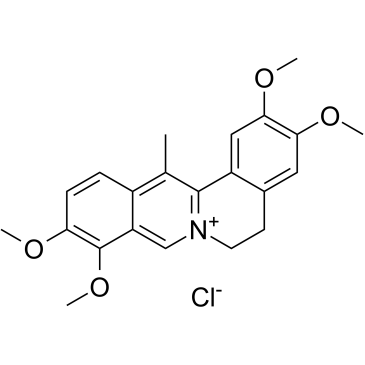
Cas No.: 10605-03-5
Sample solution is provided at 25 µL, 10mM.
_1-3.$$$39978408@51.jpg');)
_1-9.$$$38538795@65.jpg');)
_1-9.$$$39112701@51.jpg');)
_1-7.$$$37316672@70.jpg');)
_366-372.$$$36198801@70.jpg');)
.$$$38565142@65.jpg');)
_1867-1883.$$$33248023@67.jpg');)
_eads6055.$$$39977546@45.jpg');)
_eadm9805.$$$40080571@45.jpg');)
_eadj3020.$$$39666821@45.jpg');)
_1-20.$$$39757301@28.jpg');)
_1-24.$$$38898113@28.jpg');)
_273-287.$$$36806353@46.jpg');)
_1-16.$$$37156877@44.jpg');)
_1-19.$$$37460805@44.jpg');)
_1291-1307.$$$34518654@46.jpg');)
Dehydrocorydaline chloride is an alkaloidal that has anti-inflammatory and anti-cancer activities. Dehydrocorydaline chloride can elevate p38 MAPK activation. p38 MAPK[1]
Treatment of C2C12 myoblasts with 500 nM Dehydrocorydaline increases the expression levels of muscle-specific proteins, including MyoD, myogenin and myosin heavy chain. Treatment with Dehydrocorydaline elevates p38 MAPK activation and the interaction of MyoD with an E protein. Furthermore, defects in differentiation-induced p38 MAPK activation and myoblast differentiation induced by depletion of the promyogenic receptor protein Cdo in C2C12 myoblasts are restored by Dehydrocorydaline treatment[1]. Dehydrocorydaline significantly inhibits MCF-7 cell proliferation in a dose- dependent manner, which can be reversed by a caspase-8 inhibitor, Z-IETD-FMK. Dehydrocorydaline increases DNA fragments without affecting δψm. Western blotting assay shows that dehydrocorydaline dose-dependently increases Bax protein expression and decreases Bcl-2 protein expression. Furthermore, dehydrocorydaline induces activation of caspase-7,-8 and the cleavage of PARP without affecting caspase-9. These results show that dehydrocorydaline inhibits MCF-7 cell proliferation by inducing apoptosis mediated by regulating Bax/Bcl-2, activating caspases as well as cleaving PARP[3].
Dehydrocorydaline (3.6, 6 or 10 mg/kg, i.p.) shows a dose-dependent antinociceptive effect in the acetic acid-induced writhing test and significantly attenuates the formalin-induced pain responses in mice. In the formalin test, dehydrocorydaline decreases the expression of caspase 6 (CASP6), TNF-α, IL-1β and IL-6 proteins in the spinal cord. These findings confirm that Dehydrocorydaline has antinociceptive effects in mice[2].
[1]. Yoo M, et al. Dehydrocorydaline promotes myogenic differentiation via p38 MAPK activation. Mol Med Rep. 2016 Oct;14(4):3029-36. [2]. Yin ZY, et al. Antinociceptive effects of dehydrocorydaline in mouse models of inflammatory pain involve the opioid receptor and inflammatory cytokines. Sci Rep. 2016 Jun 7;6:27129 [3]. Xu Z, et al. Dehydrocorydaline inhibits breast cancer cells proliferation by inducing apoptosis in MCF-7 cells. Am J Chin Med. 2012;40(1):177-85.
| Cas No. | 10605-03-5 | SDF | |
| Canonical SMILES | CC1=C(C=CC(OC)=C2OC)C2=C[N+]3=C1C4=CC(OC)=C(OC)C=C4CC3.[Cl-] | ||
| Formula | C22H24ClNO4 | M.Wt | 401.88 |
| الذوبان | DMSO: 25 mg/mL (62.21 mM) | Storage | Store at -20°C |
| General tips | Please select the appropriate solvent to prepare the stock solution according to the
solubility of the product in different solvents; once the solution is prepared, please store it in
separate packages to avoid product failure caused by repeated freezing and thawing.Storage method
and period of the stock solution: When stored at -80°C, please use it within 6 months; when stored
at -20°C, please use it within 1 month. To increase solubility, heat the tube to 37°C and then oscillate in an ultrasonic bath for some time. |
||
| Shipping Condition | Evaluation sample solution: shipped with blue ice. All other sizes available: with RT, or with Blue Ice upon request. | ||
| Prepare stock solution | |||

|
1 mg | 5 mg | 10 mg |
| 1 mM | 2.4883 mL | 12.4415 mL | 24.883 mL |
| 5 mM | 497.7 μL | 2.4883 mL | 4.9766 mL |
| 10 mM | 248.8 μL | 1.2442 mL | 2.4883 mL |
Step 1: Enter information below (Recommended: An additional animal making an allowance for loss during the experiment)
 g
μL
g
μL
Step 2: Enter the in vivo formulation (This is only the calculator, not formulation. Please contact us first if there is no in vivo formulation at the solubility Section.)
Calculation results:
Working concentration: mg/ml;
Method for preparing DMSO master liquid: mg drug pre-dissolved in μL DMSO ( Master liquid concentration mg/mL, Please contact us first if the concentration exceeds the DMSO solubility of the batch of drug. )
Method for preparing in vivo formulation: Take μL DMSO master liquid, next addμL PEG300, mix and clarify, next addμL Tween 80, mix and clarify, next add μL saline, mix and clarify.
Method for preparing in vivo formulation: Take μL DMSO master liquid, next add μL Corn oil, mix and clarify.
Note: 1. Please make sure the liquid is clear before adding the next solvent.
2. Be sure to add the solvent(s) in order. You must ensure that the solution obtained, in the previous addition, is a clear solution before proceeding to add the next solvent. Physical methods such as vortex, ultrasound or hot water bath can be used to aid dissolving.
3. All of the above co-solvents are available for purchase on the GlpBio website.
Quality Control & SDS
- View current batch:
- Purity: >98.00% Appearance: A solid
- COA (Certificate of Analysis)
- SDS (Safety Data Sheet)
- Datasheet
Average Rating: 5 (Based on Reviews and 38 reference(s) in Google Scholar.)