

K-604 dihydrochloride |
رقم الكتالوجGC32488
 One-Click Copy Product Info
|

ثنائي هيدروكلوريد K-604 هو مادة أسيل- CoA قوية وانتقائية: مثبط الكوليسترول أسيل ترانسفيراز 1 (ACAT-1) مع IC50 من 0.45 ± 0.06 ميكرومتر
Products are for research use only. Not for human use. We do not sell to patients.
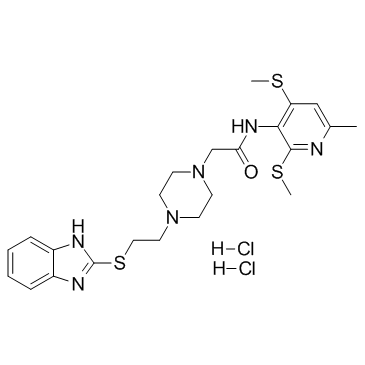
Cas No.: 217094-32-1
Sample solution is provided at 25 µL, 10mM.
_1-3.$$$39978408@51.jpg');)
_1-9.$$$38538795@65.jpg');)
_1-9.$$$39112701@51.jpg');)
_1-7.$$$37316672@70.jpg');)
_366-372.$$$36198801@70.jpg');)
.$$$38565142@65.jpg');)
_1867-1883.$$$33248023@67.jpg');)
_eads6055.$$$39977546@45.jpg');)
_eadm9805.$$$40080571@45.jpg');)
_eadj3020.$$$39666821@45.jpg');)
_1-20.$$$39757301@28.jpg');)
_1-24.$$$38898113@28.jpg');)
_273-287.$$$36806353@46.jpg');)
_1-16.$$$37156877@44.jpg');)
_1-19.$$$37460805@44.jpg');)
_1291-1307.$$$34518654@46.jpg');)
K-604 dihydrochloride is a potent and selective acyl-CoA:cholesterol acyltransferase 1 (ACAT-1) inhibitor with an IC50 of 0.45±0.06 μM.
The potency and selectivity of K-604 for human ACAT-1 and ACAT-2 is examined. The IC50 value of K-604 for human ACAT-1 is 0.45 μM and that for human ACAT-2 is 102.85 μM, indicating that K-604 is 229-fold more selective for ACAT-1 than ACAT-2. Kinetic analysis indicates that the inhibition is competitive with respect to oleoyl-coenzyme A with a Ki value of 0.378 μM. K-604 efficiently inhibits cholesterol esterification in human macrophages with IC50 value of 68 nM[1]. In cell free biochemical assays, K604 at 0.5 µM inhibits ACAT1 enzymatic activity by 70% without significantly inhibiting the ACAT2 enzyme activity. To investigate whether blocking ACAT1 increases autophagy in neuronal cells, N2a cells are treated with K604. The result shows that at 0.1 to 1 µM, K604 inhibits ACAT activity by 60-80%. Next K604 is added to N2a cells at concentrations from 0.1 to 1 µM for 24 h, and LC3 levels are examined by western blot. The result shows that K604 increases the LC3-II/LC3-I ratio, a reliable marker for autophagosome formation, in a dose-dependent manner. The number of the fluorescent LC3 puncta is significantly increased in N2a cells after K604 treatment. By western blot, K604 significantly decreases the levels of p62 in N2a cells[2].
Using F1B hamsters, an animal model susceptible to diet-induced hyperlipidemia and atherosclerosis, the effects of K-604 on aortic lesion areas and plasma cholesterol levels are assessed. Administration of K-604 does not affect body weight or food consumption. The plasma cholesterol levels in fat-fed hamsters are ~12-fold higher than those in chow-fed hamsters, which are significantly decreased by K-604 only at the highest dose tested (30 mg/kg) but not at lower doses (1-10 mg/kg).The fatty streak lesions stain with oil red O are markedly induced by the high-fat diet, which is significantly reduced by administration of K-604. Further, the histological analyses of the atherosclerotic lesions are performed. The fatty streak lesions in the control group are characterized by accumulation of foamy macrophages in the subendothelial space. In contrast, the areas occupied by foamy macrophages are markedly reduced by administration of K-604[1].
[1]. Ikenoya M, et al. A selective ACAT-1 inhibitor, K-604, suppresses fatty streak lesions in fat-fed hamsters without affecting plasma cholesterol levels. Atherosclerosis. 2007 Apr;191(2):290-7. [2]. Shibuya Y, et al. Acyl-coenzyme A:cholesterol acyltransferase 1 blockage enhances autophagy in the neurons of triple transgenic Alzheimer's disease mouse and reduces human P301L-tau content at the presymptomatic stage. Neurobiol Aging. 2015 Jul;36(7):2248-2259.
|
Kinase experiment: |
ACAT activity is determined by measuring the production of cholesteryl[14C]oleate. Microsomal fractions derived from CHO-ACAT-1 or CHO-ACAT-2 cells are diluted with CHAPS in 0.5 M KCl, 0.5 mM EDTA, and 25 mM Tris-HCl (pH 7.8) (buffer A) to a final protein concentration of 1.0 mg/mL. The microsomal fractions containing 9.2 μg of protein for ACAT-1 or 4.9 μg for ACAT-2 in 10 μL of buffer A are mixed with various concentrations of K-604 (0.4, 0.6 and 0.8 μM) or CI-1011 in 5 μL of DMSO, and reconstituted with 152.5 μL of mixed micelles containing 1.6 mM Cholesterol, 11.2 mM Phosphatidylcholine, and 9.3 mM Taurocholate in 25, 0.5 mM EDTA, and Tris-HCl (pH 7.8). The reaction is started by adding 10 μL of 0.45 μM [14C]oleoyl-CoA, 10 nM fatty acid-free bovine serum albumin (fatty acid-free BSA) and 25 mM Tris-HCl (pH 7.8). Reaction mixtures are incubated for 25 min at 37°C and terminated by adding 150 μL of Chloroform/Methanol (2:1). The organic phase is dried under a stream of nitrogen. The lipids are resuspended with 150 μL of Chloroform/Methanol (2:1) and developed by thin layer chromatography (TLC) using hexane/diethyl ether/acetic acid (75:25:1). Radioactivities of cholesterol [14C]oleate are determined using a BAS 2500 image analyzer[1]. |
|
Cell experiment: |
The mouse neuroblastoma cell line N2a is cultured in DMEM/Opti-MEM (50:50) with 10% fetal bovine serum (FBS) at 37°C with 5% CO2 in a humidified incubator. Cells are incubated for 24 h with the ACAT1-specific inhibitor K604 (0.1, 0.5 and 1 µM) or isotype-nonspecific ACAT inhibitor CI-1011. Primary cortical neurons are isolated from mouse brains at postnatal day 0-3. Cortical neurons are plated in 6 well plates at 350,000 cells/well and grown in 2 mL/well Neurobasal A with 1×B27, 0.5 mM L-glutamine, and 5 ng/mL fibroblast growth factor. Half of the media is replaced with fresh media once every 7 days. After 14-21 days in culture, cells are used for individual experiments[2]. |
|
Animal experiment: |
Hamsters[1]Male F1B hamsters (n=30) at 8 weeks old are used for animal experiments. The animal room is controlled at 23±3°C and relative humidity of 50±20%. Animals are fed a CE-2 chow diet, followed by supplementation with CE-2 containing 0.3% cholesterol and 10% coconut oil for 10 weeks. During fat loading, K-604 is administered orally at 1, 3, 10, or 30 mg/kg/day (n=6 for each dose group). The control group (n=6) receive an aqueous solution of 0.5% methylcellulose instead of K-604. Tap water is given ad libitum. Body weight is measured at the time of drug administration. Blood is sampled for determination of plasma cholesterol levels using a commercially available kit (Cholesterol E-Test). |
|
References: [1]. Ikenoya M, et al. A selective ACAT-1 inhibitor, K-604, suppresses fatty streak lesions in fat-fed hamsters without affecting plasma cholesterol levels. Atherosclerosis. 2007 Apr;191(2):290-7. |
|
| Cas No. | 217094-32-1 | SDF | |
| Canonical SMILES | O=C(NC1=C(SC)C=C(C)N=C1SC)CN2CCN(CCSC3=NC4=CC=CC=C4N3)CC2.[H]Cl.[H]Cl | ||
| Formula | C23H32Cl2N6OS3 | M.Wt | 575.64 |
| الذوبان | DMSO: 62.5 mg/mL (108.57 mM) | Storage | Store at -20°C |
| General tips | Please select the appropriate solvent to prepare the stock solution according to the
solubility of the product in different solvents; once the solution is prepared, please store it in
separate packages to avoid product failure caused by repeated freezing and thawing.Storage method
and period of the stock solution: When stored at -80°C, please use it within 6 months; when stored
at -20°C, please use it within 1 month. To increase solubility, heat the tube to 37°C and then oscillate in an ultrasonic bath for some time. |
||
| Shipping Condition | Evaluation sample solution: shipped with blue ice. All other sizes available: with RT, or with Blue Ice upon request. | ||
| Prepare stock solution | |||

|
1 mg | 5 mg | 10 mg |
| 1 mM | 1.7372 mL | 8.686 mL | 17.372 mL |
| 5 mM | 347.4 μL | 1.7372 mL | 3.4744 mL |
| 10 mM | 173.7 μL | 868.6 μL | 1.7372 mL |
Step 1: Enter information below (Recommended: An additional animal making an allowance for loss during the experiment)
 g
μL
g
μL
Step 2: Enter the in vivo formulation (This is only the calculator, not formulation. Please contact us first if there is no in vivo formulation at the solubility Section.)
Calculation results:
Working concentration: mg/ml;
Method for preparing DMSO master liquid: mg drug pre-dissolved in μL DMSO ( Master liquid concentration mg/mL, Please contact us first if the concentration exceeds the DMSO solubility of the batch of drug. )
Method for preparing in vivo formulation: Take μL DMSO master liquid, next addμL PEG300, mix and clarify, next addμL Tween 80, mix and clarify, next add μL saline, mix and clarify.
Method for preparing in vivo formulation: Take μL DMSO master liquid, next add μL Corn oil, mix and clarify.
Note: 1. Please make sure the liquid is clear before adding the next solvent.
2. Be sure to add the solvent(s) in order. You must ensure that the solution obtained, in the previous addition, is a clear solution before proceeding to add the next solvent. Physical methods such as vortex, ultrasound or hot water bath can be used to aid dissolving.
3. All of the above co-solvents are available for purchase on the GlpBio website.
Quality Control & SDS
- View current batch:
- Purity: >98.00% Appearance: A solid
- COA (Certificate of Analysis)
- SDS (Safety Data Sheet)
- Datasheet
Average Rating: 5 (Based on Reviews and 15 reference(s) in Google Scholar.)