

Polymyxin B1 |
رقم الكتالوجGC11160
 One-Click Copy Product Info
|

Polymyxin B1 هو ببتيد شحمي قوي مضاد للميكروبات مشتق أولاً من Bacilus polymyxa
Products are for research use only. Not for human use. We do not sell to patients.
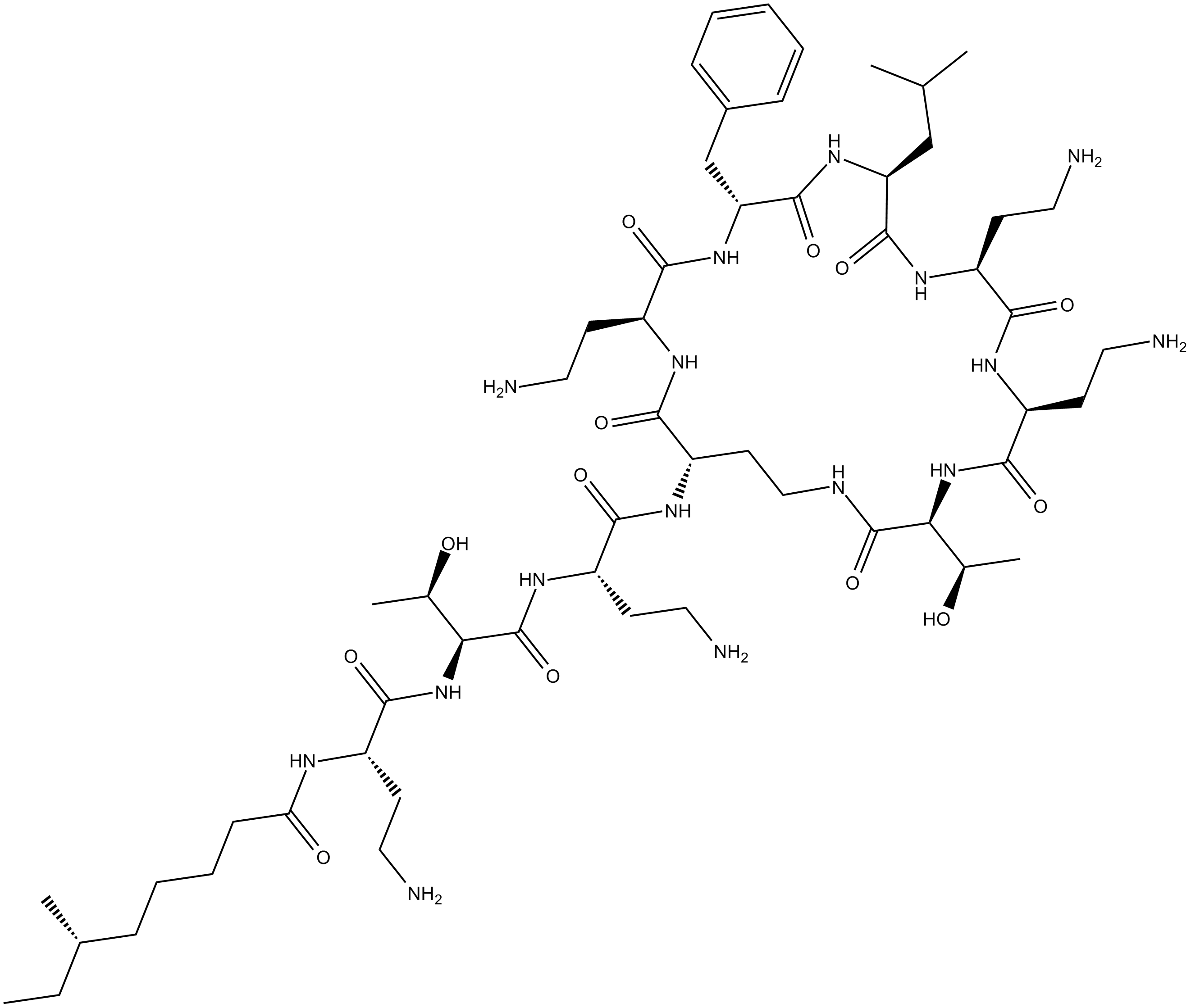
Cas No.: 4135-11-9
Sample solution is provided at 25 µL, 10mM.
Polymyxin B1 can bind and kill Gram-negative bacteria.
In view of the emergence of multidrug resistance among Gram-negative bacteria, polymyxin B has emerged as one of the therapeutic agents of last resort.
In vitro: Previous study reported the first molecular dynamics simulation investigation of the interaction of polymyxin B1 with complex models of membranes of E. coli. The results of >16 microseconds of simulation predicted that polymyxin B1 was probably to interact with the membranes via distinct mechanisms. Polymyxin B1 aggregated in the lipopolysaccharide headgroup region of the outer membrane with limited tendency for insertion within the lipid A tails. Whereas, polymyxin B1 readily insert into the inner membrane core, and the concomitant increased hydration might be responsible for bilayer destabilization and antimicrobial function [1].
In vivo: The PK parameters of the major components including polymyxin B1 from Polymyxin B did not appear to be significantly different. Less than 1% of the dose was recovered unchanged in urine collected over 48 h. Therapeutic drug concentrations maintained in kidney tissue at 48 h. The post-renal insufficiency to pre-renal insufficiency ratio of the area under the serum concentration-time curve from time zero to infinity was 1.33. Polymyxin B components seemed to have similar pharmacokinetics. Polymyxin B preferentially persisted in kidneys, suggesting a selective uptake process in renal cells [2].
Clinical trial: Treatment of patients with PMB1 has been shown to have adverse side effects on the renal and nervous system, and thus clinical use of PMB1 has been limited to topical treatment and “last resort” therapy of patients infected with multidrug-resistant bacteria or with chronic conditions who suffer from recurring respiratory infections [1].
References:
[1] Nils A. Berglund, Thomas J. Piggot, Damien Jefferies, Richard B. Sessions, Peter J. Bond, Syma Khalid. Interaction of the Antimicrobial Peptide Polymyxin B1 with Both Membranes of E. coli: A Molecular Dynamics Study. PLoS Comput Biol. 2015 Apr; 11(4): e1004180.
[2] Kamilia Abdelraouf, Jie He, Kimberly R. Ledesma, Ming Hu, and Vincent H. Tam. Pharmacokinetics and Renal Disposition of Polymyxin B in an Animal Model. Antimicrob Agents Chemother. 2012 Nov; 56(11): 5724–5727.
| Cas No. | 4135-11-9 | SDF | |
| Chemical Name | (S)-N-((S)-4-amino-1-(((2S,3R)-1-(((S)-4-amino-1-oxo-1-(((3S,6S,9S,12S,15R,18S,21S)-6,9,18-tris(2-aminoethyl)-15-benzyl-3-((R)-1-hydroxyethyl)-12-isobutyl-2,5,8,11,14,17,20-heptaoxo-1,4,7,10,13,16,19-heptaazacyclotricosan-21-yl)amino)butan-2-yl)a | ||
| Canonical SMILES | O=C([C@@H](NC([C@H](CCN)NC(CCCC[C@@H](C)CC)=O)=O)[C@@H](C)O)N[C@@H](CCN)C(N[C@@H](CCNC([C@@H](NC([C@@H](NC([C@H](CCN)N1)=O)CCN)=O)[C@H](O)C)=O)C(N[C@@H](CCN)C(N[C@H](CC2=CC=CC=C2)C(N[C@@H](CC(C)C)C1=O)=O)=O)=O)=O | ||
| Formula | C56H98N16O13 | M.Wt | 1203.5 |
| الذوبان | 2 mg/ml in PBS (pH 7.2) | Storage | Store at -20°C |
| General tips | Please select the appropriate solvent to prepare the stock solution according to the
solubility of the product in different solvents; once the solution is prepared, please store it in
separate packages to avoid product failure caused by repeated freezing and thawing.Storage method
and period of the stock solution: When stored at -80°C, please use it within 6 months; when stored
at -20°C, please use it within 1 month. To increase solubility, heat the tube to 37°C and then oscillate in an ultrasonic bath for some time. |
||
| Shipping Condition | Evaluation sample solution: shipped with blue ice. All other sizes available: with RT, or with Blue Ice upon request. | ||
| Prepare stock solution | |||

|
1 mg | 5 mg | 10 mg |
| 1 mM | 830.9 μL | 4.1545 mL | 8.3091 mL |
| 5 mM | 166.2 μL | 830.9 μL | 1.6618 mL |
| 10 mM | 83.1 μL | 415.5 μL | 830.9 μL |
Step 1: Enter information below (Recommended: An additional animal making an allowance for loss during the experiment)
 g
μL
g
μL
Step 2: Enter the in vivo formulation (This is only the calculator, not formulation. Please contact us first if there is no in vivo formulation at the solubility Section.)
Calculation results:
Working concentration: mg/ml;
Method for preparing DMSO master liquid: mg drug pre-dissolved in μL DMSO ( Master liquid concentration mg/mL, Please contact us first if the concentration exceeds the DMSO solubility of the batch of drug. )
Method for preparing in vivo formulation: Take μL DMSO master liquid, next addμL PEG300, mix and clarify, next addμL Tween 80, mix and clarify, next add μL saline, mix and clarify.
Method for preparing in vivo formulation: Take μL DMSO master liquid, next add μL Corn oil, mix and clarify.
Note: 1. Please make sure the liquid is clear before adding the next solvent.
2. Be sure to add the solvent(s) in order. You must ensure that the solution obtained, in the previous addition, is a clear solution before proceeding to add the next solvent. Physical methods such as vortex, ultrasound or hot water bath can be used to aid dissolving.
3. All of the above co-solvents are available for purchase on the GlpBio website.
Quality Control & SDS
- View current batch:
- Purity: >95.00% Appearance: A solid
- COA (Certificate of Analysis)
- SDS (Safety Data Sheet)
- Datasheet
Average Rating: 5 (Based on Reviews and 32 reference(s) in Google Scholar.)