

Prolactin Releasing Peptide (12-31), human |
رقم الكتالوجGC33733
 One-Click Copy Product Info
|

البرولاكتين يطلق الببتيد (12-31) ، الإنسان جزء من البرولاكتين يطلق الببتيد (PrRP)
Products are for research use only. Not for human use. We do not sell to patients.
Cas No.: 235433-36-0
Sample solution is provided at 25 µL, 10mM.
_1-3.$$$39978408@51.jpg');)
_1-9.$$$38538795@65.jpg');)
_1-9.$$$39112701@51.jpg');)
_1-7.$$$37316672@70.jpg');)
_366-372.$$$36198801@70.jpg');)
.$$$38565142@65.jpg');)
_1867-1883.$$$33248023@67.jpg');)
_eads6055.$$$39977546@45.jpg');)
_eadm9805.$$$40080571@45.jpg');)
_eadj3020.$$$39666821@45.jpg');)
_1-20.$$$39757301@28.jpg');)
_1-24.$$$38898113@28.jpg');)
_273-287.$$$36806353@46.jpg');)
_1-16.$$$37156877@44.jpg');)
_1-19.$$$37460805@44.jpg');)
_1291-1307.$$$34518654@46.jpg');)
Prolactin Releasing Peptide (12-31), human is a fragment of the prolactin releasing peptide (PrRP). Prolactin Releasing Peptide (1-31), human is a high affinity GPR10 ligand that cause the release of the prolactin.
The Prolactin Releasing Peptide (PrRP) is a C-terminally amidated, 31-amino acid peptide derived from a 98-amino acid precursor. Radioiodinated PrRP-(1-31) binds to its receptor with high affinity (1 nM) and stimulates calcium mobilization in CHOK1 cells stably transfected with the receptor. A series of N-terminal deletions reveals that the Prolactin Releasing Peptide (12-31) amino acid is equipotent to PrRP-(1-31). Further N-terminal deletions reduce the affinity of the ligand considerably[1]. Prolactin Releasing Peptide (PrRP) has been identified as a specific, high affinity endogenous ligand for GPR10. Prolactin Releasing Peptide (PrRP) preproprotein can be cleaved at two different positions to give rise to two forms of 31 or 20 amino acids; Prolactin Releasing Peptide (PrRP)-31 and Prolactin Releasing Peptide (PrRP)-20 respectively. Rat Prolactin Releasing Peptide (PrRP) has also been identified and occurs as 31 or 20 amino acid forms; these peptides are highly conserved between species. Human PrRP‐20, human PrRP‐31, rat PrRP‐20 and rat PrRP‐31 display high affinity for GPR10 receptors, with Ki values of 0.26±0.07, 1.03±0.41, 0.22±0.06 and 0.33±0.11 nM, respectively[2].
Following intracerebroventricular injection of Prolactin Releasing Peptide (1-31), human 5 nM there is a highly significant simulation of plasma LH that began at 10 minutes and is maintained over the course of the experiment. Plasma FSH increased at 20 minutes following ICV injection. Total plasma testosterone increased at 60 minutes post injection[3].
[1]. Roland BL, et al. Anatomical distribution of prolactin-releasing peptide and its receptor suggests additional functions in the central nervous system and periphery. Endocrinology. 1999 Dec;140(12):5736-45. [2]. Langmead CJ, et al. Characterization of the binding of [(125)I]-human prolactin releasing peptide (PrRP) to GPR10, a novel G protein coupled receptor. Br J Pharmacol. 2000 Oct;131(4):683-8. [3]. Seal LJ, et al. Prolactin releasing peptide (PrRP) stimulates luteinizing hormone (LH) and follicle stimulating hormone (FSH) via a hypothalamic mechanism in male rats. Endocrinology. 2000 May;141(5):1909-12.
Animal experiment: | Rats[3]Groups of rats are injected with either Prolactin Releasing Peptide (1-31) 5 nM or saline. Prolactin Releasing Peptide (1-31), human is dissolved in saline is administered in a total volume of 10 μL. Animals are habituated to the injection procedures by three ICV injections prior to the study to minimize stress in the animals. At 10, 20, 60 minutes following injection, rats are decapitated and trunk blood collected into plastic tubes[3]. |
References: [1]. Roland BL, et al. Anatomical distribution of prolactin-releasing peptide and its receptor suggests additional functions in the central nervous system and periphery. Endocrinology. 1999 Dec;140(12):5736-45. | |
| Cas No. | 235433-36-0 | SDF | |
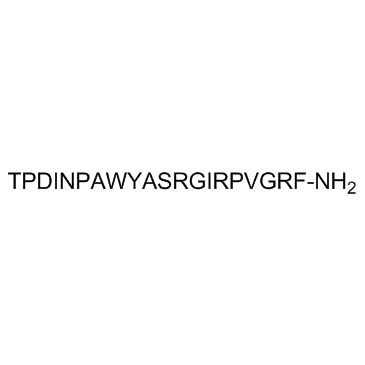
| Canonical SMILES | Thr-Pro-Asp-Ile-Asn-Pro-Ala-Trp-Tyr-Ala-Ser-Arg-Gly-Ile-Arg-Pro-Val-Gly-Arg-Phe-NH2 | ||
| Formula | C104H158N32O26 | M.Wt | 2272.57 |
| الذوبان | H2O : 100 mg/mL (44.00 mM; Need ultrasonic) | Storage | Store at -20°C |
| General tips | Please select the appropriate solvent to prepare the stock solution according to the
solubility of the product in different solvents; once the solution is prepared, please store it in
separate packages to avoid product failure caused by repeated freezing and thawing.Storage method
and period of the stock solution: When stored at -80°C, please use it within 6 months; when stored
at -20°C, please use it within 1 month. To increase solubility, heat the tube to 37°C and then oscillate in an ultrasonic bath for some time. |
||
| Shipping Condition | Evaluation sample solution: shipped with blue ice. All other sizes available: with RT, or with Blue Ice upon request. | ||
| Prepare stock solution | |||

|
1 mg | 5 mg | 10 mg |
| 1 mM | 440 μL | 2.2002 mL | 4.4003 mL |
| 5 mM | 88 μL | 440 μL | 880.1 μL |
| 10 mM | 44 μL | 220 μL | 440 μL |
Step 1: Enter information below (Recommended: An additional animal making an allowance for loss during the experiment)
 g
μL
g
μL
Step 2: Enter the in vivo formulation (This is only the calculator, not formulation. Please contact us first if there is no in vivo formulation at the solubility Section.)
Calculation results:
Working concentration: mg/ml;
Method for preparing DMSO master liquid: mg drug pre-dissolved in μL DMSO ( Master liquid concentration mg/mL, Please contact us first if the concentration exceeds the DMSO solubility of the batch of drug. )
Method for preparing in vivo formulation: Take μL DMSO master liquid, next addμL PEG300, mix and clarify, next addμL Tween 80, mix and clarify, next add μL saline, mix and clarify.
Method for preparing in vivo formulation: Take μL DMSO master liquid, next add μL Corn oil, mix and clarify.
Note: 1. Please make sure the liquid is clear before adding the next solvent.
2. Be sure to add the solvent(s) in order. You must ensure that the solution obtained, in the previous addition, is a clear solution before proceeding to add the next solvent. Physical methods such as vortex, ultrasound or hot water bath can be used to aid dissolving.
3. All of the above co-solvents are available for purchase on the GlpBio website.
Quality Control & SDS
- View current batch:
- Purity: >98.00% Appearance: A solid
- COA (Certificate of Analysis)
- SDS (Safety Data Sheet)
- Datasheet
Average Rating: 5 (Based on Reviews and 35 reference(s) in Google Scholar.)