

SP187 (MON-DNJ) (Synonyms: MON-?DNJ; UV4) |
رقم الكتالوجGC32247
 One-Click Copy Product Info
|

SP187 (MON-DNJ) هو عقار إيمينوسكر مستهدف للمضيف يتمتع بنشاط ضد الإصابات بالفيلو فيروس في الأجناس والحيوانات المختبرية.
Products are for research use only. Not for human use. We do not sell to patients.
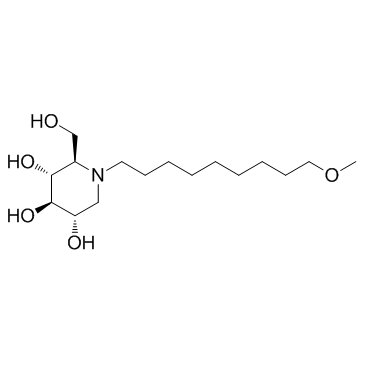
Cas No.: 615253-61-7
Sample solution is provided at 25 µL, 10mM.
_1-3.$$$39978408@51.jpg');)
_1-9.$$$38538795@65.jpg');)
_1-9.$$$39112701@51.jpg');)
_1-7.$$$37316672@70.jpg');)
_366-372.$$$36198801@70.jpg');)
.$$$38565142@65.jpg');)
_1867-1883.$$$33248023@67.jpg');)
_eads6055.$$$39977546@45.jpg');)
_eadm9805.$$$40080571@45.jpg');)
_eadj3020.$$$39666821@45.jpg');)
_1-20.$$$39757301@28.jpg');)
_1-24.$$$38898113@28.jpg');)
_273-287.$$$36806353@46.jpg');)
_1-16.$$$37156877@44.jpg');)
_1-19.$$$37460805@44.jpg');)
_1291-1307.$$$34518654@46.jpg');)
SP187 (MON-DNJ) is an iminosugar that exhibits antiviral activity against influenza and dengue virus [1]. By inhibiting glucosidases, SP187 can induce endoplasmic reticulum stress through misfolded glycoprotein accumulation, triggering the unfolded protein response, which creates a prolonged intracellular environment hostile to viral replication [2]. SP187 has been widely used to inhibit endoplasmic reticulum α-glucosidase and prevent mortality in virus-infected mice [3].
In vitro, SP187 treatment for 72 hours significantly inhibited SARS-CoV-2 viral activity in Calu-3 cells, with IC50 values of 88.1, 123.5, 186.0, and 219.2μM against the SARS-CoV-2 variants β, α, γ, and δ, respectively [4]. Treatment with 25µM SP187 for 24 hours significantly reduced the production of inflammatory cytokines in macrophages induced by dengue virus and lipopolysaccharide (LPS)[5].
In vivo, SP187 treatment via oral administration at a dose of 20mg/kg, three times a day for 5 consecutive days, significantly increased the survival rate of BALB/c mice infected with lethal influenza[6].
References:
[1] Miller J L, Tyrrell B E, Zitzmann N. Mechanisms of antiviral activity of iminosugars against dengue virus[J]. Dengue and Zika: control and antiviral treatment strategies, 2018: 277-301.
[2] Dwek R A, Feldmann M, Fotinou C, et al. If vaccines falter, broad-spectrum antivirals provide a global shield[J]. The Lancet, 2026, 407(10523): 25-26.
[3] Miller J L, Spiro S G, Dowall S D, et al. Minimal in vivo efficacy of iminosugars in a lethal Ebola virus guinea pig model[J]. PLoS One, 2016, 11(11): e0167018.
[4] Brun J, Arman B Y, Hill M L, et al. Assessment of repurposed compounds against coronaviruses highlights the antiviral broad-spectrum activity of host-targeting iminosugars and confirms the activity of potent directly acting antivirals[J]. Antiviral Research, 2025, 237: 106123.
[5] Sayce A C, Martinez F O, Tyrrell B E, et al. Pathogen‐induced inflammation is attenuated by the iminosugar MON‐DNJ via modulation of the unfolded protein response[J]. Immunology, 2021, 164(3): 587-601.
[6] Warfield K L, Alonzi D S, Hill J C, et al. Targeting endoplasmic reticulum α-glucosidase I with a single-dose iminosugar treatment protects against lethal influenza and dengue virus infections[J]. Journal of Medicinal Chemistry, 2020, 63(8): 4205-4214.
| Cell experiment [1]: | |
Cell lines | Calu-3 cells |
Preparation Method | Calu-3 cells were grown in a 1:1 mixture of Dulbecco's modified Eagle medium (DMEM) with GlutaMAX and Ham's F-12 medium supplemented with 100μg/ml streptomycin, 100U/ml penicillin, and 10% heat-inactivated (56°C; 30min) fetal bovine serum (FBS). Calu-3 cells were seeded into 96-well plates at a cell density of 8×10⁴ cells/well in 200μl of growth medium. After 48h of incubation, the supernatant was removed, and the wells were inoculated for 2h with 50μl of the challenge virus (SARS-CoV-2 ENG2/20) at a M.O.I of 0.5 in growth medium. The inoculum was removed and replaced with 200μl of growth medium containing the SP187 (0, 0.1, 1, 10, 100, and 1000µM) or matched vehicle controls. The infected cells were then incubated with SP187 for 72h. The supernatant was harvested and stored at -80°C before analysis by plaque or focus-forming unit (FFU) assay. The cell monolayer was stained with naphthol blue black to inspect cell death. |
Reaction Conditions | 0, 0.1, 1, 10, 100, and 1000µM; 72h |
Applications | SP187 treatment significantly enhanced the cell viability of Calu-3 cells exposed to SARS-CoV-2 in a dose-dependent manner. |
| Animal experiment [2]: | |
Animal models | Female BALB/c mice |
Preparation Method | Female BALB/c mice (6 weeks old) were housed in standard cages at room temperature (20-26°C) and humidity (40-60%) under a 12/12h light/dark cycle with ad libitum access to autoclaved chow and water. Mice were infected intranasally with an LD90 of the influenza A/Texas/36/91 (H1N1), and subsequently treated with SP187 (20mg/kg; three times a day) via oral gavage commencing 8-24h following virus infection for 5 days. Then, the survival rate of the mice over a period of 14 days was analyzed. |
Dosage form | 20mg/kg; three times a day for 5 days; p.o. |
Applications | SP187 treatment significantly increased the survival rate of BALB/c mice infected with influenza. |
References: | |
| Cas No. | 615253-61-7 | SDF | |
| المرادفات | MON-?DNJ; UV4 | ||
| Canonical SMILES | OC[C@H]1N(C[C@H](O)[C@@H](O)[C@@H]1O)CCCCCCCCCOC | ||
| Formula | C16H33NO5 | M.Wt | 319.44 |
| الذوبان | DMSO : 100 mg/mL (313.05 mM; Need ultrasonic) | Storage | Store at -20°C |
| General tips | Please select the appropriate solvent to prepare the stock solution according to the
solubility of the product in different solvents; once the solution is prepared, please store it in
separate packages to avoid product failure caused by repeated freezing and thawing.Storage method
and period of the stock solution: When stored at -80°C, please use it within 6 months; when stored
at -20°C, please use it within 1 month. To increase solubility, heat the tube to 37°C and then oscillate in an ultrasonic bath for some time. |
||
| Shipping Condition | Evaluation sample solution: shipped with blue ice. All other sizes available: with RT, or with Blue Ice upon request. | ||
| Prepare stock solution | |||

|
1 mg | 5 mg | 10 mg |
| 1 mM | 3.1305 mL | 15.6524 mL | 31.3048 mL |
| 5 mM | 626.1 μL | 3.1305 mL | 6.261 mL |
| 10 mM | 313 μL | 1.5652 mL | 3.1305 mL |
Step 1: Enter information below (Recommended: An additional animal making an allowance for loss during the experiment)
 g
μL
g
μL
Step 2: Enter the in vivo formulation (This is only the calculator, not formulation. Please contact us first if there is no in vivo formulation at the solubility Section.)
Calculation results:
Working concentration: mg/ml;
Method for preparing DMSO master liquid: mg drug pre-dissolved in μL DMSO ( Master liquid concentration mg/mL, Please contact us first if the concentration exceeds the DMSO solubility of the batch of drug. )
Method for preparing in vivo formulation: Take μL DMSO master liquid, next addμL PEG300, mix and clarify, next addμL Tween 80, mix and clarify, next add μL saline, mix and clarify.
Method for preparing in vivo formulation: Take μL DMSO master liquid, next add μL Corn oil, mix and clarify.
Note: 1. Please make sure the liquid is clear before adding the next solvent.
2. Be sure to add the solvent(s) in order. You must ensure that the solution obtained, in the previous addition, is a clear solution before proceeding to add the next solvent. Physical methods such as vortex, ultrasound or hot water bath can be used to aid dissolving.
3. All of the above co-solvents are available for purchase on the GlpBio website.
Quality Control & SDS
- View current batch:
- Purity: >98.00% Appearance: A solid
- COA (Certificate of Analysis)
- SDS (Safety Data Sheet)
- Datasheet
Average Rating: 5 (Based on Reviews and 31 reference(s) in Google Scholar.)