

SR9238 |
رقم الكتالوجGC14638
 One-Click Copy Product Info
|

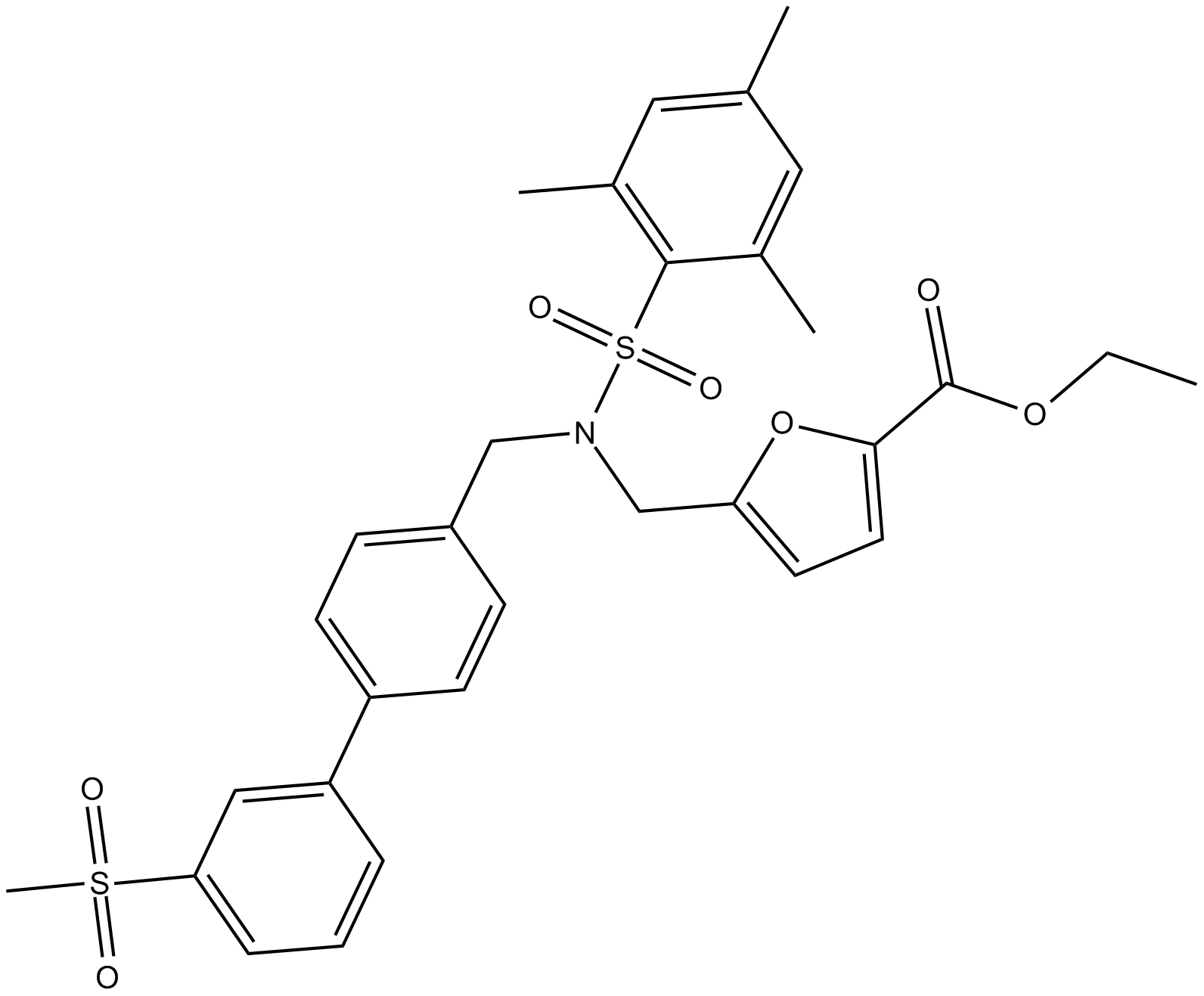
SR9238 عبارة عن ناهض عكسي لمستقبلات الكبد X الاصطناعية (LXR) مع IC50s من 214 نانومتر و 43 نانومتر لـ LXRα و LXRβ ، على التوالي
Products are for research use only. Not for human use. We do not sell to patients.
Cas No.: 1416153-62-2
Sample solution is provided at 25 µL, 10mM.
_1-3.$$$39978408@51.jpg');)
_1-9.$$$38538795@65.jpg');)
_1-9.$$$39112701@51.jpg');)
_1-7.$$$37316672@70.jpg');)
_366-372.$$$36198801@70.jpg');)
.$$$38565142@65.jpg');)
_1867-1883.$$$33248023@67.jpg');)
_eads6055.$$$39977546@45.jpg');)
_eadm9805.$$$40080571@45.jpg');)
_eadj3020.$$$39666821@45.jpg');)
_1-20.$$$39757301@28.jpg');)
_1-24.$$$38898113@28.jpg');)
_273-287.$$$36806353@46.jpg');)
_1-16.$$$37156877@44.jpg');)
_1-19.$$$37460805@44.jpg');)
_1291-1307.$$$34518654@46.jpg');)
SR9238 is a selective inverse agonist of LXRα and LXRβ with IC50 values of 214 and 43 nM, respectively [1].
The liver X receptors (LXRα and LXRβ) are members of the nuclear receptor superfamily that act as ligand-dependent transcription factors. LXRα is mainly expressed in the liver, kidneys, intestines, and adipose tissues while LXRβ is ubiquitously expressed. LXRs are well-characterized regulators of the expression of an array of lipogenic enzyme genes [1][2].
SR9238 is a potent and selective inverse agonist of LXRα and LXRβ. SR9238 increased interaction of corepressor NCoR ID1 with LXRα and LXRβ with EC50 values of 33 nM and 13 nM, respectively, and NCoR ID2 with LXRα and LXRβ with EC50 values of >10 μM and 93 nM. SR9238 also effectively inhibited transcription from a Fasn promoter driven luciferase reporter [1].
In mice, SR9238 was detected in the liver 2h after the injection and was not detectable in the plasma, skeletal muscle or brain. SR9238 displayed liver specific exposure. In hepatic steatosis mice, SR9238 (30 mg/kg/day, i.p.) significantly inhibited lipogenic gene expression and reduced lipid content in the liver [1]. In non-alcoholic steatohepatitis mice, SR9238 significantly reduced the severity of hepatic steatosis, reduced hepatic inflammation and ameliorated hepatic fibrosis [2].
References:
[1]. Griffett K, Solt LA, El-Gendy Bel-D, et al. A liver-selective LXR inverse agonist that suppresses hepatic steatosis. ACS Chem Biol. 2013 Mar 15;8(3):559-67.
[2]. Griffett K, Welch RD, Flaveny CA, et al. The LXR inverse agonist SR9238 suppresses fibrosis in a model of non-alcoholic steatohepatitis. Mol Metab. 2015 Feb 9;4(4):353-7.
Cell experiment: | HepG2 cells are seeded at 5×10⁵ cells/mL in a 4-chamber culture slide. The following day the media is removed and replaced with antibiotic-free media containing 10 μM of DMSO or SR9238 and cells are allowed to grow for 48 h. Cells are washed in TBS, fixed and fluorescently stained for SREBP2 according to the assay protocol[1]. |
Animal experiment: | Twenty-one-week-old male C57BL6 DIO mice are used. Animals are individually housed and fed a high fat diet (60% kcal/fat diet, 20% carbohydrate) for the duration of the experiment that includes SR9238 administration for 30 days (30 mg/kg, qd, ip). Prior to initiation of the experiment, animals are provided the high fat diet for 10-weeks. Animals are acclimated to the environment for one week and sham dosed with vehicle for 3 days prior to SR9238 administration. Body weight and food intake are monitored daily. Pre- and post-experiment body composition analysis is performed on all the mice. Blood is collected by cardiac puncture and used for plasma cholesterol and triglyceride measurements. Livers are weighed and immediately flash-frozen in liquid nitrogen for gene expression analysis or put in formalin on ice for histology[1]. |
References: [1]. Griffett K, et al. A liver-selective LXR inverse agonist that suppresses hepatic steatosis. ACS Chem Biol. 2013 Mar 15;8(3):559-67. | |
| Cas No. | 1416153-62-2 | SDF | |
| Chemical Name | 5-[[[[3'-(methylsulfonyl)[1,1'-biphenyl]-4-yl]methyl][(2,4,6-trimethylphenyl)sulfonyl]amino]methyl]-2-furancarboxylic acid, ethyl ester | ||
| Canonical SMILES | CS(C1=CC=CC(C2=CC=C(CN(CC3=CC=C(C(OCC)=O)O3)S(C4=C(C)C=C(C)C=C4C)(=O)=O)C=C2)=C1)(=O)=O | ||
| Formula | C31H33NO7S2 | M.Wt | 595.7 |
| الذوبان | ≤5mg/ml in DMSO;5mg/ml in dimethyl formamide | Storage | Store at -20°C |
| General tips | Please select the appropriate solvent to prepare the stock solution according to the
solubility of the product in different solvents; once the solution is prepared, please store it in
separate packages to avoid product failure caused by repeated freezing and thawing.Storage method
and period of the stock solution: When stored at -80°C, please use it within 6 months; when stored
at -20°C, please use it within 1 month. To increase solubility, heat the tube to 37°C and then oscillate in an ultrasonic bath for some time. |
||
| Shipping Condition | Evaluation sample solution: shipped with blue ice. All other sizes available: with RT, or with Blue Ice upon request. | ||
| Prepare stock solution | |||

|
1 mg | 5 mg | 10 mg |
| 1 mM | 1.6787 mL | 8.3935 mL | 16.787 mL |
| 5 mM | 335.7 μL | 1.6787 mL | 3.3574 mL |
| 10 mM | 167.9 μL | 839.3 μL | 1.6787 mL |
Step 1: Enter information below (Recommended: An additional animal making an allowance for loss during the experiment)
 g
μL
g
μL
Step 2: Enter the in vivo formulation (This is only the calculator, not formulation. Please contact us first if there is no in vivo formulation at the solubility Section.)
Calculation results:
Working concentration: mg/ml;
Method for preparing DMSO master liquid: mg drug pre-dissolved in μL DMSO ( Master liquid concentration mg/mL, Please contact us first if the concentration exceeds the DMSO solubility of the batch of drug. )
Method for preparing in vivo formulation: Take μL DMSO master liquid, next addμL PEG300, mix and clarify, next addμL Tween 80, mix and clarify, next add μL saline, mix and clarify.
Method for preparing in vivo formulation: Take μL DMSO master liquid, next add μL Corn oil, mix and clarify.
Note: 1. Please make sure the liquid is clear before adding the next solvent.
2. Be sure to add the solvent(s) in order. You must ensure that the solution obtained, in the previous addition, is a clear solution before proceeding to add the next solvent. Physical methods such as vortex, ultrasound or hot water bath can be used to aid dissolving.
3. All of the above co-solvents are available for purchase on the GlpBio website.
Quality Control & SDS
- View current batch:
- Purity: >99.50% Appearance: A solid
- COA (Certificate of Analysis)
- SDS (Safety Data Sheet)
- Datasheet
Average Rating: 5 (Based on Reviews and 13 reference(s) in Google Scholar.)