

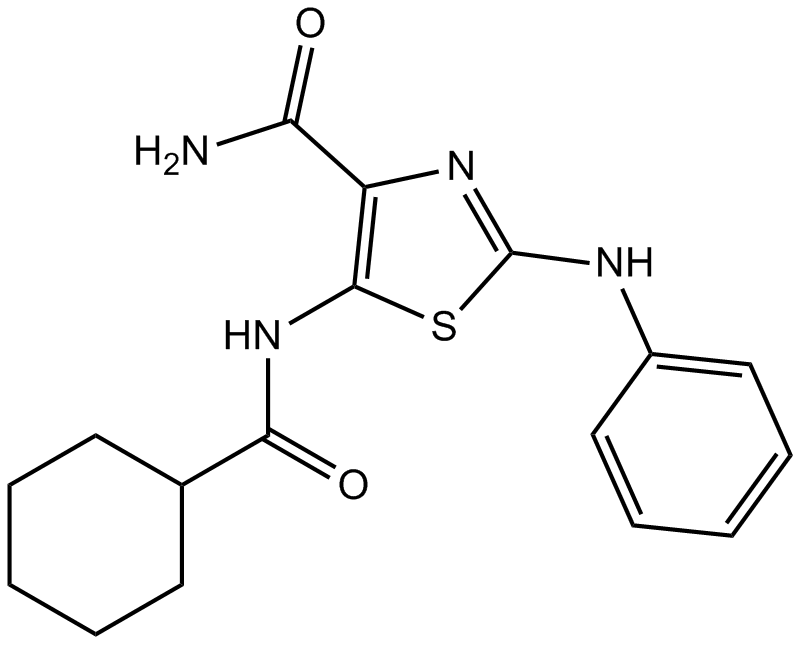
UNC 3230 |
رقم الكتالوجGC13054
 One-Click Copy Product Info
|

UNC 3230 هو مثبط PIP5K1C قوي وانتقائي وتنافسي ATP مع IC50 بحوالي 41 نانومتر.
Products are for research use only. Not for human use. We do not sell to patients.
Cas No.: 1031602-63-7
Sample solution is provided at 25 µL, 10mM.
_1-3.$$$39978408@51.jpg');)
_1-9.$$$38538795@65.jpg');)
_1-9.$$$39112701@51.jpg');)
_1-7.$$$37316672@70.jpg');)
_366-372.$$$36198801@70.jpg');)
.$$$38565142@65.jpg');)
_1867-1883.$$$33248023@67.jpg');)
_eads6055.$$$39977546@45.jpg');)
_eadm9805.$$$40080571@45.jpg');)
_eadj3020.$$$39666821@45.jpg');)
_1-20.$$$39757301@28.jpg');)
_1-24.$$$38898113@28.jpg');)
_273-287.$$$36806353@46.jpg');)
_1-16.$$$37156877@44.jpg');)
_1-19.$$$37460805@44.jpg');)
_1291-1307.$$$34518654@46.jpg');)
UNC 3230 is a highly selective and ATP-competitive phosphatidylinositol 4-phosphate 5-kinase type 1C (PIP5K1C) inhibitor with an IC50 value of 41nM[1,2]. By inhibiting PIP5K1C, UNC 3230 reduces PIP2 levels in dorsal root ganglion (DRG) neurons, leading to decreased calcium signaling and alleviation of pain hypersensitivity[3]. UNC 3230 is commonly used in research to investigate the specific mechanisms of PIP5K1C and its related pathways in pain regulation and tumorigenesis[1,4].
In vitro, treatment of mouse oligodendrocyte FBD-102b cells with UNC 3230 (5μM) for 2 days inhibited cellular morphological differentiation and reduced the expression levels of myelin differentiation marker proteins PLP1 and CNPase[5]. Pretreatment of hACE2-GFP-expressing HEK293T cells with UNC 3230 (0.5μM), followed by co-incubation with the spike protein receptor-binding domain (RBD) for 2h, effectively inhibited ACE2-mediated endocytosis triggered by the spike protein[6]. Treatment of α-Syn-expressing SH-SY5Y cells with UNC 3230 (100nM) for 24h significantly reduced the accumulation of α-Syn near the cell membrane[7].
In vivo, when xenograft tumors formed by SW480 cells in specific pathogen-free female athymic nude mice reached a visible size (approximately 200mm3), administration of UNC 3230 (5mg/kg; three times/week) via intraperitoneal injection for 3 weeks significantly reduced tumor burden, glucose levels, and lactate levels in the subcutaneous model[8]. Intrathecal injection of UNC 3230 (2nM; 5μL) in wild-type mice significantly increased their paw withdrawal latency in response to noxious heat stimuli within 2h post-injection[1].
References:
[1] WRIGHT B D, LOO L, STREET S E, et al. The lipid kinase PIP5K1C regulates pain signaling and sensitization[J]. Neuron, 2014, 82(4): 836-847.
[2] WRIGHT B D, SIMPSON C, STASHKO M, et al. Development of a high-throughput screening assay to identify inhibitors of the lipid kinase PIP5K1C[J]. Journal of Biomolecular Screening, 2015, 20(5): 655-662.
[3] LOO L, WRIGHT B D, ZYLKA M J. Lipid kinases as therapeutic targets for chronic pain[J]. Pain, 2015, 156: S2-S10.
[4] HOFBRUCKER-MACKENZIE S A, SEEMANN E, WESTERMANN M, et al. Long-term depression in neurons involves temporal and ultra-structural dynamics of phosphatidylinositol-4, 5-bisphosphate relying on PIP5K, PTEN and PLC[J]. Communications Biology, 2023, 6(1): 366.
[5] KATO Y, OCHIAI A, SEKI Y, et al. Phospholipase D and phosphatidylinositol-4-phosphate 5-kinase 1 are involved in the regulation of oligodendrocyte morphological differentiation[J]. Experimental Cell Research, 2021, 405(1): 112654.
[6] SEO Y, JANG Y, LEE S G, et al. A dual inhibitor of PIP5K1C and PIKfyve prevents SARS-CoV-2 entry into cells[J]. Experimental & Molecular Medicine, 2024, 56(8): 1736-1749.
[7] HORVATH J D, CASAS M, KUTCHUKIAN C, et al. α-Synuclein-dependent increases in PIP5K1γ drive inositol signaling to promote neurotoxicity[J]. Cell Reports, 2023, 42(10).
[8] PENG W, HUANG W, GE X, et al. Type Iγ phosphatidylinositol phosphate kinase promotes tumor growth by facilitating Warburg effect in colorectal cancer[J]. EBioMedicine, 2019, 44: 375-386.
| Kinase experiment [1]: | |
Preparation Method | Fluorescein-conjugated PI(4)P (1µM) was incubated with 100nM N-terminal His6-tagged full-length (90kDa) recombinant human PIP5K1C and varying concentrations of ATP (threefold serial dilution starting at 1000µM; 11 concentrations total) to determine the ATP Km. The LabChip MSA platform was used to monitor the reactions kinetically (every 5min for ~80min). Michaelis-Menten analysis, using initial rate velocities, revealed an ATP Km of 15µM. Next, reactions containing 1µM PI(4)P, 15µM ATP, and varying concentrations (twofold serial dilution starting at 10nM; seven concentrations total) of PIP5K1C were read kinetically (every 6min for 45min) to determine the concentration of enzyme that would give ~30% conversion of substrate to product at an endpoint within the linear range of the reaction. A final concentration of 3nM PIP5K1C and a 40min incubation time were chosen. Kinase titrations were performed for UNC 3230. Further optimization of the assay (incubation of kinase with UNC 3230 for 20min prior to the addition of kinase), using a new lot of kinase and a tighter dose-response curve (10 point; 1µM highest concentration). |
Reaction Conditions | 20min |
Applications | UNC 3230 was the most potent inhibitors of PIP5K1C (IC50 of 0.120μM). Following assay optimization, UNC 3230 yielded a reproducible potency value of ~40nM. |
| Cell experiment [2]: | |
Cell lines | FBD-102b (Mouse brain oligodendrocyte precursor cell line) |
Preparation Method | FBD-102b cells were allowed to differentiate in the presence of 5μM UNC 3230 for two days. Their cell lysates were used for immunoblotting with an antibody against PLP1, CNPase. Cells with myelin web-like membrane structures bearing multiple processes (primary and secondary branches) from the cell bodies were identified as differentiated. |
Reaction Conditions | 5μM; 2 days |
Applications | Treatment with UNC 3230 blunted morphological differentiation and decreased expression of myelin and differentiation marker proteins (PLP1 and CNPase). |
| Animal experiment [3]: | |
Animal models | Pathogen-free female athymic nude mice implanted with SW480 xenograft tumors |
Preparation Method | Tumor cells (SW480, 1 × 10⁶) were injected subcutaneously into the right scapular region of nude. Mice were intraperitoneally injected with 5mg/kg UNC 3230 three times a week for three weeks when bore visible tumors (200mm3). Lactate production was measured using a commercial Lactate Assay Kit, glucose levels in the culture medium were measured using a Colorimetric Glucose Assay Kit. |
Dosage form | 5mg/kg; three times/week; 3 weeks; i.p. |
Applications | In xenograft tumors formed by SW480 cells, blocking PIPKIγ activity with UNC 3230 significantly reduced tumor burden, glucose level, and lactate level in the subcutaneous model. |
References: | |
| Cas No. | 1031602-63-7 | SDF | |
| Chemical Name | 5-(cyclohexanecarboxamido)-2-(phenylamino)thiazole-4-carboxamide | ||
| Canonical SMILES | NC(C1=C(NC(C2CCCCC2)=O)SC(NC3=CC=CC=C3)=N1)=O | ||
| Formula | C17H20N4O2S | M.Wt | 344.43 |
| الذوبان | 0.2mg/mL in ethanol, 30mg/mL in DMSO, or in DMF | Storage | Store at -20°C |
| General tips | Please select the appropriate solvent to prepare the stock solution according to the
solubility of the product in different solvents; once the solution is prepared, please store it in
separate packages to avoid product failure caused by repeated freezing and thawing.Storage method
and period of the stock solution: When stored at -80°C, please use it within 6 months; when stored
at -20°C, please use it within 1 month. To increase solubility, heat the tube to 37°C and then oscillate in an ultrasonic bath for some time. |
||
| Shipping Condition | Evaluation sample solution: shipped with blue ice. All other sizes available: with RT, or with Blue Ice upon request. | ||
| Prepare stock solution | |||

|
1 mg | 5 mg | 10 mg |
| 1 mM | 2.9033 mL | 14.5167 mL | 29.0335 mL |
| 5 mM | 580.7 μL | 2.9033 mL | 5.8067 mL |
| 10 mM | 290.3 μL | 1.4517 mL | 2.9033 mL |
Step 1: Enter information below (Recommended: An additional animal making an allowance for loss during the experiment)
 g
μL
g
μL
Step 2: Enter the in vivo formulation (This is only the calculator, not formulation. Please contact us first if there is no in vivo formulation at the solubility Section.)
Calculation results:
Working concentration: mg/ml;
Method for preparing DMSO master liquid: mg drug pre-dissolved in μL DMSO ( Master liquid concentration mg/mL, Please contact us first if the concentration exceeds the DMSO solubility of the batch of drug. )
Method for preparing in vivo formulation: Take μL DMSO master liquid, next addμL PEG300, mix and clarify, next addμL Tween 80, mix and clarify, next add μL saline, mix and clarify.
Method for preparing in vivo formulation: Take μL DMSO master liquid, next add μL Corn oil, mix and clarify.
Note: 1. Please make sure the liquid is clear before adding the next solvent.
2. Be sure to add the solvent(s) in order. You must ensure that the solution obtained, in the previous addition, is a clear solution before proceeding to add the next solvent. Physical methods such as vortex, ultrasound or hot water bath can be used to aid dissolving.
3. All of the above co-solvents are available for purchase on the GlpBio website.
Quality Control & SDS
- View current batch:
- Purity: >99.50% Appearance: A solid
- COA (Certificate of Analysis)
- SDS (Safety Data Sheet)
- Datasheet
Average Rating: 5 (Based on Reviews and 9 reference(s) in Google Scholar.)