

AS601245 (Synonyms: AS-601245, c-Jun N-terminal Kinase Inhibitor V) |
رقم الكتالوجGC10010
 One-Click Copy Product Info
|

AS601245 هو مثبط JNK نشط عن طريق الفم ، انتقائي ، ATP تنافسي (c-Jun NH2- بروتين كيناز) مع IC50s من 150 ، 220 ، و 70 نانومتر لثلاثة أشكال إسوية بشرية JNK (hJNK1 ، hJNK2 ، و hJNK3) ، على التوالي
Products are for research use only. Not for human use. We do not sell to patients.
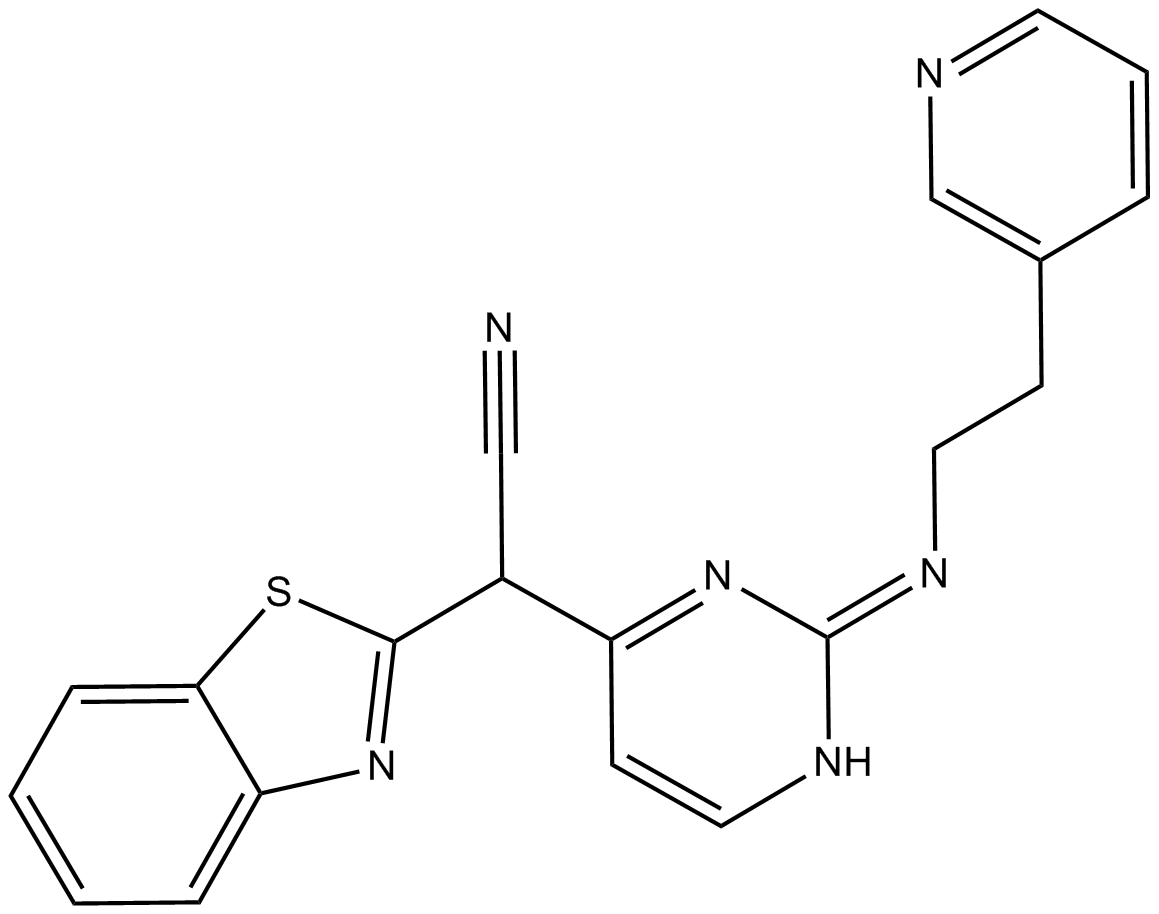
Cas No.: 345987-15-7
Sample solution is provided at 25 µL, 10mM.
AS601245 is a potent ATP-competitive JNK inhibitor with IC50 values of 0.15µM, 0.22, and 0.07µM for JNK1, JNK2, and JNK3, respectively [1]. AS601245 can prevent P-TEFb from being released from the inactive complex formed with HEXIM-1, and interfere with the reactivation of the HIV-1 virus at multiple levels[2]. AS601245 has been widely used to inhibit the growth of follicular cells and interfere with the progression of the cell cycle[3].
In vitro, AS601245 treatment for 96h significantly inhibited the proliferation of CaCo-2 cells, with an IC50 value of 2.5µM[4]. 0.1µM of AS601245 treatment for 24 hours significantly increased the expression of p21 in HepG2 cells and inhibited cell viability[5]. Treatment with 10µM AS601245 for 24 hours significantly promoted apoptosis of SH-SY5Y cells, accompanied by an increase in caspase-3 activity, expression of pro-apoptotic proteins, as well as significant disruptions in oxidative phosphorylation and glycolysis[6].
In vivo, AS601245 treatment via intraperitoneal injection at a dose of 80mg/kg at 15 minutes and 24 hours after restoration of carotid artery flow prevented neurite loss, reduced astrogliosis, and improved long-term memory deficits induced by cerebral ischemia in gerbils [7]. A single oral administration of 10mg/kg dose of AS601245 significantly inhibited the release of TNF-α in mice caused by endotoxins[8].
References:
[1] Malemud C J. Small molecular weight inhibitors of stress-activated and mitogen-activated protein kinases[J]. Mini Reviews in Medicinal Chemistry, 2006, 6(6): 689-698.
[2] Wolschendorf F, Bosque A, Shishido T, et al. Kinase control prevents HIV-1 reactivation in spite of high levels of induced NF-κB activity[J]. Journal of virology, 2012, 86(8): 4548-4558.
[3] Oktem O, Oktay K. c-Jun N-terminal kinase (JNK) pathway controls granulosa cell mitosis: a novel mechanism in regulation of preantral follicle growth[J]. Fertility and Sterility, 2008, 90: S330.
[4] Cerbone A, Toaldo C, Minelli R, et al. Rosiglitazone and AS601245 decrease cell adhesion and migration through modulation of specific gene expression in human colon cancer cells[J]. PLoS One, 2012, 7(6): e40149.
[5] Cerbone A, Toaldo C, Pizzimenti S, et al. AS601245, an anti‐inflammatory JNK inhibitor, and Clofibrate have a synergistic effect in inducing cell responses and in affecting the gene expression profile in CaCo‐2 colon cancer cells[J]. PPAR research, 2012, 2012(1): 269751.
[6] Granek Z, Siwecka N, Saramowicz K, et al. Pharmacological Inhibition of JNK Signalling Exerts Anti-Neoplastic Effects on SH-SY5Y Human Neuroblastoma Cells[J]. International Journal of Molecular Sciences, 2025, 26(24): 11894.
[7] Carboni S, Boschert U, Gaillard P, et al. AS601245, ac‐Jun NH2‐terminal kinase (JNK) inhibitor, reduces axon/dendrite damage and cognitive deficits after global cerebral ischaemia in gerbils[J]. British journal of pharmacology, 2008, 153(1): 157-163.
[8] Carboni S, Hiver A, Szyndralewiez C, et al. AS601245 (1, 3-Benzothiazol-2-yl (2-{[2-(3-pyridinyl) ethyl] amino}-4 pyrimidinyl) Acetonitrile): a c-Jun NH2-terminal protein kinase inhibitor with neuroprotective properties[J]. The Journal of pharmacology and experimental therapeutics, 2004, 310(1): 25-32.
| Cell experiment [1]: | |
Cell lines | CaCo-2 cells |
Preparation Method | CaCo-2 cells were grown in DMEM medium with 10% (v/v) fetal bovine serum (FBS), 2 mM glutamine, 1% non-essential amino acids solution, and 1% antibiotic mixture (penicillin-streptomycin) at 37°C in 5% CO2/atmosphere. CaCo-2 cells (3×10³ cells) were seeded in 96-well plates, incubated for 24h, and then treated with different concentrations of AS601245 (0.1, 1, 10, and 50µM) at 37°C. After 96h, cell viability was measured. |
Reaction Conditions | 0.1, 1, 10, and 50µM; 96h |
Applications | AS601245 treatment significantly reduced the cell viability of CaCo-2 cells in a concentration-dependent manner. |
| Animal experiment [2]: | |
Animal models | C3H/HEN mice |
Preparation Method | C3H/HEN mice were kept in a temperature-controlled (20-22°C) and light/dark cycle-controlled animal room (lights on at 7:00 AM and off at 7:00 PM). Standard laboratory chow and water were available ad libitum. Mice received an oral treatment with AS601245 (10mg/kg in 0.5% CMC/0.25% Tween 20). Fifteen minutes later, endotoxins (O111:B4; 0.3mg/kg) were i.p. injected. Heparinized whole blood was collected by retroorbital puncture under isoflurane anesthesia. TNF-α was determined in plasma. |
Dosage form | 10mg/kg for once; p.o. |
Applications | AS601245 treatment significantly reduced TNF-α levels in mice after treatment with endotoxins. |
References: | |
| Cas No. | 345987-15-7 | SDF | |
| المرادفات | AS-601245, c-Jun N-terminal Kinase Inhibitor V | ||
| Chemical Name | (Z)-2-(benzo[d]thiazol-2-yl)-2-(2-((2-(pyridin-3-yl)ethyl)imino)-1,2-dihydropyrimidin-4-yl)acetonitrile | ||
| Canonical SMILES | N#CC(C1=NC2=CC=CC=C2S1)C(C=CN/3)=NC3=N/CCC4=CN=CC=C4 | ||
| Formula | C20H16N6S | M.Wt | 372.45 |
| الذوبان | ≥ 14.25mg/mL in DMSO, ≥ 10mg/mL in Water with gentle warming | Storage | Store at -20°C |
| General tips | Please select the appropriate solvent to prepare the stock solution according to the
solubility of the product in different solvents; once the solution is prepared, please store it in
separate packages to avoid product failure caused by repeated freezing and thawing.Storage method
and period of the stock solution: When stored at -80°C, please use it within 6 months; when stored
at -20°C, please use it within 1 month. To increase solubility, heat the tube to 37°C and then oscillate in an ultrasonic bath for some time. |
||
| Shipping Condition | Evaluation sample solution: shipped with blue ice. All other sizes available: with RT, or with Blue Ice upon request. | ||
| Prepare stock solution | |||

|
1 mg | 5 mg | 10 mg |
| 1 mM | 2.6849 mL | 13.4246 mL | 26.8492 mL |
| 5 mM | 537 μL | 2.6849 mL | 5.3698 mL |
| 10 mM | 268.5 μL | 1.3425 mL | 2.6849 mL |
Step 1: Enter information below (Recommended: An additional animal making an allowance for loss during the experiment)
 g
μL
g
μL
Step 2: Enter the in vivo formulation (This is only the calculator, not formulation. Please contact us first if there is no in vivo formulation at the solubility Section.)
Calculation results:
Working concentration: mg/ml;
Method for preparing DMSO master liquid: mg drug pre-dissolved in μL DMSO ( Master liquid concentration mg/mL, Please contact us first if the concentration exceeds the DMSO solubility of the batch of drug. )
Method for preparing in vivo formulation: Take μL DMSO master liquid, next addμL PEG300, mix and clarify, next addμL Tween 80, mix and clarify, next add μL saline, mix and clarify.
Method for preparing in vivo formulation: Take μL DMSO master liquid, next add μL Corn oil, mix and clarify.
Note: 1. Please make sure the liquid is clear before adding the next solvent.
2. Be sure to add the solvent(s) in order. You must ensure that the solution obtained, in the previous addition, is a clear solution before proceeding to add the next solvent. Physical methods such as vortex, ultrasound or hot water bath can be used to aid dissolving.
3. All of the above co-solvents are available for purchase on the GlpBio website.
Quality Control & SDS
- View current batch:
- Purity: >98.50% Appearance: A solid
- COA (Certificate of Analysis)
- SDS (Safety Data Sheet)
- Datasheet
Average Rating: 5 (Based on Reviews and 13 reference(s) in Google Scholar.)