
C6 Ceramide (d18:1/6:0) (Synonyms: N-hexanoyl-D-erythro-sphingosine) |
| رقم الكتالوجGC11079 |
يُظهر C6-ceramide ، وهو منشط لمسار سيراميد ، نشاطًا ضد مجموعة متنوعة من خطوط الخلايا السرطانية. يمكن استخدام C6-ceramide كعامل مساعد لعوامل العلاج الكيميائي ، لتعزيز التأثيرات المضادة للورم.
Products are for research use only. Not for human use. We do not sell to patients.
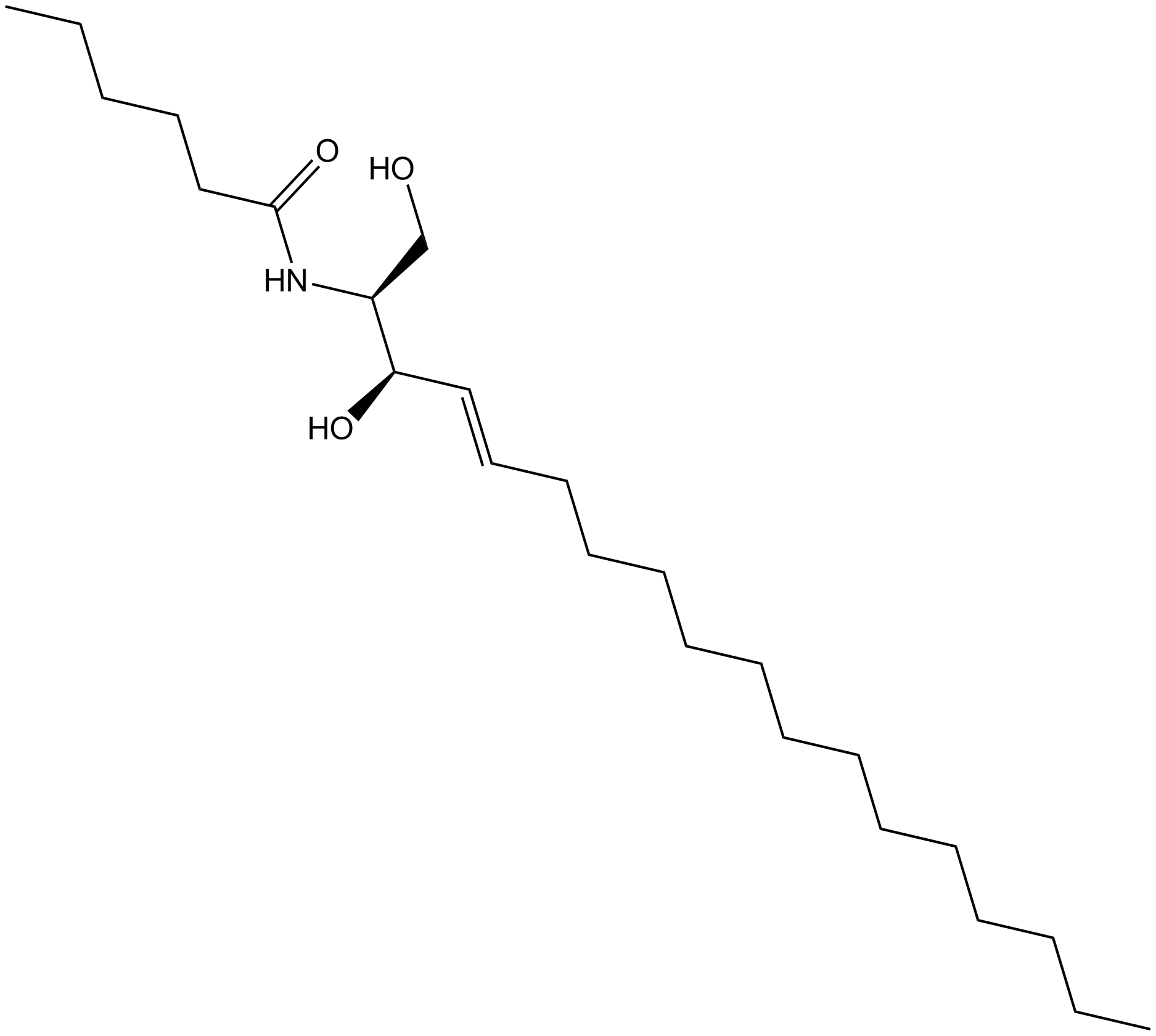
Cas No.: 124753-97-5
Sample solution is provided at 25 µL, 10mM.
C6 Ceramide (d18:1/6:0) is a short-chain, cell-permeable analog of ceramide that has been utilized in preclinical studies to mimic the effects of endogenous ceramide[1]. C6 Ceramide (d18:1/6:0) can induce cell death by both apoptosis and necrosis[2]. C6 Ceramide (d18:1/6:0) is primarily used in research areas such as cancer biology[3][4].
C6 Ceramide (d18:1/6:0) (25µM; 24h) treatment strongly reduced cell viability of CTCL cell lines and induced cell death via apoptosis and necrosis[5]. In MDA-231 and MCF-7 cells, treatment with C6 Ceramide (d18:1/6:0) at 10μg/mL for 72 hours dramatically enhances docetaxel-induced cytotoxicity[6].
C6 Ceramide (d18:1/6:0) (60mg/kg; 15d; i.p.) treatment effectively suppresses the growth of CHMp xenograft tumors in mice[7]. C6 Ceramide (d18:1/6:0) (10mg/kg; 6d; i.p.) combined with Trichostatin-A treatment showed significant tumor growth inhibition, increased survival rate and reduced tumor size in mice xenograft pancreatic and ovarian cancer models[8].
References:
[1]. Morad SA, Ryan TE, Neufer PD, et al. Ceramide-tamoxifen regimen targets bioenergetic elements in acute myelogenous leukemia. J Lipid Res. 2016 Jul;57(7):1231-42. doi: 10.1194/jlr.M067389. Epub 2016 May 2. PMID: 27140664; PMCID: PMC4918852.
[2]. Gentil B, Grimot F, Riva C. Commitment to apoptosis by ceramides depends on mitochondrial respiratory function, cytochrome c release and caspase-3 activation in Hep-G2 cells. Mol Cell Biochem. 2003 Dec;254(1-2):203-10. doi: 10.1023/a:1027359832177. PMID: 14674699.
[3]. Flowers M, Fabriás G, Delgado A, et al. C6-ceramide and targeted inhibition of acid ceramidase induce synergistic decreases in breast cancer cell growth. Breast Cancer Res Treat. 2012 Jun;133(2):447-58. doi: 10.1007/s10549-011-1768-8. Epub 2011 Sep 21. PMID: 21935601.
[4]. Fillet M, Bentires-Alj M, Deregowski V, et al. Mechanisms involved in exogenous C2- and C6-ceramide-induced cancer cell toxicity. Biochem Pharmacol. 2003 May 15;65(10):1633-42. doi: 10.1016/s0006-2952(03)00125-4. PMID: 12754099.
[5]. Wilhelm R, Eckes T, Imre G, et al. C6 Ceramide (d18:1/6:0) as a Novel Treatment of Cutaneous T Cell Lymphoma. Cancers (Basel). 2021 Jan 13;13(2):270. doi: 10.3390/cancers13020270. PMID: 33450826; PMCID: PMC7828274.
[6]. Yang L, Zheng LY, Tian Y, et al. C6 ceramide dramatically enhances docetaxel-induced growth inhibition and apoptosis in cultured breast cancer cells: a mechanism study. Exp Cell Res. 2015 Mar 1;332(1):47-59. doi: 10.1016/j.yexcr.2014.12.017. Epub 2015 Jan 6. PMID: 25576381.
[7]. Liu J, Zhao F, Zhang Y, et al. C6 Ceramide Inhibits Canine Mammary Cancer Growth and Metastasis by Targeting EGR3 through JAK1/STAT3 Signaling. Animals (Basel). 2024 Jan 27;14(3):422. doi: 10.3390/ani14030422. PMID: 38338065; PMCID: PMC10854580.
[8]. Zhu QY, Wang Z, Ji C, et al. C6-ceramide synergistically potentiates the anti-tumor effects of histone deacetylase inhibitors via AKT dephosphorylation and α-tubulin hyperacetylation both in vitro and in vivo. Cell Death Dis. 2011 Jan 27;2(1):e117. doi: 10.1038/cddis.2010.96. PMID: 21368888; PMCID: PMC3077291.
| Cell experiment [1]: | |
Cell lines | HaCaT cells |
Preparation Method | HaCaT cells were treated with 1, 5, 10, 25, 50, and 100µM C6 Ceramide (d18:1/6:0) for 24h. Then Cell viability was determined by MTS assay. To measure cell viability, 3×10⁴ HaCaT cells were seeded in 96-well plates in 100µL volume and 10µL MTS was added and incubated at 37◦C for 1h. The absorbance at 490nm was recorded using the microplate reader. |
Reaction Conditions | 1, 5, 10, 25, 50, 100µM; 24h |
Applications | C6 Ceramide (d18:1/6:0) treatment can significantly reduce the cell viability of HaCaT cells. |
| Animal experiment [2]: | |
Animal models | Primary tumor model Mouse |
Preparation Method | Primary tumor-bearing mouse were treatment with 60 mg/kg C6 Ceramide (d18:1/6:0) for 15 days, the tumor volume were measure at the end of the experiment. |
Dosage form | 60mg/kg/d; 15d; i.p. |
Applications | C6 Ceramide (d18:1/6:0) treatment effectively suppresses the growth of CHMp xenograft tumors in vivo. |
References: | |
| Cas No. | 124753-97-5 | SDF | |
| المرادفات | N-hexanoyl-D-erythro-sphingosine | ||
| Chemical Name | N-[(1S,2R,3E)-2-hydroxy-1-(hydroxymethyl)-3-heptadecen-1-yl]-hexanamide | ||
| Canonical SMILES | CCCCCCCCCCCCC/C=C/[C@@H](O)[C@@H](NC(CCCCC)=O)CO | ||
| Formula | C24H47NO3 | M.Wt | 397.6 |
| الذوبان | 20mg/mL in DMSO, 22mg/mL in DMF, 33mg/mL in Ethanol | Storage | Store at -20°C |
| General tips | Please select the appropriate solvent to prepare the stock solution according to the
solubility of the product in different solvents; once the solution is prepared, please store it in
separate packages to avoid product failure caused by repeated freezing and thawing.Storage method
and period of the stock solution: When stored at -80°C, please use it within 6 months; when stored
at -20°C, please use it within 1 month. To increase solubility, heat the tube to 37°C and then oscillate in an ultrasonic bath for some time. |
||
| Shipping Condition | Evaluation sample solution: shipped with blue ice. All other sizes available: with RT, or with Blue Ice upon request. | ||
| Prepare stock solution | |||
|
1 mg | 5 mg | 10 mg |
| 1 mM | 2.5151 mL | 12.5755 mL | 25.1509 mL |
| 5 mM | 503 μL | 2.5151 mL | 5.0302 mL |
| 10 mM | 251.5 μL | 1.2575 mL | 2.5151 mL |
Step 1: Enter information below (Recommended: An additional animal making an allowance for loss during the experiment)
Step 2: Enter the in vivo formulation (This is only the calculator, not formulation. Please contact us first if there is no in vivo formulation at the solubility Section.)
Calculation results:
Working concentration: mg/ml;
Method for preparing DMSO master liquid: mg drug pre-dissolved in μL DMSO ( Master liquid concentration mg/mL, Please contact us first if the concentration exceeds the DMSO solubility of the batch of drug. )
Method for preparing in vivo formulation: Take μL DMSO master liquid, next addμL PEG300, mix and clarify, next addμL Tween 80, mix and clarify, next add μL ddH2O, mix and clarify.
Method for preparing in vivo formulation: Take μL DMSO master liquid, next add μL Corn oil, mix and clarify.
Note: 1. Please make sure the liquid is clear before adding the next solvent.
2. Be sure to add the solvent(s) in order. You must ensure that the solution obtained, in the previous addition, is a clear solution before proceeding to add the next solvent. Physical methods such as vortex, ultrasound or hot water bath can be used to aid dissolving.
3. All of the above co-solvents are available for purchase on the GlpBio website.
Quality Control & SDS
- View current batch:
- Purity: >98.00%
- COA (Certificate Of Analysis)
- SDS (Safety Data Sheet)
- Datasheet
Average Rating: 5 (Based on Reviews and 3 reference(s) in Google Scholar.)
GLPBIO products are for RESEARCH USE ONLY. Please make sure your review or question is research based.
Required fields are marked with *
