

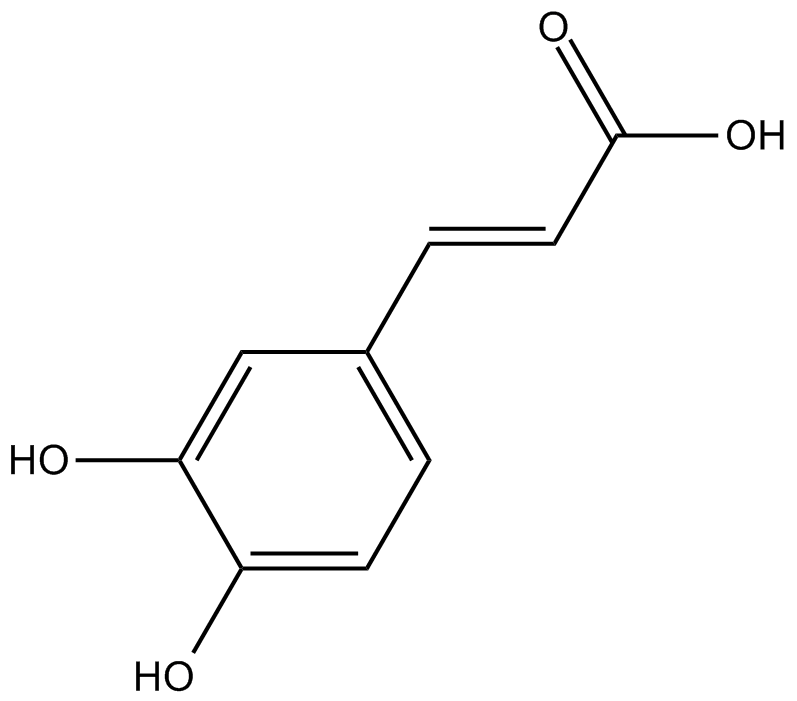
Caffeic acid (Synonyms: 3,4-Dihydroxycinnamic Acid) |
رقم الكتالوجGN10792
 One-Click Copy Product Info
|

Caffeic acid is a hydroxycinnamic acid polyphenol compound with antioxidant activity. Caffeic acid is an inhibitor of TRPV1 ion channel and 5-lipoxygenase.
Products are for research use only. Not for human use. We do not sell to patients.
Cas No.: 331-39-5
Sample solution is provided at 25 µL, 10mM.
_1-3.$$$39978408@51.jpg');)
_1-9.$$$38538795@65.jpg');)
_1-9.$$$39112701@51.jpg');)
_1-7.$$$37316672@70.jpg');)
_366-372.$$$36198801@70.jpg');)
.$$$38565142@65.jpg');)
_1867-1883.$$$33248023@67.jpg');)
_eads6055.$$$39977546@45.jpg');)
_eadm9805.$$$40080571@45.jpg');)
_eadj3020.$$$39666821@45.jpg');)
_1-20.$$$39757301@28.jpg');)
_1-24.$$$38898113@28.jpg');)
_273-287.$$$36806353@46.jpg');)
_1-16.$$$37156877@44.jpg');)
_1-19.$$$37460805@44.jpg');)
_1291-1307.$$$34518654@46.jpg');)
Caffeic acid is a hydroxycinnamic acid polyphenol compound with antioxidant activity. Caffeic acid is an inhibitor of TRPV1 ion channel and 5-lipoxygenase. Caffeic acid scavenges free radicals and chelates metal ions. Caffeic acid inhibits inflammatory signaling pathways such as NF-κB and activates Nrf2 pathway to enhance cellular antioxidant defense. These actions reduce oxidative stress and inflammation. Caffeic acid can be used for research on oxidative stress, inflammation, microbial infection, and tumor[1-4].
In vitro, treatment of A2780 cells and cisplatin-resistant A2780cisR cells with 50µM Caffeic acid and 5-20µM Cisplatin for 24-48 hours enhanced cisplatin cytotoxicity, increased nuclear DNA platinum binding, and activated Caspase-3[5]. Treatment of HT-29 cells with 1.68μg/ml Caffeic acid for 24 hours downregulated CTSZ, AFF4, DHRS2, and HMGCS1 gene expression and upregulated HINT3, SIAE, and DHRS2 gene expression[6]. Treatment of MDA-MB-231 and MDA-MB-468 cells with 100-300µM Caffeic acid for 48 hours inhibited cell proliferation, induced apoptosis, arrested cell cycle at G2/M phase, decreased mitochondrial membrane potential, reduced reactive oxygen species levels, downregulated FOXO1 protein, upregulated phosphorylated FOXO1, upregulated mitochondrial fission proteins FIS and DRP1, decreased CD44-positive tumor stem cell sphere proportion, reduced sphere volume, activated lysosomes, and induced mitophagy[7].
In vivo, oral gavage of 50mg/kg/day Caffeic acid to Aβ1–42-induced mice for 2 weeks improved spatial learning, memory, and cognitive ability, decreased reactive oxygen species and lipid peroxidation levels in the brain, downregulated Aβ and BACE-1 expression, and enhanced PI3K/AKT, BDNF, and synaptic marker SNAP-25, Synaptophysin, SNAP-23, and PSD-95 expression[8]. Intraperitoneal injection of 20mg/kg Caffeic acid into ApoE-/- mice every other day for 2 months reduced atherosclerotic lesion area in the aorta and aortic sinus, alleviated cognitive decline, and decreased hippocampal β-amyloid accumulation[9]. Daily oral gavage of 10mg/kg Caffeic acid to pulmonary fibrosis BALB/c mouse models for 3 weeks prolonged treadmill exercise time, decreased serum TNF-α, IL-6, and IL-1β concentrations, attenuated pulmonary septal thickening, and reduced pulmonary tissue collagen deposition[10].
References:
[1] Pavlíková N. Caffeic Acid and Diseases-Mechanisms of Action. Int J Mol Sci. 2022 Dec 29;24(1):588.
[2] Calabrese EJ, Pressman P, Hayes AW, Baldwin L, Agathokleous E, Dhawan G, Kapoor R, Calabrese V. Caffeic Acid: Numerous Chemoprotective Effects are Mediated via Hormesis. J Diet Suppl. 2024;21(6):842-867.
[3] Cortez N, Villegas C, Burgos V, et al. Adjuvant Properties of Caffeic Acid in Cancer Treatment. Int J Mol Sci. 2024 Jul 11;25(14):7631.
[4] Almatroodi SA, Rahmani AH. Caffeic Acid and Human Health: Evidence-Based Roles in Disease Prevention and Treatment. Int J Mol Sci. 2026 May 23;27(11):4719.
[5] Sirota R, Gibson D, Kohen R, et al. The timing of caffeic acid treatment with cisplatin determines sensitization or resistance of ovarian carcinoma cell lines. Redox Biology. 2017;11:170-175.
[6] Rezaei-Tavirani M, Rezaei Tavirani M, Zamanian Azodi M. The bioinformatics aspects of gene screening of HT-29, human colon cell line treated with caffeic acid. Gastroenterol Hepatol Bed Bench. 2019;12(3):246-253.
[7] Xie C, Chan L, Pang Y, et al. Caffeic acid inhibits the tumorigenicity of triple-negative breast cancer cells through the FOXO1/FIS pathway. Biomedicine & Pharmacotherapy. 2024 Jul;178:117158.
[8] Khan A, Park JS, Kang MH, et al. Caffeic Acid, a Polyphenolic Micronutrient Rescues Mice Brains against Aβ-Induced Neurodegeneration and Memory Impairment. Antioxidants. 2023;12:1284.
[9] Sun R, Wu T, Xing S, et al. Caffeic acid protects against atherosclerotic lesions and cognitive decline in ApoE-/- mice. Journal of Pharmacological Sciences. 2023;151(2):110-118.
[10] Zhu Y, Zhang Y, Zhang Q, et al. Caffeic Acid Acts as a Potent Senomorphic and Alleviates Inflammation and Lung Fibrosis by Covalently Targeting Annexin A5 Protein in Mice. Exploration. 2025;5:20240069.
| Cell experiment [1]: | |
|
Cell lines |
MDA-MB-231, MDA-MB-468 cells (human triple-negative breast cancer cell line) |
|
Preparation Method |
MDA-MB-231 and MDA-MB-468 cells were maintained in DMEM supplemented with 10% heat-inactivated FBS at 37°C, 5% CO2. Cells were treated with Caffeic acid at 100-300μM for 48h, followed by CCK-8 assay, Annexin V-FITC/PI double staining, JC-1 staining, PI staining, DCFH-DA and MitoSOX probing, flow cytometry for FOXO1/FIS/DRP1/CD44/Mitotracker/Lysotracker, Western blot for FOXO1/p-FOXO1/FIS, TEM observation, and 3D sphere formation assay. |
|
Reaction Conditions |
100-300μM; 48h |
|
Applications |
Caffeic acid inhibited proliferation, induced apoptosis, blocked cell cycle at G2/M phase, reduced ROS and MitoSOX levels, decreased mitochondrial membrane potential, downregulated FOXO1 and CD44, upregulated p-FOXO1/FIS/DRP1/Lysotracker, and reduced TNBC stem cell sphere size and CD44-positive population. |
| Animal experiment [2]: | |
|
Animal models |
ApoE-/- mice (female, 5-month-old) |
|
Preparation Method |
Mice were intraperitoneally injected with 20mg/kg Caffeic acid dissolved in 0.9% saline every other day for 2 months (starting at 20 weeks of age), then subjected to Y-maze and Morris water maze tests 7 days before sacrifice at 7 months of age; aorta and aortic sinus were stained with Sudan IV and Oil-red O, hippocampus analyzed by anti-amyloidβ immunohistochemistry, aortic sinus and hippocampus by CD68 and GFAP immunofluorescence, serum by cytometric bead array for TNF-α/IL-6/MCP-1, brain homogenate by RT-PCR for ABCA1/ABCG1 mRNA, and serum HDL-c by commercial kit. |
|
Dosage form |
20mg/kg; i.p.; every other day for 2 months |
|
Applications |
Caffeic acid reduced atherosclerotic lesion area in whole aorta and aortic sinus, elevated Y-maze alternation rate, shortened Morris water maze escape latency and increased target-quadrant staying time, decreased hippocampal β-amyloid accumulation, elevated serum HDL-c, upregulated brain ABCA1 and ABCG1 mRNA, decreased serum TNF-α/IL-6/MCP-1, reduced CD68+ macrophage infiltration in aortic sinus and GFAP fluorescent intensity in hippocampus. |
References: [1] Xie C, Chan L, Pang Y, et al. Caffeic acid inhibits the tumorigenicity of triple-negative breast cancer cells through the FOXO1/FIS pathway. Biomedicine & Pharmacotherapy. 2024 Jul;178:117158. [2] Sun R, Wu T, Xing S, et al. Caffeic acid protects against atherosclerotic lesions and cognitive decline in ApoE-/- mice. Journal of Pharmacological Sciences. 2023;151(2):110-118. | |
| Cas No. | 331-39-5 | SDF | |
| المرادفات | 3,4-Dihydroxycinnamic Acid | ||
| Chemical Name | (E)-3-(3,4-dihydroxyphenyl)prop-2-enoic acid | ||
| Canonical SMILES | C1=CC(=C(C=C1C=CC(=O)O)O)O | ||
| Formula | C9H8O4 | M.Wt | 180.15 |
| الذوبان | ≥ 8mg/mL in DMSO | Storage | Store at -20°C |
| Shipping Condition | Evaluation sample solution: shipped with blue ice. All other sizes available: with RT, or with Blue Ice upon request. | ||
| Prepare stock solution | |||

|
1 mg | 5 mg | 10 mg |
| 1 mM | 5.5509 mL | 27.7546 mL | 55.5093 mL |
| 5 mM | 1.1102 mL | 5.5509 mL | 11.1019 mL |
| 10 mM | 555.1 μL | 2.7755 mL | 5.5509 mL |
Step 1: Enter information below (Recommended: An additional animal making an allowance for loss during the experiment)
 g
μL
g
μL
Step 2: Enter the in vivo formulation (This is only the calculator, not formulation. Please contact us first if there is no in vivo formulation at the solubility Section.)
Calculation results:
Working concentration: mg/ml;
Method for preparing DMSO master liquid: mg drug pre-dissolved in μL DMSO ( Master liquid concentration mg/mL, Please contact us first if the concentration exceeds the DMSO solubility of the batch of drug. )
Method for preparing in vivo formulation: Take μL DMSO master liquid, next addμL PEG300, mix and clarify, next addμL Tween 80, mix and clarify, next add μL saline, mix and clarify.
Method for preparing in vivo formulation: Take μL DMSO master liquid, next add μL Corn oil, mix and clarify.
Note: 1. Please make sure the liquid is clear before adding the next solvent.
2. Be sure to add the solvent(s) in order. You must ensure that the solution obtained, in the previous addition, is a clear solution before proceeding to add the next solvent. Physical methods such as vortex, ultrasound or hot water bath can be used to aid dissolving.
3. All of the above co-solvents are available for purchase on the GlpBio website.
Quality Control & SDS
- View current batch:
- Purity: >98.50% Appearance: A solid
- COA (Certificate of Analysis)
- SDS (Safety Data Sheet)
- Datasheet
Average Rating: 5 (Based on Reviews and 30 reference(s) in Google Scholar.)