

(-)-epigallocatechin (Synonyms: (-)EGC, epi-Gallocatechin, NSC 674039) |
رقم الكتالوجGC17242
 One-Click Copy Product Info
|

(-) - Epigallocatechin (Epigallocatechin) هو أكثر الفلافونويد وفرة في الشاي الأخضر ، ويمكن أن يرتبط بالببتيدات الأصلية غير المطوية ويمنع التحول إلى ألياف أميلويد
Products are for research use only. Not for human use. We do not sell to patients.
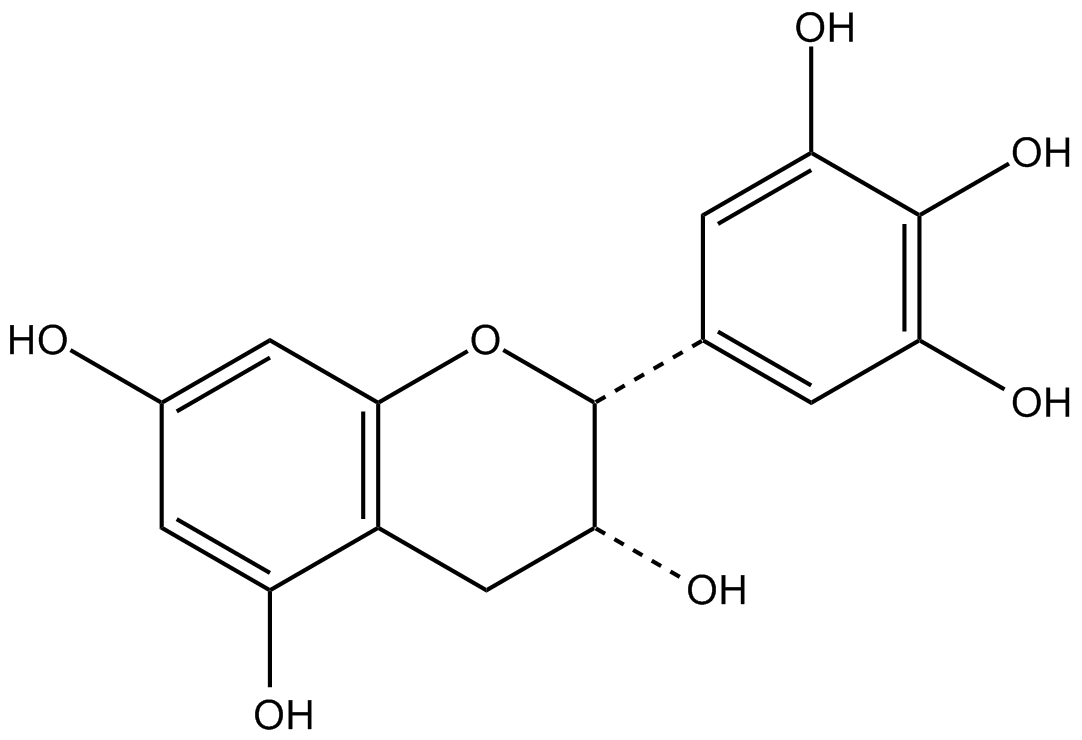
Cas No.: 970-74-1
Sample solution is provided at 25 µL, 10mM.
_1-3.$$$39978408@51.jpg');)
_1-9.$$$38538795@65.jpg');)
_1-9.$$$39112701@51.jpg');)
_1-7.$$$37316672@70.jpg');)
_366-372.$$$36198801@70.jpg');)
.$$$38565142@65.jpg');)
_1867-1883.$$$33248023@67.jpg');)
_eads6055.$$$39977546@45.jpg');)
_eadm9805.$$$40080571@45.jpg');)
_eadj3020.$$$39666821@45.jpg');)
_1-20.$$$39757301@28.jpg');)
_1-24.$$$38898113@28.jpg');)
_273-287.$$$36806353@46.jpg');)
_1-16.$$$37156877@44.jpg');)
_1-19.$$$37460805@44.jpg');)
_1291-1307.$$$34518654@46.jpg');)
(-)-epigallocatechin is a major polyphenolic compound in green tea with antioxidant properties [1]. (-)-epigallocatechin binds to bovine β-lactoglobulin (βLG) through van der Waals forces and hydrogen bonds, leading to a change in the native conformation of βLG and improving the functionality of dairy products [2]. (-)-epigallocatechin has been widely used to inhibit the growth of different cancer cells[3].
In vitro, (-)-epigallocatechin treatment for 3 days significantly inhibited the proliferation of HCT 116 cells and Hep G2 cells, with IC50 values of 11.2 and 52.3µM, respectively[4]. Treatment of UMR-106 cells with 20μM (-)-epigallocatechin for 6 days increased alkaline phosphatase (ALP) activity and significantly increased matrix mineralization[5]. Treatment of H1299 cells with 40μM (-)-epigallocatechin for 24h induced apoptosis and down-regulated the mRNA level of hTERT[6].
In vivo, Oral administration of (-)-epigallocatechin (1g/kg/day) for 10 days significantly inhibited platelet aggregation and prolonged activated partial prothrombin time in ICR mice[7].
References:
[1] Hu J, Zhou D, Chen Y. Preparation and antioxidant activity of green tea extract enriched in epigallocatechin (EGC) and epigallocatechin gallate (EGCG)[J]. Journal of Agricultural and Food Chemistry, 2009, 57(4): 1349-1353.
[2] Wu X, Wu H, Liu M, et al. Analysis of binding interaction between (−)-epigallocatechin (EGC) and β-lactoglobulin by multi-spectroscopic method[J]. Spectrochimica Acta Part A: Molecular and Biomolecular Spectroscopy, 2011, 82(1): 164-168.
[3] Du G J, Zhang Z, Wen X D, et al. Epigallocatechin Gallate (EGCG) is the most effective cancer chemopreventive polyphenol in green tea[J]. Nutrients, 2012, 4(11): 1679-1691.
[4] Uesato S, Kitagawa Y, Kamishimoto M, et al. Inhibition of green tea catechins against the growth of cancerous human colon and hepatic epithelial cells[J]. Cancer Letters, 2001, 170(1): 41-44.
[5] Ko C H, Lau K M, Choy W Y, et al. Effects of tea catechins, epigallocatechin, gallocatechin, and gallocatechin gallate, on bone metabolism[J]. Journal of Agricultural and Food Chemistry, 2009, 57(16): 7293-7297.
[6] Lin S C, Li W C, Shih J W, et al. The tea polyphenols EGCG and EGC repress mRNA expression of human telomerase reverse transcriptase (hTERT) in carcinoma cells[J]. Cancer letters, 2006, 236(1): 80-88.
[7] Chen X Q, Wang X B, Guan R F, et al. Blood anticoagulation and antiplatelet activity of green tea (−)-epigallocatechin (EGC) in mice[J]. Food & function, 2013, 4(10): 1521-1525.
| Cell experiment [1]: | |
Cell lines | HCT 116 cells |
Preparation Method | HCT 116 cells were cultured in McCoy's 5A medium [12.0g/H2O (1000ml) and NaHCO3 (2.2g)], supplemented with 10% fetal bovine serum, and incubated at 37℃ in a humidified environment with 5% CO2. The cells were seeded in 96-well flat plate with a concentration of 2.5×10⁴ cells/ml, and cultured at 37℃ for 1 day to stabilize the cells. Then, different concentrations of (-)-epigallocatechin (1, 10, 100, and 1000µM) were added to each well, and cell viability analysis was performed after 3 days of incubation at 37°C. |
Reaction Conditions | 1, 10, 100, and 1000µM; 72h |
Applications | (-)-epigallocatechin treatment decreased the cell viability of HCT 116 cells in a dose-dependent manner. |
| Animal experiment [2]: | |
Animal models | ICR mice |
Preparation Method | ICR mice weighing 18-22 grams were housed in an SPF-level barrier animal room. The temperature was maintained at 23±2°C, the light/dark cycle was 12 hours, the humidity was 50-70%, and mice had free access to food and filtered water. The mice were divided into two groups: the experimental group was fed 1.0g/kg/day of (-)-epigallocatechin for 10 days; the control group was fed normal saline every day. The eyeballs were taken from the mice. One drop of blood (except the first drop) was collected and dropped onto a glass slide with a diameter of approximately 5mm. The blood clotting time and bleeding time were analyzed. |
Dosage form | 1.0g/kg/day for 10 days; p.o. |
Applications | (-)-epigallocatechin treatment enhanced the blood clotting time and bleeding time in mice. |
References: | |
| Cas No. | 970-74-1 | SDF | |
| المرادفات | (-)EGC, epi-Gallocatechin, NSC 674039 | ||
| Chemical Name | (2R,3R)-2-(3,4,5-trihydroxyphenyl)chroman-3,5,7-triol | ||
| Canonical SMILES | O[C@@H]1CC2=C(C=C(O)C=C2O)O[C@@H]1C3=CC(O)=C(O)C(O)=C3 | ||
| Formula | C15H14O7 | M.Wt | 306.27 |
| الذوبان | DMF: 25 mg/ml,DMSO: 15 mg/ml,Ethanol: 5 mg/ml,PBS (pH 7.2): 1 mg/ml | Storage | Store at -20°C,protect from light |
| General tips | Please select the appropriate solvent to prepare the stock solution according to the
solubility of the product in different solvents; once the solution is prepared, please store it in
separate packages to avoid product failure caused by repeated freezing and thawing.Storage method
and period of the stock solution: When stored at -80°C, please use it within 6 months; when stored
at -20°C, please use it within 1 month. To increase solubility, heat the tube to 37°C and then oscillate in an ultrasonic bath for some time. |
||
| Shipping Condition | Evaluation sample solution: shipped with blue ice. All other sizes available: with RT, or with Blue Ice upon request. | ||
| Prepare stock solution | |||

|
1 mg | 5 mg | 10 mg |
| 1 mM | 3.2651 mL | 16.3255 mL | 32.6509 mL |
| 5 mM | 653 μL | 3.2651 mL | 6.5302 mL |
| 10 mM | 326.5 μL | 1.6325 mL | 3.2651 mL |
Step 1: Enter information below (Recommended: An additional animal making an allowance for loss during the experiment)
 g
μL
g
μL
Step 2: Enter the in vivo formulation (This is only the calculator, not formulation. Please contact us first if there is no in vivo formulation at the solubility Section.)
Calculation results:
Working concentration: mg/ml;
Method for preparing DMSO master liquid: mg drug pre-dissolved in μL DMSO ( Master liquid concentration mg/mL, Please contact us first if the concentration exceeds the DMSO solubility of the batch of drug. )
Method for preparing in vivo formulation: Take μL DMSO master liquid, next addμL PEG300, mix and clarify, next addμL Tween 80, mix and clarify, next add μL saline, mix and clarify.
Method for preparing in vivo formulation: Take μL DMSO master liquid, next add μL Corn oil, mix and clarify.
Note: 1. Please make sure the liquid is clear before adding the next solvent.
2. Be sure to add the solvent(s) in order. You must ensure that the solution obtained, in the previous addition, is a clear solution before proceeding to add the next solvent. Physical methods such as vortex, ultrasound or hot water bath can be used to aid dissolving.
3. All of the above co-solvents are available for purchase on the GlpBio website.
Quality Control & SDS
- View current batch:
- Purity: >98.00% Appearance: A solid
- COA (Certificate of Analysis)
- SDS (Safety Data Sheet)
- Datasheet
Average Rating: 5 (Based on Reviews and 8 reference(s) in Google Scholar.)