

Ac-Ile-Glu-Pro-Asp-pNA |
رقم الكتالوجGA20580
 One-Click Copy Product Info
|

Ac-Ile-Glu-Pro-Asp-pNA (Ac-IEPD-pNA) is a colorimetric substrate for granzyme B (GzmB) and caspase-8. Granzyme B and caspase-8 preferentially bind and cleave the Ile-Glu-Pro-Asp (IEPD) peptide sequence, and the catalytic activity of the enzyme is indirectly measured by detecting the release of p-nitroaniline (pNA), which is measured by the optical density (OD) at 405 nm.
Products are for research use only. Not for human use. We do not sell to patients.
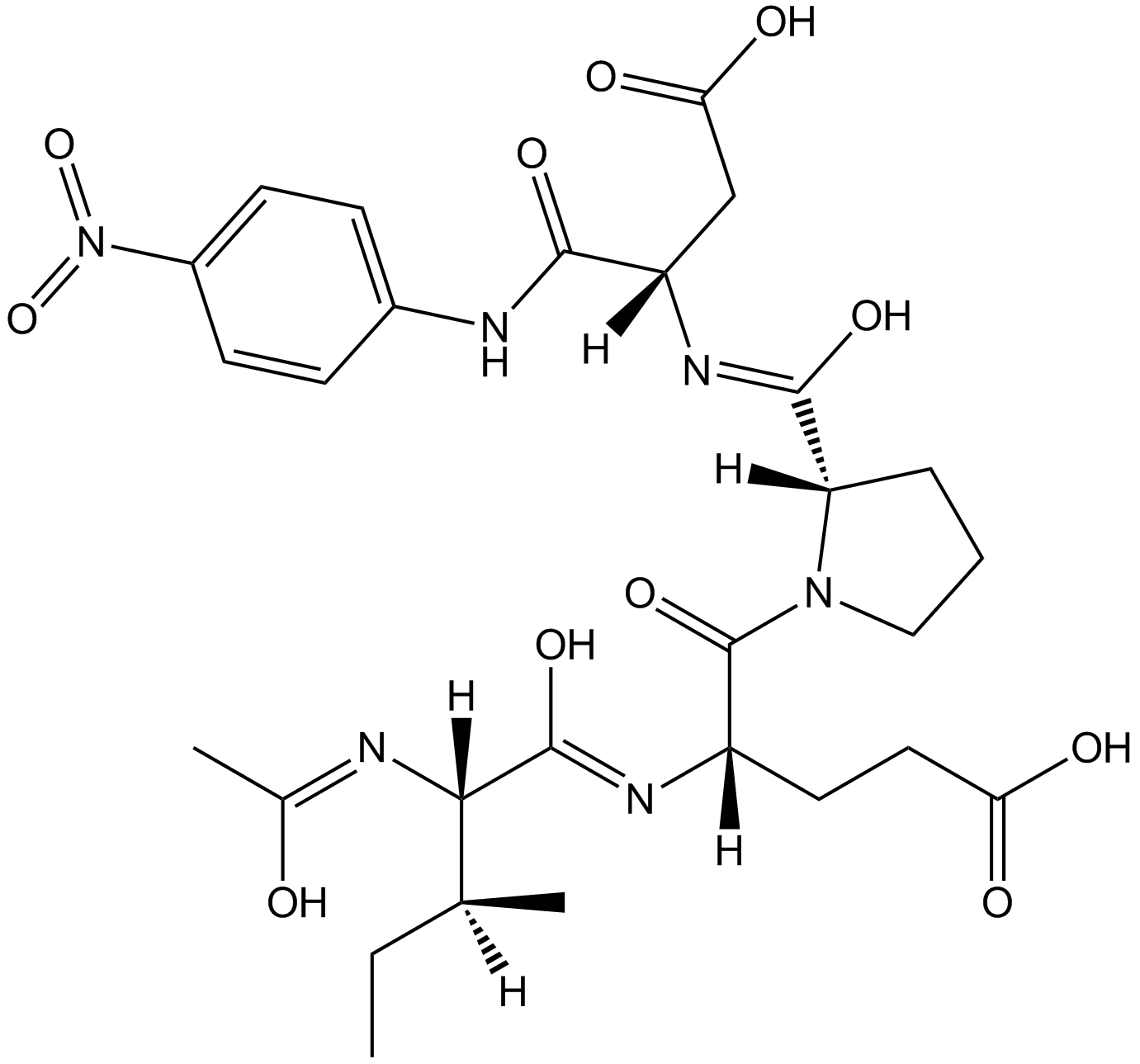
Cas No.: 216757-29-8
Sample solution is provided at 25 µL, 10mM.
_1-3.$$$39978408@51.jpg');)
_1-9.$$$38538795@65.jpg');)
_1-9.$$$39112701@51.jpg');)
_1-7.$$$37316672@70.jpg');)
_366-372.$$$36198801@70.jpg');)
.$$$38565142@65.jpg');)
_1867-1883.$$$33248023@67.jpg');)
_eads6055.$$$39977546@45.jpg');)
_eadm9805.$$$40080571@45.jpg');)
_eadj3020.$$$39666821@45.jpg');)
_1-20.$$$39757301@28.jpg');)
_1-24.$$$38898113@28.jpg');)
_273-287.$$$36806353@46.jpg');)
_1-16.$$$37156877@44.jpg');)
_1-19.$$$37460805@44.jpg');)
_1291-1307.$$$34518654@46.jpg');)
Ac-Ile-Glu-Pro-Asp-pNA (Ac-IEPD-pNA) is a colorimetric substrate for granzyme B (GzmB) and caspase-8 [1, 2]. Granzyme B and caspase-8 preferentially bind and cleave the Ile-Glu-Pro-Asp (IEPD) peptide sequence, and the catalytic activity of the enzyme is indirectly measured by detecting the release of p-nitroaniline (pNA), which is measured by the optical density (OD) at 405 nm[3]. Granzyme B is a serine protease found in cytotoxic T cells and NK cells, which cleaves and activates several caspases involved in apoptosis[4]. Caspase-8 is a caspase protein that participates in the signal transduction of death receptors of the tumor necrosis factor receptor family and is also essential for the induction of the transcription factor NF-κB[5]. Ac-Ile-Glu-Pro-Asp-pNA is recommended as a potential granzyme B target and the optimal P4-P1 substrate sequence for granzyme B.
The structural and group characteristics of Ac-Ile-Glu-Pro-Asp-pNA are as follows:
(1) N-acetyl group (Ac): protects the N-terminus of the amino acid to prevent nonspecific reactions.
(2) Amino acid sequence (Ile-Glu-Pro-Asp): This specific sequence mimics certain natural substrates and helps to study the specificity of proteases for different substrates.
(3) p-Nitroaniline (pNA): It is a common chromogenic group that releases a yellow product with light-absorbing properties after hydrolysis, which is convenient for monitoring enzyme reactions through spectral measurement.
References:
[1]Ewen C, Kane K P, Shostak I, et al. A novel cytotoxicity assay to evaluate antigen-specific CTL responses using a colorimetric substrate for Granzyme B[J]. Journal of immunological methods, 2003, 276(1-2): 89-101.
[2]Almeida S, Domingues A, Rodrigues L, et al. FK506 prevents mitochondrial-dependent apoptotic cell death induced by 3-nitropropionic acid in rat primary cortical cultures[J]. Neurobiology of disease, 2004, 17(3): 435-444.
[3]Chaves-Pozo E, Valero Y, Lozano M T, et al. Fish granzyme A shows a greater role than granzyme B in fish innate cell-mediated cytotoxicity, Front. Immunol. 10 (2019) 2579[J]. 2019.
[4]Rousalova I, Krepela E. Granzyme B-induced apoptosis in cancer cells and its regulation[J]. International journal of oncology, 2010, 37(6): 1361-1378.
[5]Chun H J, Zheng L, Ahmad M, et al. Pleiotropic defects in lymphocyte activation caused by caspase-8 mutations lead to human immunodeficiency[J]. Nature, 2002, 419(6905): 395-399.
This protocol only provides a guideline, and should be modified according to your specific needs.
1. Solution preparation
(1) Stock solution: Dissolve Ac-Ile-Glu-Pro-Asp-pNA in DMSO to a final concentration of 1 mM.
Note: After unused storage solution is aliquoted, store it at -20℃ in the dark to avoid repeated freezing and thawing.
(2) Working solution: Dilute the stock solution with experimental buffer to the required working concentration, for example: 0.2 mM.
Note: Please adjust the optimal working concentration according to the actual situation or refer to the literature to set the gradient concentration by yourself. The working solution must be prepared and used immediately.
2. Procedure for Measuring Granzyme B Activity in Cells Using Ac-Ile-Glu-Pro-Asp-pNA [1] (from the literature, for reference only)
(1) Sample aliquoting: Dispense 10μL of cell lysate sample into a 96-well plate.
(2) Add substrate: Add 90μL of Ac-Ile-Glu-Pro-Asp-pNA working solution at a concentration of 0.2 mM.
(3) Optical density measurement: Measure the optical density (OD) at 405 nm at 0 minutes and 90 minutes to determine the change in OD. Use the assay buffer in place of the sample as a blank control.
Note: This protocol provides guidance for measuring granzyme B activity in cells using Ac-Ile-Glu-Pro-Asp-pNA. Adjustments can be made based on other literature and specific experimental requirements.
References:
[1] Chaves-Pozo E, Valero Y, Lozano M T, et al. Fish granzyme A shows a greater role than granzyme B in fish innate cell-mediated cytotoxicity, Front. Immunol. 10 (2019) 2579[J]. 2019.
| Cas No. | 216757-29-8 | SDF | |
| Formula | C28H38N6O11 | M.Wt | 634.64 |
| الذوبان | Soluble in DMSO | Storage | Store at -20°C |
| General tips | Please select the appropriate solvent to prepare the stock solution according to the
solubility of the product in different solvents; once the solution is prepared, please store it in
separate packages to avoid product failure caused by repeated freezing and thawing.Storage method
and period of the stock solution: When stored at -80°C, please use it within 6 months; when stored
at -20°C, please use it within 1 month. To increase solubility, heat the tube to 37°C and then oscillate in an ultrasonic bath for some time. |
||
| Shipping Condition | Evaluation sample solution: shipped with blue ice. All other sizes available: with RT, or with Blue Ice upon request. | ||
| Prepare stock solution | |||

|
1 mg | 5 mg | 10 mg |
| 1 mM | 1.5757 mL | 7.8785 mL | 15.757 mL |
| 5 mM | 315.1 μL | 1.5757 mL | 3.1514 mL |
| 10 mM | 157.6 μL | 787.8 μL | 1.5757 mL |
Step 1: Enter information below (Recommended: An additional animal making an allowance for loss during the experiment)
 g
μL
g
μL
Step 2: Enter the in vivo formulation (This is only the calculator, not formulation. Please contact us first if there is no in vivo formulation at the solubility Section.)
Calculation results:
Working concentration: mg/ml;
Method for preparing DMSO master liquid: mg drug pre-dissolved in μL DMSO ( Master liquid concentration mg/mL, Please contact us first if the concentration exceeds the DMSO solubility of the batch of drug. )
Method for preparing in vivo formulation: Take μL DMSO master liquid, next addμL PEG300, mix and clarify, next addμL Tween 80, mix and clarify, next add μL saline, mix and clarify.
Method for preparing in vivo formulation: Take μL DMSO master liquid, next add μL Corn oil, mix and clarify.
Note: 1. Please make sure the liquid is clear before adding the next solvent.
2. Be sure to add the solvent(s) in order. You must ensure that the solution obtained, in the previous addition, is a clear solution before proceeding to add the next solvent. Physical methods such as vortex, ultrasound or hot water bath can be used to aid dissolving.
3. All of the above co-solvents are available for purchase on the GlpBio website.
Quality Control & SDS
- View current batch:
- Purity: >98.00% Appearance: A solid
- COA (Certificate of Analysis)
- SDS (Safety Data Sheet)
- Datasheet
Average Rating: 5 (Based on Reviews and 25 reference(s) in Google Scholar.)