

GPR81 agonist 1 |
رقم الكتالوجGC61625
 One-Click Copy Product Info
|

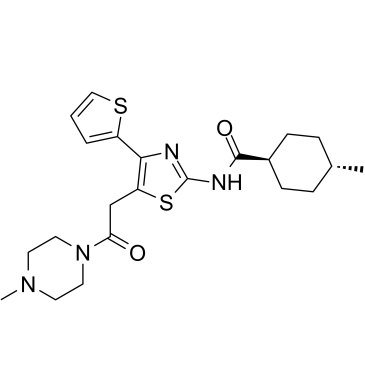
ناهض GPR81 1 هو ناهض GPR81 قوي وانتقائي للغاية ، مع EC50s من 58 نانومتر و 50 نانومتر للإنسان والفأر GPR81 ، على التوالي
Products are for research use only. Not for human use. We do not sell to patients.
Cas No.: 1620992-67-7
Sample solution is provided at 25 µL, 10mM.
_1-3.$$$39978408@51.jpg');)
_1-9.$$$38538795@65.jpg');)
_1-9.$$$39112701@51.jpg');)
_1-7.$$$37316672@70.jpg');)
_366-372.$$$36198801@70.jpg');)
.$$$38565142@65.jpg');)
_1867-1883.$$$33248023@67.jpg');)
_eads6055.$$$39977546@45.jpg');)
_eadm9805.$$$40080571@45.jpg');)
_eadj3020.$$$39666821@45.jpg');)
_1-20.$$$39757301@28.jpg');)
_1-24.$$$38898113@28.jpg');)
_273-287.$$$36806353@46.jpg');)
_1-16.$$$37156877@44.jpg');)
_1-19.$$$37460805@44.jpg');)
_1291-1307.$$$34518654@46.jpg');)
GPR81 agonist 1 is a highly potent and selective G protein-coupled receptor 81 (GPR81) agonist with EC50 values of 58nM for human and 50nM for mouse GPR81[1]. GPR81, as a lactate receptor, plays an important role in immune regulation[2]. GPR81 agonist 1 can inhibit lipolysis in differentiated 3T3-L1 adipocytes[3]. GPR81 agonist 1 can improve insulin resistance and liver inflammation by inhibiting the NLRP3 inflammasome signaling pathway[4].
In vivo, intraperitoneal injection of GPR81 agonist 1 (10mg/kg) in a breast cancer (BRCA) model mouse significantly reduced PD-L1 expression in tumor tissue but did not reduce tumor volume[5].
References:
[1] Sakurai T, Davenport R, Stafford S, et al. Identification of a novel GPR81-selective agonist that suppresses lipolysis in mice without cutaneous flushing[J]. European journal of pharmacology, 2014, 727: 1-7.
[2] Brown T P, Bhattacharjee P, Ramachandran S, et al. The lactate receptor GPR81 promotes breast cancer growth via a paracrine mechanism involving antigen-presenting cells in the tumor microenvironment[J]. Oncogene, 2020, 39(16): 3292-3304.
[3] Feingold K R, Moser A, Shigenaga J K, et al. Inflammation inhibits GPR81 expression in adipose tissue[J]. Inflammation Research, 2011, 60(10): 991-995.
[4] Zhang Y, Lu Q H, Cao H F, et al. Effects of GPR81 agonist on insulin resistance in rats with nonalcoholic fatty liver disease[J]. Chinese Journal of Applied Physiology, 2021, 37(4): 354-358.
[5] Guo S, Zhou J, Lou P, et al. Potentiated effects of lactate receptor GPR81 on immune microenvironment in breast cancer[J]. Molecular Carcinogenesis, 2023, 62(9): 1369-1377.
| Animal experiment [1]: | |
Animal models | Balb/c mice |
Preparation Method | 1×10⁶ 4T1 GFP mouse BRCA cells were injected subcutaneously into the mammary fat pad region of mice. Tumor size was measured twice weekly using a caliper. After the tumor volume reached 100-200mm3, the mice were randomly assigned to the following two groups: (1)vehicle (saline); (2) GPR81 agonist 1 (10mg/kg). All drugs were administered by intraperitoneal injections as indicated. The investigator was blinded to the treatment groups during the experiment and when assessing the outcome. Mice were monitored daily and euthanized by CO2 asphyxiation and cervical dislocation before any sign of distress. |
Dosage form | 10mg/kg; i.p. |
Applications | Mice treated with GPR81 agonist 1 showed significantly reduced PD-L1 expression; however, there was no significant difference in tumor volume between the two groups of mice. |
References: | |
| Cas No. | 1620992-67-7 | SDF | |
| Canonical SMILES | O=C([C@H]1CC[C@H](C)CC1)NC2=NC(C3=CC=CS3)=C(CC(N4CCN(C)CC4)=O)S2 | ||
| Formula | C22H30N4O2S2 | M.Wt | 446.63 |
| الذوبان | DMSO : 50 mg/mL (111.95 mM; Need ultrasonic) | Storage | Store at -20°C |
| General tips | Please select the appropriate solvent to prepare the stock solution according to the
solubility of the product in different solvents; once the solution is prepared, please store it in
separate packages to avoid product failure caused by repeated freezing and thawing.Storage method
and period of the stock solution: When stored at -80°C, please use it within 6 months; when stored
at -20°C, please use it within 1 month. To increase solubility, heat the tube to 37°C and then oscillate in an ultrasonic bath for some time. |
||
| Shipping Condition | Evaluation sample solution: shipped with blue ice. All other sizes available: with RT, or with Blue Ice upon request. | ||
| Prepare stock solution | |||

|
1 mg | 5 mg | 10 mg |
| 1 mM | 2.239 mL | 11.1949 mL | 22.3899 mL |
| 5 mM | 447.8 μL | 2.239 mL | 4.478 mL |
| 10 mM | 223.9 μL | 1.1195 mL | 2.239 mL |
Step 1: Enter information below (Recommended: An additional animal making an allowance for loss during the experiment)
 g
μL
g
μL
Step 2: Enter the in vivo formulation (This is only the calculator, not formulation. Please contact us first if there is no in vivo formulation at the solubility Section.)
Calculation results:
Working concentration: mg/ml;
Method for preparing DMSO master liquid: mg drug pre-dissolved in μL DMSO ( Master liquid concentration mg/mL, Please contact us first if the concentration exceeds the DMSO solubility of the batch of drug. )
Method for preparing in vivo formulation: Take μL DMSO master liquid, next addμL PEG300, mix and clarify, next addμL Tween 80, mix and clarify, next add μL saline, mix and clarify.
Method for preparing in vivo formulation: Take μL DMSO master liquid, next add μL Corn oil, mix and clarify.
Note: 1. Please make sure the liquid is clear before adding the next solvent.
2. Be sure to add the solvent(s) in order. You must ensure that the solution obtained, in the previous addition, is a clear solution before proceeding to add the next solvent. Physical methods such as vortex, ultrasound or hot water bath can be used to aid dissolving.
3. All of the above co-solvents are available for purchase on the GlpBio website.
Quality Control & SDS
- View current batch:
- Purity: >98.50% Appearance: A solid
- COA (Certificate of Analysis)
- SDS (Safety Data Sheet)
- Datasheet
Average Rating: 5 (Based on Reviews and 18 reference(s) in Google Scholar.)