
ITSA-1 (ITSA1) |
| رقم الكتالوجGC14597 |
ITSA-1 (ITSA1) هو منشط للهيستون ديسيتيلاز (HDAC) ، ومضاد لدورة الخلية التي يسببها trichostatin A (TSA) ، واستلة هيستون ، وتنشيط النسخ.
Products are for research use only. Not for human use. We do not sell to patients.
Cas No.: 200626-61-5
Sample solution is provided at 25 µL, 10mM.
ITSA-1 (ITSA1), a histone deacetylase (HDAC) activator, can prevent arterial laminar shear stress-induced endothelial cell detachment and reduce VCAM-1 expression in vascular endothelial cells (vECs)[1].
In vitro, ITSA-1 (150μM; 0, 3, 6; 24h) can reverse the inflammatory response in vascular endothelial cells (vECs) induced by amyotrophic lateral sclerosis (ALS) by increasing the expression of histone deacetylases (HDACs) and histone H3 lysine 9 trimethylation (H3K9me3)[2]. Short-term stimulation with ITSA-1 (0, 50, 100, 200 and 400ng/ml; 0, 24 and 48h) induces epithelial-mesenchymal transition in nasopharyngeal carcinoma cells[3].
In vivo, ITSA-1 (0.5mg/kg; i.p.) enhances the recovery and survival of post-ROSC rats by diminishing histone acetylation and mitigating systemic inflammation[1]. A blockade of HDAC3 inhibition in CBS+/− mice by HDAC activator ITSA-1 (0.5mg/kg/3 times/week; 8 weeks; i.p.), led to the remodeling of histone landscapes in the genome and thereby attenuated histone acetylation-dependent inflammatory signaling[4].
References:
[1] Zhang C, Wei H, Zhang Q, et al. The Histone Deacetylase Activator ITSA-1 Improves the Prognosis of Cardiac Arrest Rats by Alleviating Systemic Inflammatory Responses Following Cardiopulmonary Resuscitation. Mediators Inflamm. 2025 Mar 20;2025:8156593.
[2] Wang TY, Chang MM, Li YJ, et al. Maintenance of HDACs and H3K9me3 Prevents Arterial Flow-Induced Venous Endothelial Damage. Front Cell Dev Biol. 2021 Apr 9;9:642150.
[3] Shen Z, Liao X, Shao Z, et al. Short-term stimulation with histone deacetylase inhibitor trichostatin a induces epithelial-mesenchymal transition in nasopharyngeal carcinoma cells without increasing cell invasion ability. BMC Cancer. 2019 Mar 22;19(1):262.
[4] Behera J, Kelly KE, Voor MJ, et al. Hydrogen Sulfide Promotes Bone Homeostasis by Balancing Inflammatory Cytokine Signaling in CBS-Deficient Mice through an Epigenetic Mechanism. Sci Rep. 2018 Oct 15;8(1):15226.
| Cell experiment [1]: | |
Cell lines | CNE2 and C666-1 cells |
Preparation Method | CNE2 and C666-1 cells were treated with 0 and 200ng/ml ITSA-1 for 0, 24 and 48h, and then cells were photographed under inverted microscope. CNE2 and C666-1 cells were treated with various concentrations of ITSA-1 (0, 50, 100, 200 and 400ng/ml) for short period within 48h, and then cells were harvested and subjected to real-time PCR and western blot analysis of EMT-associated E-cadherin, Vimentin, Snail1 and Twist1 gene and protein expressions. |
Reaction Conditions | 0, 50, 100, 200 and 400ng/ml; 0, 24 and 48h |
Applications | Short-term stimulation with ITSA-1 induces epithelial-mesenchymal transition in nasopharyngeal carcinoma cells. |
| Animal experiment [2]: | |
Animal models | Adult male Wistar rats |
Preparation Method | All rats were randomly divided into five groups: Normal group: The rats received the same treatment as the other groups except that they did not undergo cardiac arrest (CA) and cardiopulmonary resuscitation (CPR), until the end of the operation. Sham group: Rats were subjected to mechanical ventilation while Vecuronium bromide was administered. Control group, Suberoylanilide hydroxamic acid (SAHA) group, and ITSA-1 group: Rats in these groups were administered normal saline, SAHA, or ITSA-1 via intraperitoneal injection at a dose of 100mg/kg or 0.5mg/kg. These injections were given per kilogram of body weight for three consecutive days before the asphyxiated CA surgery. Experiment 1 (n=45): Five rats each in the normal and sham groups and 10 each in the control, SAHA, and ITSA-1 groups were used to investigate the effects of the drug on cardiac function 4h after post-CA syndrome (ROSC). Additionally, survival status and neurological function, including the neurological deficit score (NDS) at 24, 48, and 72h after ROSC, and performance in the Morris water maze at 72h after ROSC, were assessed. Experiment 2 (n=24): Three rats each in the normal and sham groups and five each in the control, SAHA, and ITSA-1 groups were used to observe the effects of ITSA-1 on the levels of TNF-α, IL-1β, glial fibrillary acidic protein (GFAP), and S100β in plasma, as well as TNF-α and IL-1β levels in the hippocampus 4h after CA-ROSC. This experiment also aimed to evaluate the effect of ITSA-1 on the infiltration of astrocytes and microglia in the hippocampus 4h after ROSC. |
Dosage form | 0.5mg/kg; i.p. |
Applications | ITSA-1 enhances the recovery and survival of post-ROSC rats by diminishing histone acetylation and mitigating systemic inflammation. |
References: | |
| Cas No. | 200626-61-5 | SDF | |
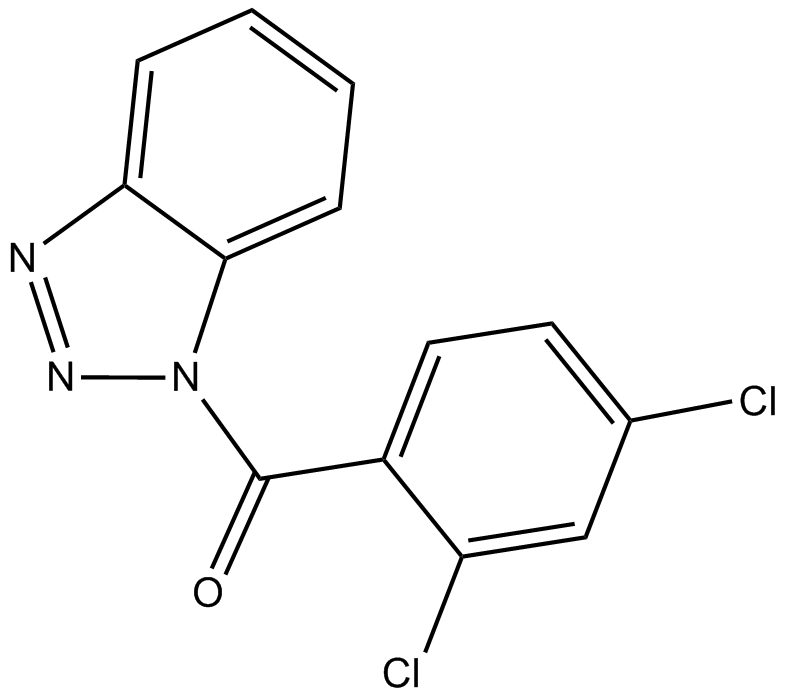
| Chemical Name | (1H-benzo[d][1,2,3]triazol-1-yl)(2,4-dichlorophenyl)methanone | ||
| Canonical SMILES | O=C(N1N=NC2=CC=CC=C21)C3=CC=C(Cl)C=C3Cl | ||
| Formula | C13H7Cl2N3O | M.Wt | 292.12 |
| الذوبان | ≥ 89mg/mL in DMSO | Storage | Store at -20°C |
| General tips | Please select the appropriate solvent to prepare the stock solution according to the
solubility of the product in different solvents; once the solution is prepared, please store it in
separate packages to avoid product failure caused by repeated freezing and thawing.Storage method
and period of the stock solution: When stored at -80°C, please use it within 6 months; when stored
at -20°C, please use it within 1 month. To increase solubility, heat the tube to 37°C and then oscillate in an ultrasonic bath for some time. |
||
| Shipping Condition | Evaluation sample solution: shipped with blue ice. All other sizes available: with RT, or with Blue Ice upon request. | ||
| Prepare stock solution | |||
|
1 mg | 5 mg | 10 mg |
| 1 mM | 3.4233 mL | 17.1163 mL | 34.2325 mL |
| 5 mM | 684.7 μL | 3.4233 mL | 6.8465 mL |
| 10 mM | 342.3 μL | 1.7116 mL | 3.4233 mL |
Step 1: Enter information below (Recommended: An additional animal making an allowance for loss during the experiment)
Step 2: Enter the in vivo formulation (This is only the calculator, not formulation. Please contact us first if there is no in vivo formulation at the solubility Section.)
Calculation results:
Working concentration: mg/ml;
Method for preparing DMSO master liquid: mg drug pre-dissolved in μL DMSO ( Master liquid concentration mg/mL, Please contact us first if the concentration exceeds the DMSO solubility of the batch of drug. )
Method for preparing in vivo formulation: Take μL DMSO master liquid, next addμL PEG300, mix and clarify, next addμL Tween 80, mix and clarify, next add μL ddH2O, mix and clarify.
Method for preparing in vivo formulation: Take μL DMSO master liquid, next add μL Corn oil, mix and clarify.
Note: 1. Please make sure the liquid is clear before adding the next solvent.
2. Be sure to add the solvent(s) in order. You must ensure that the solution obtained, in the previous addition, is a clear solution before proceeding to add the next solvent. Physical methods such as vortex, ultrasound or hot water bath can be used to aid dissolving.
3. All of the above co-solvents are available for purchase on the GlpBio website.
Quality Control & SDS
- View current batch:
- Purity: >98.00%
- COA (Certificate Of Analysis)
- SDS (Safety Data Sheet)
- Datasheet
Average Rating: 5 (Based on Reviews and 20 reference(s) in Google Scholar.)
GLPBIO products are for RESEARCH USE ONLY. Please make sure your review or question is research based.
Required fields are marked with *
