

Macitentan (Synonyms: ACT-064992, Actelion-1) |
رقم الكتالوجGC17785
 One-Click Copy Product Info
|

Macitentan (ACT-064992) هو مضاد ETA مزدوج نشط عن طريق الفم وغير ببتيد (مستقبلات الإندوثيلين)
Products are for research use only. Not for human use. We do not sell to patients.
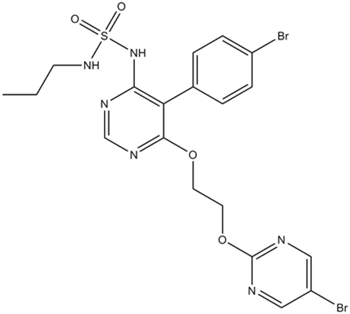
Cas No.: 441798-33-0
Sample solution is provided at 25 µL, 10mM.
_1-3.$$$39978408@51.jpg');)
_1-9.$$$38538795@65.jpg');)
_1-9.$$$39112701@51.jpg');)
_1-7.$$$37316672@70.jpg');)
_366-372.$$$36198801@70.jpg');)
.$$$38565142@65.jpg');)
_1867-1883.$$$33248023@67.jpg');)
_eads6055.$$$39977546@45.jpg');)
_eadm9805.$$$40080571@45.jpg');)
_eadj3020.$$$39666821@45.jpg');)
_1-20.$$$39757301@28.jpg');)
_1-24.$$$38898113@28.jpg');)
_273-287.$$$36806353@46.jpg');)
_1-16.$$$37156877@44.jpg');)
_1-19.$$$37460805@44.jpg');)
_1291-1307.$$$34518654@46.jpg');)
Macitentan is a new dual ETA/ETB endothelin (ET) receptor antagonist, with mean IC50 values of 0.5 ± 0.2 nM (n= 17) to inhibit the binding of 125I-ET-1 to recombinant ETA receptors, and of 391±182 nM (n= 17) for ETB receptors in Chinese hamster ovary cells [1].
ETA and ETB are ET receptors, both of them mediate the detrimental actions of ET-1, and dual blockade of them may be necessary [1].
In microsomal membranes of human-ETA and ETB-overexpressing Chinese hamster ovary cells, macitentan inhibited the binding between 125I-ET-1 and recombinant ETA receptors, with a mean IC50 value of 0.5 ± 0.2 nM (n= 17). The mean IC50 value for ETB receptors was 391±182 nM (n= 17). Macitentan completely inhibited the effect that ET-1 increased intracellular calcium in non-recombinant cells [1].
Intravenous administrated macitentan had a volume of distribution largely exceeding plasma volume and a terminal half-life of 2 h in rats. Macitentan was hence metabolized to its major and the only circulating metabolite, a dual ET receptor antagonist, ACT-132577. ACT-132577 also had a volume of distribution greater than the plasma volume. It showed a longer half-life than macitentan in rats. In rat, multiple oral dosing of macitentan at a dose of 10 mg/kg led to 4 to 5-fold higher exposure levels of ACT-132577 than those of the parent compound [1].
Reference:
[1]. Marc Iglarz, Christoph Binkert, Keith Morrison, et al. Pharmacology of Macitentan, an Orally Active Tissue-Targeting Dual Endothelin Receptor Antagonist. Journal of Pharmacology and Experimental Therapeutics, 2008, 327:736-745.
| Cell experiment [1,2]: | |
|
Cell lines |
Primary human pulmonary smooth muscle cells, microvascular endothelial cells |
|
Preparation method |
The solubility of this compound in DMSO is >21.2 mg/mL. General tips for obtaining a higher concentration: Please warm the tube at 37 ℃ for 10 minutes and/or shake it in the ultrasonic bath for a while. Stock solution can be stored below -20℃ for several months. |
|
Reacting condition |
IC50: 1 nM |
|
Applications |
Macitentan completely inhibited intracellular calcium increase induced by ET-1 on primary human pulmonary smooth muscle cells with approximate IC50 of 1 nM. Macitentan inhibited ET-1-induced contractions on isolated rat aortic rings or S6c-induced contractions on isolated rat tracheal rings with pA2 of 7.6 and 5.9, respectively. In microvascular endothelial cells, pretreatment with macitentan restored tube formation ability and reduced the expression of mesenchymal markers and restored CD31 expression and the imbalance between VEGF-A and VEGF-A165b. |
| Animal experiment [1,3-5]: | |
|
Animal models |
Hypertensive DOCA-salt rats, monocrotaline rat model of pulmonary hypertension, SKOV3ip1 ovarian cancer model |
|
Dosage form |
Oral administration, 25 mg/kg/day |
|
Application |
In normotensive rats, macitentan increased plasma ET-1 concentration. Macitentan dose-dependently decreased mean arterial blood pressure in hypertensive DOCA-salt rats with a maximal effect of -26 mm Hg at a dose of 10 mg/kg. Oral administration of macitentan dose-dependently prevented the development of pulmonary hypertension and the development of right ventricle hypertrophy with a maximal efficacy of 30 mg/kg/day in monocrotaline rat model of pulmonary hypertension. Chronic oral administration of macitentan at 30 mg/kg/day significantly improved the 42-day survival in monocrotaline rats. Macitentan (25 mg/kg/day, p.o.) prevented increased production of vasoactive and fibrogenic factors, NF-κB activation, structural and functional changes, and increased extracellular matrix protein production in type 2 diabetes. Macitentan (10 mg/kg, p.o.) in combination with once-per-week 5 mg/kg taxol significantly reduced the weight (size) of HeyA8-MDR tumors in mice. Combination therapy with macitentan (10 or 50 mg/kg) and taxol or macitentan (10 mg/kg) and cisplatinum significantly reduced the number of proliferating Ki-67-positive cells. Macitentan (100 mg/kg) treatment combined with paclitaxel (5 mg/kg) reduced tumor incidence and further reduced tumor weight and incidences of ascites in SKOV3ip1 ovarian cancer model. Macitentan plus paclitaxel inhibited the phosphorylation of ETRs and suppressed the survival pathways of tumor cells by decreasing the levels of pVEGFR2, pAkt, and pMAPK. Macitentan enhanced effects of paclitaxel on tumor cells dividing and apoptosis. |
|
Other notes |
Please test the solubility of all compounds indoor, and the actual solubility may slightly differ with the theoretical value. This is caused by an experimental system error and it is normal. |
|
References: [1]. Marc Iglarz, Christoph Binkert, Keith Morrison, et al. Pharmacology of Macitentan, an Orally Active Tissue-Targeting Dual Endothelin Receptor Antagonist. Journal of Pharmacology and Experimental Therapeutics, 2008, 327:736-745. [2]. Corallo C, et al. Bosentan and macitentan prevent the endothelial-to-mesenchymal transition (EndoMT) in systemic sclerosis: in vitro study. Arthritis Res Ther. 2016 Oct 6;18(1):228. [3]. Sen S, et al. Renal, retinal and cardiac changes in type 2 diabetes are attenuated by macitentan, a dual endothelin receptor antagonist. Life Sci. 2012 Apr 13. [4]. Kim SJ, et al. Antivascular therapy for multidrug-resistant ovarian tumors by macitentan, a dual endothelin receptor antagonist. Transl Oncol. 2012 Feb;5(1):39-47. [5].Kim S J, Kim J S, Kim S W, et al. Macitentan (ACT-064992), a tissue-targeting endothelin receptor antagonist, enhances therapeutic efficacy of paclitaxel by modulating survival pathways in orthotopic models of metastatic human ovarian cancer[J]. Neoplasia, 2011, 13(2): 167-IN12. |
|
| Cas No. | 441798-33-0 | SDF | |
| المرادفات | ACT-064992, Actelion-1 | ||
| Chemical Name | 5-(4-bromophenyl)-6-[2-(5-bromopyrimidin-2-yl)oxyethoxy]-N-(propylsulfamoyl)pyrimidin-4-amine | ||
| Canonical SMILES | CCCNS(=O)(=O)NC1=C(C(=NC=N1)OCCOC2=NC=C(C=N2)Br)C3=CC=C(C=C3)Br | ||
| Formula | C19H20Br2N6O4S | M.Wt | 588.27 |
| الذوبان | ≥ 24.4mg/mL in DMSO | Storage | Store at -20°C |
| General tips | Please select the appropriate solvent to prepare the stock solution according to the
solubility of the product in different solvents; once the solution is prepared, please store it in
separate packages to avoid product failure caused by repeated freezing and thawing.Storage method
and period of the stock solution: When stored at -80°C, please use it within 6 months; when stored
at -20°C, please use it within 1 month. To increase solubility, heat the tube to 37°C and then oscillate in an ultrasonic bath for some time. |
||
| Shipping Condition | Evaluation sample solution: shipped with blue ice. All other sizes available: with RT, or with Blue Ice upon request. | ||
| Prepare stock solution | |||

|
1 mg | 5 mg | 10 mg |
| 1 mM | 1.6999 mL | 8.4995 mL | 16.999 mL |
| 5 mM | 340 μL | 1.6999 mL | 3.3998 mL |
| 10 mM | 170 μL | 849.9 μL | 1.6999 mL |
Step 1: Enter information below (Recommended: An additional animal making an allowance for loss during the experiment)
 g
μL
g
μL
Step 2: Enter the in vivo formulation (This is only the calculator, not formulation. Please contact us first if there is no in vivo formulation at the solubility Section.)
Calculation results:
Working concentration: mg/ml;
Method for preparing DMSO master liquid: mg drug pre-dissolved in μL DMSO ( Master liquid concentration mg/mL, Please contact us first if the concentration exceeds the DMSO solubility of the batch of drug. )
Method for preparing in vivo formulation: Take μL DMSO master liquid, next addμL PEG300, mix and clarify, next addμL Tween 80, mix and clarify, next add μL saline, mix and clarify.
Method for preparing in vivo formulation: Take μL DMSO master liquid, next add μL Corn oil, mix and clarify.
Note: 1. Please make sure the liquid is clear before adding the next solvent.
2. Be sure to add the solvent(s) in order. You must ensure that the solution obtained, in the previous addition, is a clear solution before proceeding to add the next solvent. Physical methods such as vortex, ultrasound or hot water bath can be used to aid dissolving.
3. All of the above co-solvents are available for purchase on the GlpBio website.
Quality Control & SDS
- View current batch:
- Purity: >99.00% Appearance: A solid
- COA (Certificate of Analysis)
- SDS (Safety Data Sheet)
- Datasheet
Average Rating: 5 (Based on Reviews and 19 reference(s) in Google Scholar.)