

NCT-503 |
رقم الكتالوجGC15943
 One-Click Copy Product Info
|

NCT-503 هو مثبط نازعة هيدروجين الفوسفوجليسيرات (PHGDH) مع IC 50 من 2.5 ميكرومتر
Products are for research use only. Not for human use. We do not sell to patients.
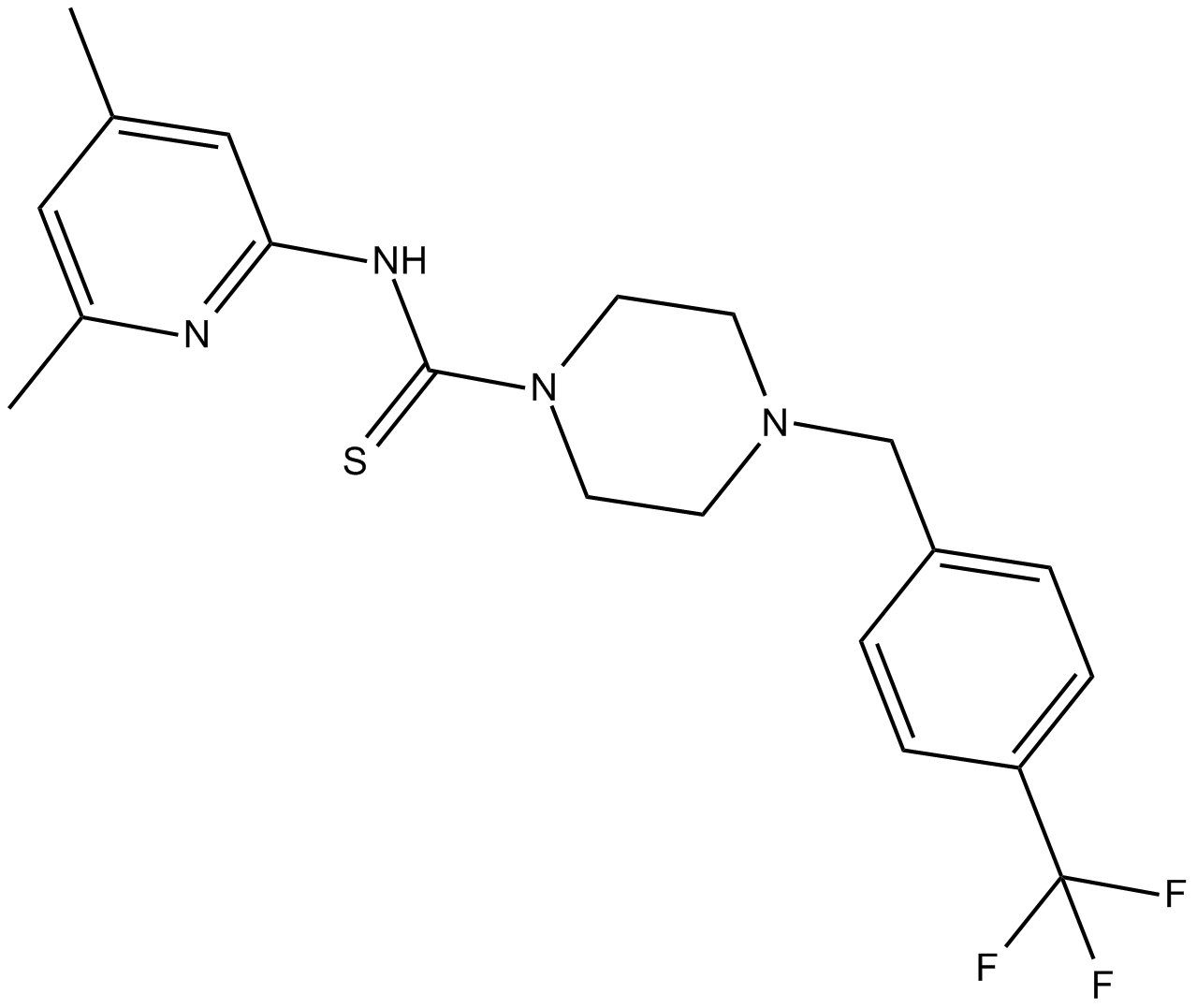
Cas No.: 1916571-90-8
Sample solution is provided at 25 µL, 10mM.
_1-3.$$$39978408@51.jpg');)
_1-9.$$$38538795@65.jpg');)
_1-9.$$$39112701@51.jpg');)
_1-7.$$$37316672@70.jpg');)
_366-372.$$$36198801@70.jpg');)
.$$$38565142@65.jpg');)
_1867-1883.$$$33248023@67.jpg');)
_eads6055.$$$39977546@45.jpg');)
_eadm9805.$$$40080571@45.jpg');)
_eadj3020.$$$39666821@45.jpg');)
_1-20.$$$39757301@28.jpg');)
_1-24.$$$38898113@28.jpg');)
_273-287.$$$36806353@46.jpg');)
_1-16.$$$37156877@44.jpg');)
_1-19.$$$37460805@44.jpg');)
_1291-1307.$$$34518654@46.jpg');)
NCT-503 is a phosphoglycerate dehydrogenase (PHGDH) inhibitor (IC50=2.5μM). NCT-503 selectively blocks glucose-derived serine synthesis while causing SHMT1-dependent one-carbon unit consumption, leading to cell cycle arrest through nucleotide depletion and reducing PHGDH-dependent tumor growth. NCT-503 can be used in research related to breast cancer and insulin resistance[1-4].
In vitro, treatment with 10μM NCT-503 for 24 to 48 hours in neuroblastoma cells BE(2)-C, Kelly, SH-EP, and SK-N-AS reduced glucose-derived carbon incorporation into serine, decreased cell viability, and redirected glucose-derived carbon from entering citrate to entering malate[5]. Treatment with NCT-503 (20-40μM) in prostate cancer cells (C4-2, LNCaP) for 48 hours reduced cell viability, induced ferroptosis, and increased lipid peroxide accumulation[6]. Treatment with NCT-503 (0-250μM) in triple-negative breast cancer cell lines (MDA-MB-231, MDA-MB-468, Hs 578T) for 48 hours dose-dependently inhibited cell proliferation and produced cytotoxicity, caused morphological changes such as nuclear fragmentation, unclear cytoplasmic membrane boundaries, and disruption of cytoskeletal actin fibers, and suppressed colony formation ability of MDA-MB cells and wound healing ability of MDA-MB-468 cells[7].
In vivo, oral administration of NCT-503 (40mg/kg) for 7 consecutive days in neonatal mice after apical resection inhibited cardiac function recovery and led to more myocardial scarring, suppressing cardiomyocyte proliferation and myocardial regeneration[8]. Intraperitoneal injection of NCT-503 at 4mg/kg or 40mg/kg every two days for 18 days in CAnN.Cg-Foxn1nu/CrlNarl mice subcutaneously inoculated with OCI-AML3-OR cells significantly suppressed tumor growth and prolonged mouse survival time[9]. Daily intraperitoneal injection of 40mg/kg for two months NCT-503 in mice subjected to 5/6 nephrectomy and fed a 1.8% high-phosphorus diet exacerbated aortic vascular calcification[10].
References:
[1] Elsaadi S, Steiro I, Abdollahi P, et al. Targeting phosphoglycerate dehydrogenase in multiple myeloma. Exp Hematol Oncol. 2021 Jan 4;10(1):3.
[2] Islam MM, Kasana S, Priya S, et al. Harnessing PHGDH Inhibition for Cancer Therapy: Mechanisms, SAR, Computational Aspects, and Clinical Potential. Arch Pharm (Weinheim). 2025 Aug;358(8):e70083.
[3] Wang K, Lu H, Wang X, et al. Simultaneous suppression of PKM2 and PHGDH elicits synergistic anti-cancer effect in NSCLC. Front Pharmacol. 2023 May 22;14:1200538.
[4] Dewdney B, Alanazy M, Gillman R, et al. The effects of fructose and metabolic inhibition on hepatocellular carcinoma. Sci Rep. 2020 Oct 7;10(1):16769.
[5] Arlt B, Mastrobuoni G, Wuenschel J, et al. Inhibiting PHGDH with NCT-503 reroutes glucose-derived carbons into the TCA cycle, independently of its on-target effect. J Enzyme Inhib Med Chem. 2021;36(1):1282-1289.
[6] Wang J, Zeng L, Wu N, et al. Inhibition of phosphoglycerate dehydrogenase induces ferroptosis and overcomes enzalutamide resistance in castration-resistant prostate cancer cells. Drug Resistance Updates. 2023;70:100985.
[7] Pralea IE, Moldovan RC, Tigu AB, et al. Cellular Responses Induced by NCT-503 Treatment on Triple-Negative Breast Cancer Cell Lines: A Proteomics Approach. Biomedicines. 2024;12(5):1087.
[8] Zhang H, Zhang L, Feng Z, et al. PHGDH orchestrates cell cycle progression to drive cardiomyocyte proliferation and myocardial regeneration via TGF-β/Smad signalling pathway. Cell Proliferation. 2026;59:e70123.
[9] Tseng CY, Fu YH, Ou DL, et al. Targeting serine metabolism vulnerability in omipalisib-resistant acute myeloid leukemia with phosphoglycerate dehydrogenase inhibitors. Biomedicine & Pharmacotherapy. 192(2025):118689.
[10] Tan L, Liu J, Shi R, et al. PHGDH mediated serine biosynthesis metabolism suppresses vascular calcification. Biology Direct. 2026;21:57.
| Cell experiment [1]: | |
|
Cell lines |
BE(2)-C, Kelly, SH-EP and SK-N-AS neuroblastoma cells, including CRISPR/Cas9-derived PHGDH knockout clones from BE(2)-C cells |
|
Preparation Method |
Neuroblastoma cells were maintained in DMEM lacking glucose, glutamine, sodium pyruvate and phenol red, supplemented with 10% foetal calf serum, 2.5g/L glucose and 2mM glutamine at 37°C, 5% CO₂. Cells were treated with 10μM NCT-503 for 24 hours or 48 hours, followed by pulsed stable isotope-resolved metabolomics using 13C-glucose labelling coupled with GC-MS, proliferation assay, citrate synthase activity assay, acetyl-CoA assay and cellular thermal shift assay. |
|
Reaction Conditions |
10μM; 24h or 48h |
|
Applications |
NCT-503 reduced the number of viable cells in all four neuroblastoma cell lines. NCT-503 reduced incorporation of glucose-derived carbons into serine in BE(2)-C cells, significantly reduced 13C-glucose incorporation into citrate in BE(2)-C, SH-EP cells and PHGDH knockout clones, and enhanced incorporation of glucose-derived carbons into malate. NCT-503 did not alter citrate synthase activity or thermal stability, and acetyl-CoA levels remained stable. |
| Animal experiment [2]: | |
|
Animal models |
CAnN.Cg-Foxn1nu/CrlNarl mice subcutaneously inoculated with OCI-AML3-OR cells |
|
Preparation Method |
Mice were intraperitoneally administered NCT-503 at 4mg/kg or 40mg/kg, with every two days for 18 days. Body weight and tumor growth were regularly monitored. |
|
Dosage form |
4mg/kg or 40mg/kg; i.p.; every two days for 18 days |
|
Applications |
NCT-503 significantly suppressed tumor growth and extended mouse survival time. During the dosing period, mice showed great tolerance to NCT-503 without apparent effects on body weight. |
References: [1] Arlt B, Mastrobuoni G, Wuenschel J, et al. Inhibiting PHGDH with NCT-503 reroutes glucose-derived carbons into the TCA cycle, independently of its on-target effect. J Enzyme Inhib Med Chem. 2021;36(1):1282-1289. [2] Tseng CY, Fu YH, Ou DL, et al. Targeting serine metabolism vulnerability in omipalisib-resistant acute myeloid leukemia with phosphoglycerate dehydrogenase inhibitors. Biomedicine & Pharmacotherapy. 192(2025):118689. | |
| Cas No. | 1916571-90-8 | SDF | |
| Chemical Name | N-(4,6-dimethyl-2-pyridinyl)-4-[[4-(trifluoromethyl)phenyl]methyl]-1-piperazinecarbothioamide | ||
| Canonical SMILES | S=C(N1CCN(CC2=CC=C(C(F)(F)F)C=C2)CC1)NC3=NC(C)=CC(C)=C3 | ||
| Formula | C20H23F3N4S | M.Wt | 408.5 |
| الذوبان | ≥ 40.9mg/mL in DMSO | Storage | Store at -20°C |
| General tips | Please select the appropriate solvent to prepare the stock solution according to the
solubility of the product in different solvents; once the solution is prepared, please store it in
separate packages to avoid product failure caused by repeated freezing and thawing.Storage method
and period of the stock solution: When stored at -80°C, please use it within 6 months; when stored
at -20°C, please use it within 1 month. To increase solubility, heat the tube to 37°C and then oscillate in an ultrasonic bath for some time. |
||
| Shipping Condition | Evaluation sample solution: shipped with blue ice. All other sizes available: with RT, or with Blue Ice upon request. | ||
| Prepare stock solution | |||

|
1 mg | 5 mg | 10 mg |
| 1 mM | 2.448 mL | 12.2399 mL | 24.4798 mL |
| 5 mM | 489.6 μL | 2.448 mL | 4.896 mL |
| 10 mM | 244.8 μL | 1.224 mL | 2.448 mL |
Step 1: Enter information below (Recommended: An additional animal making an allowance for loss during the experiment)
 g
μL
g
μL
Step 2: Enter the in vivo formulation (This is only the calculator, not formulation. Please contact us first if there is no in vivo formulation at the solubility Section.)
Calculation results:
Working concentration: mg/ml;
Method for preparing DMSO master liquid: mg drug pre-dissolved in μL DMSO ( Master liquid concentration mg/mL, Please contact us first if the concentration exceeds the DMSO solubility of the batch of drug. )
Method for preparing in vivo formulation: Take μL DMSO master liquid, next addμL PEG300, mix and clarify, next addμL Tween 80, mix and clarify, next add μL saline, mix and clarify.
Method for preparing in vivo formulation: Take μL DMSO master liquid, next add μL Corn oil, mix and clarify.
Note: 1. Please make sure the liquid is clear before adding the next solvent.
2. Be sure to add the solvent(s) in order. You must ensure that the solution obtained, in the previous addition, is a clear solution before proceeding to add the next solvent. Physical methods such as vortex, ultrasound or hot water bath can be used to aid dissolving.
3. All of the above co-solvents are available for purchase on the GlpBio website.
Quality Control & SDS
- View current batch:
- Purity: >98.00% Appearance: A solid
- COA (Certificate of Analysis)
- SDS (Safety Data Sheet)
- Datasheet
Average Rating: 5 (Based on Reviews and 32 reference(s) in Google Scholar.)