

PF-04691502 |
رقم الكتالوجGC16417
 One-Click Copy Product Info
|

PF-04691502 هو مثبط قوي وانتقائي لـ PI3K و mTORيرتبط PF-04691502 بالإنسان PI3Kα و β و δ و γ و mTOR مع Kis 1.8 و 2.1 و 1.6 و 1.9 و 16 نانومتر على التوالي
Products are for research use only. Not for human use. We do not sell to patients.
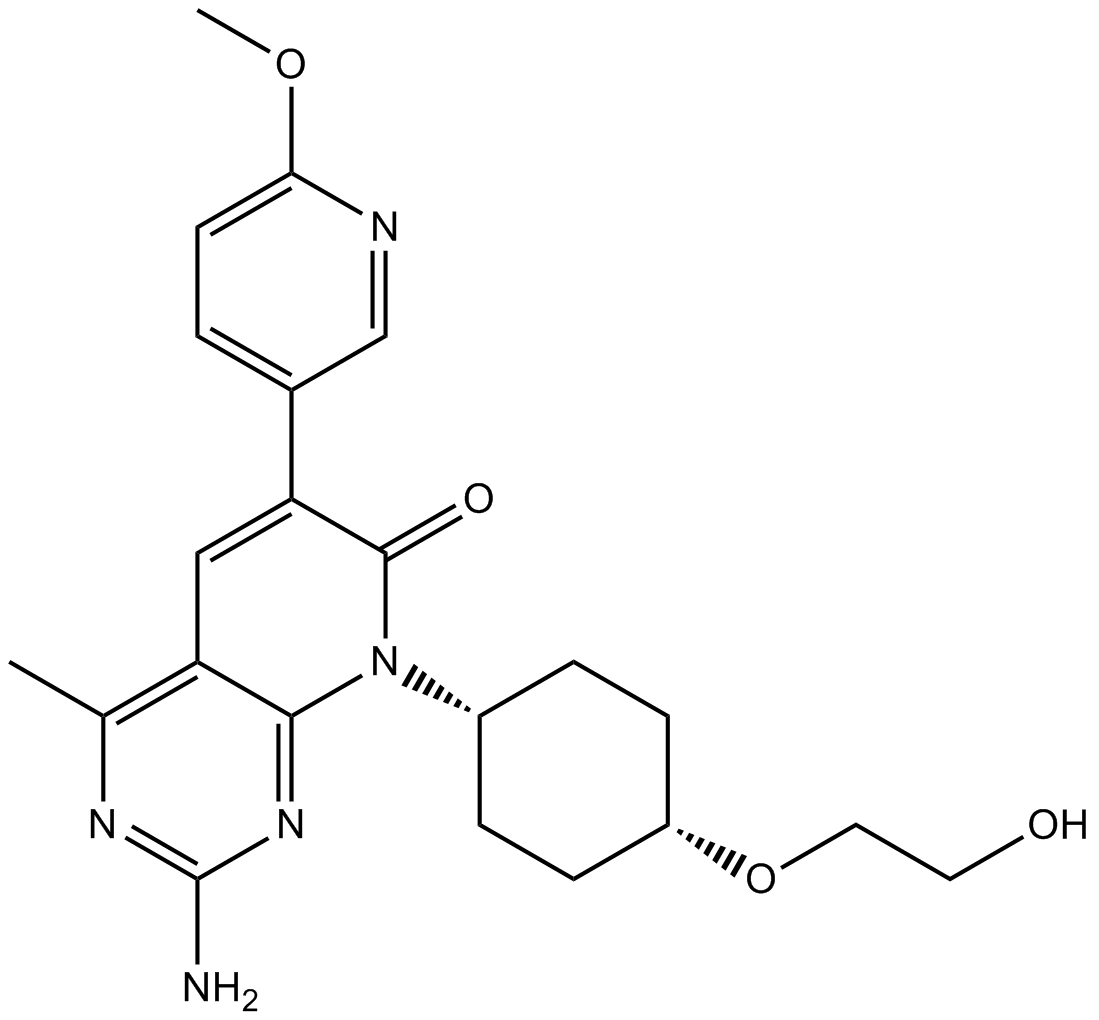
Cas No.: 1013101-36-4
Sample solution is provided at 25 µL, 10mM.
_1-3.$$$39978408@51.jpg');)
_1-9.$$$38538795@65.jpg');)
_1-9.$$$39112701@51.jpg');)
_1-7.$$$37316672@70.jpg');)
_366-372.$$$36198801@70.jpg');)
.$$$38565142@65.jpg');)
_1867-1883.$$$33248023@67.jpg');)
_eads6055.$$$39977546@45.jpg');)
_eadm9805.$$$40080571@45.jpg');)
_eadj3020.$$$39666821@45.jpg');)
_1-20.$$$39757301@28.jpg');)
_1-24.$$$38898113@28.jpg');)
_273-287.$$$36806353@46.jpg');)
_1-16.$$$37156877@44.jpg');)
_1-19.$$$37460805@44.jpg');)
_1291-1307.$$$34518654@46.jpg');)
PF-04691502 is an orally active, ATP-competitive dual inhibitor of PI3K and mTOR, with Ki values of 1.2, 2.1, 1.6, and 1.9nM for PI3Kα, β, δ, and γ isoforms, respectively [1]. PF-04691502 blocks glucose transport and/or metabolism, leading to high glucose levels [2]. PF-04691502 has been widely used to inhibit the growth of various drug-resistant cancer cells and to prevent the tumor growth in mouse xenograft models[3].
In vitro, PF-04691502 treatment for 48 hours significantly inhibited the proliferation of CNE-1, CNE-2, and HK1 cells, with IC50 values of 222.3nM, 97nM and 181.2nM, respectively[4]. Treatment with 10μM PF-04691502 for 48 hours specifically targeted and eliminated the senescent cells in the NIH-3T3 cell model induced by doxorubicin[5]. 20μM of PF-04691502 treatment for 24 hours inhibited the phosphorylation of Akt and the expression of PTEN in HepG2 cells, suppressed cell proliferation, and induced cell cycle arrest at the G1 phase[6].
In vivo, PF-04691502 treatment via oral administration at a dose of 10mg/kg/day for 11 days significantly inhibited tumor growth in the U87MG xenograft mouse model and reduced the phosphorylation levels of AKT and S6RP in the tumor tissues[7]. Oral administration of 10mg/kg dose of PF-04691502 daily for 12 weeks significantly enhanced the cognitive function of APP/PS1 mice and significantly reduced the accumulation of insoluble Aβ in the brain[8].
References:
[1] Blunt M D, Carter M J, Larrayoz M, et al. The PI3K/mTOR inhibitor PF-04691502 induces apoptosis and inhibits microenvironmental signaling in CLL and the Eµ-TCL1 mouse model[J]. Blood, The Journal of the American Society of Hematology, 2015, 125(26): 4032-4041.
[2] Britten C D, Adjei A A, Millham R, et al. Phase I study of PF-04691502, a small-molecule, oral, dual inhibitor of PI3K and mTOR, in patients with advanced cancer[J]. Investigational new drugs, 2014, 32(3): 510-517.
[3] Mehta P P, Walls M, Baxi S M, et al. PF-04691502, a potent and selective mTOR/PI3K dual inhibitor, demonstrates in vitro and in vivo antitumor activity in non-small cell lung carcinoma cells[J]. Cancer Research, 2010, 70(8_Supplement): 4473-4473.
[4] Wong C H, Loong H H, Hui C W C, et al. Preclinical evaluation of the PI3K-mTOR dual inhibitor PF-04691502 as a novel therapeutic drug in nasopharyngeal carcinoma[J]. Investigational new drugs, 2013, 31(6): 1399-1408.
[5] Fan Z, Tong Y, Yang Z, et al. Inhibitor PF-04691502 works as a senolytic to regulate cellular senescence[J]. Experimental Gerontology, 2024, 186: 112359.
[6] Wang F Z, Yang N N, Zhao Y L, et al. PF-04691502 triggers cell cycle arrest, apoptosis and inhibits the angiogenesis in hepatocellular carcinoma cells[J]. Toxicology Letters, 2013, 220(2): 150-156.
[7] Yuan J, Mehta P P, Yin M J, et al. PF-04691502, a potent and selective oral inhibitor of PI3K and mTOR kinases with antitumor activity[J]. Molecular cancer therapeutics, 2011, 10(11): 2189-2199.
[8] Lanza M, Basilotta R, Caccamo A, et al. PF-04691502, a PI3K/mTOR Dual Inhibitor, Ameliorates AD-like Pathology in a Mouse Model of AD[J]. Cells, 2025, 14(18): 1474.
| Cell experiment [1]: | |
Cell lines | HK1 cells |
Preparation Method | HK1 cells were grown in RPMI-1640 medium supplemented with 1% penicillin/streptomycin, and 10% heat-inactivated fetal bovine serum (FBS) at 37°C in an incubator with 5% CO2. HK1 cells were cultured in 48-well plates (7000 cells per well) in culture medium. Different concentrations of PF-04691502 (0.1, 1, 10, 100, and 1000nM) were added at 24h after cell plating and incubated at 37°C with 5% CO2 for 48h in complete medium. Cell growth inhibition was expressed as the percentage of the absorbance of control cultures measured at 570nm with a microplate reader. |
Reaction Conditions | 0.1, 1, 10, 100, and 1000nM; 48h |
Applications | PF-04691502 treatment significantly reduced growth of HK1 cells in a dose-dependent manner. |
| Animal experiment [2]: | |
Animal models | APP/PS1 mice |
Preparation Method | APP/PS1 mice were maintained at 22±1°C with a 12-h light/dark cycle and had free access to food and water. Mice were treated daily with PF-04691502 (1mg/kg/day) by oral administration for 12 weeks. The compound was formulated in 0.5% carboxymethylcellulose (CMC) dissolved in saline. At the end of the experimental period, the mice were sacrificed, and the whole brain was collected for downstream analyses. |
Dosage form | 1mg/kg/day for 12 weeks; p.o. |
Applications | PF-04691502 treatment reduced Aβ accumulation and total tau expression in the brains of APP/PS1 mice. |
References: | |
| Cas No. | 1013101-36-4 | SDF | |
| Chemical Name | 2-amino-8-[4-(2-hydroxyethoxy)cyclohexyl]-6-(6-methoxypyridin-3-yl)-4-methylpyrido[2,3-d]pyrimidin-7-one | ||
| Canonical SMILES | CC1=C2C=C(C(=O)N(C2=NC(=N1)N)C3CCC(CC3)OCCO)C4=CN=C(C=C4)OC | ||
| Formula | C22H27N5O4 | M.Wt | 425.48 |
| الذوبان | ≥ 10.625mg/mL in DMSO with gentle warming | Storage | Store at -20°C |
| General tips | Please select the appropriate solvent to prepare the stock solution according to the
solubility of the product in different solvents; once the solution is prepared, please store it in
separate packages to avoid product failure caused by repeated freezing and thawing.Storage method
and period of the stock solution: When stored at -80°C, please use it within 6 months; when stored
at -20°C, please use it within 1 month. To increase solubility, heat the tube to 37°C and then oscillate in an ultrasonic bath for some time. |
||
| Shipping Condition | Evaluation sample solution: shipped with blue ice. All other sizes available: with RT, or with Blue Ice upon request. | ||
| Prepare stock solution | |||

|
1 mg | 5 mg | 10 mg |
| 1 mM | 2.3503 mL | 11.7514 mL | 23.5029 mL |
| 5 mM | 470.1 μL | 2.3503 mL | 4.7006 mL |
| 10 mM | 235 μL | 1.1751 mL | 2.3503 mL |
Step 1: Enter information below (Recommended: An additional animal making an allowance for loss during the experiment)
 g
μL
g
μL
Step 2: Enter the in vivo formulation (This is only the calculator, not formulation. Please contact us first if there is no in vivo formulation at the solubility Section.)
Calculation results:
Working concentration: mg/ml;
Method for preparing DMSO master liquid: mg drug pre-dissolved in μL DMSO ( Master liquid concentration mg/mL, Please contact us first if the concentration exceeds the DMSO solubility of the batch of drug. )
Method for preparing in vivo formulation: Take μL DMSO master liquid, next addμL PEG300, mix and clarify, next addμL Tween 80, mix and clarify, next add μL saline, mix and clarify.
Method for preparing in vivo formulation: Take μL DMSO master liquid, next add μL Corn oil, mix and clarify.
Note: 1. Please make sure the liquid is clear before adding the next solvent.
2. Be sure to add the solvent(s) in order. You must ensure that the solution obtained, in the previous addition, is a clear solution before proceeding to add the next solvent. Physical methods such as vortex, ultrasound or hot water bath can be used to aid dissolving.
3. All of the above co-solvents are available for purchase on the GlpBio website.
Quality Control & SDS
- View current batch:
- Purity: >99.50% Appearance: A solid
- COA (Certificate of Analysis)
- SDS (Safety Data Sheet)
- Datasheet
Average Rating: 5 (Based on Reviews and 32 reference(s) in Google Scholar.)