

PHA-767491 (Synonyms: CAY10572;PHA767491;PHA 767491;CAY-10572;CAY 10572) |
رقم الكتالوجGC11324
 One-Click Copy Product Info
|

مثبط قوي لإنزيم سي دي سي 7 كايناز
Products are for research use only. Not for human use. We do not sell to patients.
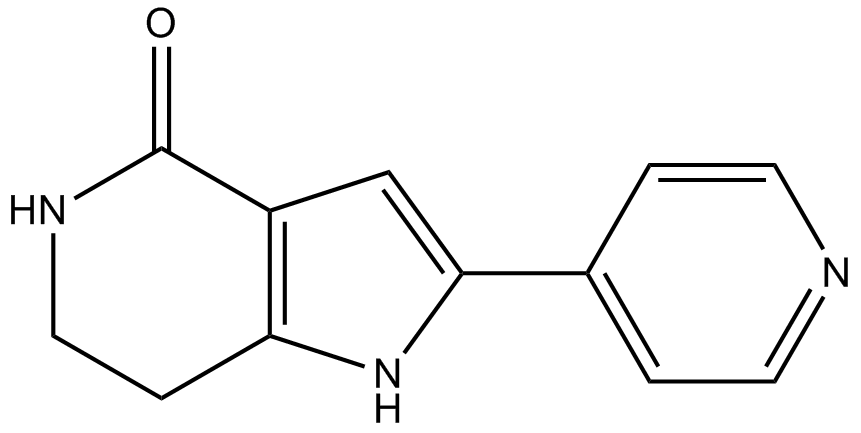
Cas No.: 845714-00-3
Sample solution is provided at 25 µL, 10mM.
_1-3.$$$39978408@51.jpg');)
_1-9.$$$38538795@65.jpg');)
_1-9.$$$39112701@51.jpg');)
_1-7.$$$37316672@70.jpg');)
_366-372.$$$36198801@70.jpg');)
.$$$38565142@65.jpg');)
_1867-1883.$$$33248023@67.jpg');)
_eads6055.$$$39977546@45.jpg');)
_eadm9805.$$$40080571@45.jpg');)
_eadj3020.$$$39666821@45.jpg');)
_1-20.$$$39757301@28.jpg');)
_1-24.$$$38898113@28.jpg');)
_273-287.$$$36806353@46.jpg');)
_1-16.$$$37156877@44.jpg');)
_1-19.$$$37460805@44.jpg');)
_1291-1307.$$$34518654@46.jpg');)
PHA-767491 is a small-molecule inhibitor of Cdc7 kinase with IC50 value of 10 nM [1].
In the process of DNA synthesis, Cdc7 kinase is critical to the activation of replication origins. It phosphorylates several subunits of mini chromosome maintenance proteins (MCMs), especially the Mcm2 at Ser40 and Ser53 sites, which constitute the replicative DNA helicase. Cdc7 is overexpressed in tumor cells and tumor specimens, therefore the Cdc7 inhibitors are developed as anticancer agents. As a small-molecule Cdc7 inhibitor, PHA-767491 exerted antitumor activity through a different mechanism than other drugs target DNA replication. PHA-767491 competed with ATP for binding to Cdc7 and showed an IC50 value of 10 nM in the presence of 1.5 μM ATP [1].
PHA-767491 is a selective inhibitor. It showed no inhibitory effect on 15 kinases when tested against a panel of 38 serine/theronine and tyrosine kinases. However, it inhibited cdk1, cdk2 and GSK-3β with 20-fold less potency. Besides that, PHA-767491 was found to have inhibitory effect on Cdk9 with IC50 value of 34 nM, which made it be regarded as a dual inhibitor of Cdk7/9 kinase. When treated to a panel of 61 human cell lines, PHA-767491 caused cell proliferation inhibition with an average IC50 value of 3.17μM. It killed cells both p53-positive and p53-negative. Among the exceptions, NHDF and MCF7 cells were resistant to PHA-767491. K562 cells were less sensitive to PHA-767491 [1].
In mice bearing implanted tumors derived from HL60 cell lines, administration of PHA-767491 at dose of 20 and 30 mg/kg twice a day reduced tumor volume dose-dependently. PHA-767491 administration also resulted in 50% tumor growth inhibition in xenograft models of A2780 ovary carcinoma, HCT-116 colon carcinoma or Mx-1 mammary adenocarcinoma [1].
Reference:
[1] Montagnoli A, Valsasina B, Croci V, et al. A Cdc7 kinase inhibitor restricts initiation of DNA replication and has antitumor activity. Nature chemical biology, 2008, 4(6): 357-365.
Kinase experiment: | 20 ng of purified human DDK is pre-incubated with increasing concentrations of each DDK inhibitor for 5 min. Then 10 µCi (γ)-32P ATP and 1.5 µM cold ATP are added in a buffer containing 50 mM Tris-HCl (pH 7.5), 10 mM MgCl2, and 1 mM DTT and incubated for 30 min at 30°C. The proteins are denatured in 1X Laemmli buffer at 100°C followed by SDS-PAGE and autoradiography on HyBlot CL film. Auto-phosphorylation of DDK is used as an indicator of its kinase activity. 32P-labeled bands are quantified using ImageJ and the IC50 values are calculated using GraphPad. |
Cell experiment: | For assays in 96 well plates 2500 cells are plated per well. After 24 hours, cells are treated with small molecule inhibitors and incubated for 72 hours at 37°C. Subsequently the cells are lysed and the ATP content is measured as an indicator of metabolically active cells using the CellTiter-Glo assay. IC50 values are calculated using the GraphPad software. For assays in six well plates, 100,000 cells are plated per well. After 24 hours, cells are treated with small molecule inhibitors and incubated for varying time points. Cells are trypsinized and a suspension is made in 5 mL of phosphate buffered saline. 30 µL of this suspension is mixed with 30 µL of CellTiter-Glo reagent followed by a 10-minute incubation at room temperature. Luminescence is measured using EnVision 2104 Multilabel Reader and BioTek Synergy Neo Microplate Reader. |
References: [1]. Sasi NK, et al. The potent Cdc7-Dbf4 (DDK) kinase inhibitor XL413 has limited activity in many cancer cell lines and discovery of potential new DDK inhibitor scaffolds. PLoS One. 2014 Nov 20;9(11):e113300. | |
| Cas No. | 845714-00-3 | SDF | |
| المرادفات | CAY10572;PHA767491;PHA 767491;CAY-10572;CAY 10572 | ||
| Chemical Name | 2-pyridin-4-yl-1,5,6,7-tetrahydropyrrolo[3,2-c]pyridin-4-one | ||
| Canonical SMILES | C1CNC(=O)C2=C1NC(=C2)C3=CC=NC=C3 | ||
| Formula | C12H11N3O | M.Wt | 213.24 |
| الذوبان | ≥ 10.65 mg/mL in DMSO | Storage | Store at -20°C |
| General tips | Please select the appropriate solvent to prepare the stock solution according to the
solubility of the product in different solvents; once the solution is prepared, please store it in
separate packages to avoid product failure caused by repeated freezing and thawing.Storage method
and period of the stock solution: When stored at -80°C, please use it within 6 months; when stored
at -20°C, please use it within 1 month. To increase solubility, heat the tube to 37°C and then oscillate in an ultrasonic bath for some time. |
||
| Shipping Condition | Evaluation sample solution: shipped with blue ice. All other sizes available: with RT, or with Blue Ice upon request. | ||
| Prepare stock solution | |||

|
1 mg | 5 mg | 10 mg |
| 1 mM | 4.6896 mL | 23.4478 mL | 46.8955 mL |
| 5 mM | 937.9 μL | 4.6896 mL | 9.3791 mL |
| 10 mM | 469 μL | 2.3448 mL | 4.6896 mL |
Step 1: Enter information below (Recommended: An additional animal making an allowance for loss during the experiment)
 g
μL
g
μL
Step 2: Enter the in vivo formulation (This is only the calculator, not formulation. Please contact us first if there is no in vivo formulation at the solubility Section.)
Calculation results:
Working concentration: mg/ml;
Method for preparing DMSO master liquid: mg drug pre-dissolved in μL DMSO ( Master liquid concentration mg/mL, Please contact us first if the concentration exceeds the DMSO solubility of the batch of drug. )
Method for preparing in vivo formulation: Take μL DMSO master liquid, next addμL PEG300, mix and clarify, next addμL Tween 80, mix and clarify, next add μL saline, mix and clarify.
Method for preparing in vivo formulation: Take μL DMSO master liquid, next add μL Corn oil, mix and clarify.
Note: 1. Please make sure the liquid is clear before adding the next solvent.
2. Be sure to add the solvent(s) in order. You must ensure that the solution obtained, in the previous addition, is a clear solution before proceeding to add the next solvent. Physical methods such as vortex, ultrasound or hot water bath can be used to aid dissolving.
3. All of the above co-solvents are available for purchase on the GlpBio website.
Quality Control & SDS
- View current batch:
- Purity: >98.00% Appearance: A solid
- COA (Certificate of Analysis)
- SDS (Safety Data Sheet)
- Datasheet
Average Rating: 5 (Based on Reviews and 30 reference(s) in Google Scholar.)