

RMC-4550 |
رقم الكتالوجGC33044
 One-Click Copy Product Info
|

RMC-4550 هو مثبط قوي وانتقائي وخيفي لـ SHP2 ، مع IC50 يبلغ 0.583 نانومتر
Products are for research use only. Not for human use. We do not sell to patients.
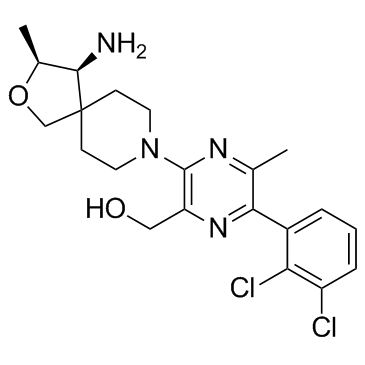
Cas No.: 2172651-73-7
Sample solution is provided at 25 µL, 10mM.
_1-3.$$$39978408@51.jpg');)
_1-9.$$$38538795@65.jpg');)
_1-9.$$$39112701@51.jpg');)
_1-7.$$$37316672@70.jpg');)
_366-372.$$$36198801@70.jpg');)
.$$$38565142@65.jpg');)
_1867-1883.$$$33248023@67.jpg');)
_eads6055.$$$39977546@45.jpg');)
_eadm9805.$$$40080571@45.jpg');)
_eadj3020.$$$39666821@45.jpg');)
_1-20.$$$39757301@28.jpg');)
_1-24.$$$38898113@28.jpg');)
_273-287.$$$36806353@46.jpg');)
_1-16.$$$37156877@44.jpg');)
_1-19.$$$37460805@44.jpg');)
_1291-1307.$$$34518654@46.jpg');)
RMC-4550 is an orally active allosteric inhibitor of SHP2 (IC₅₀=0.583nM). RMC-4550 disrupts the SHP2/SOS1/GRB2 module by stabilizing the autoinhibited conformation of the wild-type SHP2 enzyme, thereby downregulating RAS-GTP levels and inhibiting the RAS/MAPK signaling pathway[1-2]. RMC-4550 can be used in research related to KRAS-mutant pancreatic cancer, lung cancer, and esophageal cancer, among others[3-4].
In vitro, FLT3-ITD-mutant AML cell lines (Molm-14, MV4-11) and KIT-mutant cell lines (SKNO-1) were treated with RMC-4550 (500nM) for 24-48 hours. RMC-4550 upregulated the expression of interferon-stimulated genes, including IFIT2, OAS1, and OASL, inhibited cell proliferation, induced apoptosis, and reduced RAS-GTP levels and ERK phosphorylation[5]. Treatment of neuroblastoma cell lines (CLB-GE, CLB-GA, CLB-BA, KELLY, and SK-N-AS) with RMC-4550 (0.1-1000nM) for 72 hours inhibited cell proliferation in a dose-dependent manner[6].
In vivo, Balb/c nude mice with subcutaneous RPMI-8226 cell-derived tumors were orally administered RMC-4550 (30mg/kg) once daily for 20 days. RMC-4550 significantly inhibited the growth of myeloma xenograft tumors[7]. C57BL/6J or nu/nu mice, which received orthotopic inoculation of LLC 46 NRAS KO or mKRC.1 cells into the left lung, were orally administered RMC-4550 (30mg/kg) once daily for 35 days. RMC-4550 monotherapy slightly slowed the growth of LLC 46 NRAS KO tumors, and its combination with MRTX-849 caused tumor regression; in mKRC.1 tumors, RMC-4550 monotherapy was ineffective, but its combination with MRTX-849 produced sustained tumor regression[8].
References:
[1] Nichols RJ, Haderk F, Stahlhut C, et al. RAS nucleotide cycling underlies the SHP2 phosphatase dependence of mutant BRAF-, NF1- and RAS-driven cancers. Nat Cell Biol. 2018 Sep;20(9):1064-1073.
[2] Frank KJ, Mulero-Sánchez A, Berninger A, et al. Extensive preclinical validation of combined RMC-4550 and LY3214996 supports clinical investigation for KRAS mutant pancreatic cancer. Cell Rep Med. 2022 Nov 15;3(11):100815.
[3] Wang RR, Liu WS, Zhou L, et al. Probing the acting mode and advantages of RMC-4550 as an Src-homology 2 domain-containing protein tyrosine phosphatase (SHP2) inhibitor at molecular level through molecular docking and molecular dynamics. J Biomol Struct Dyn. 2020 Mar;38(5):1525-1538.
[4] Vemulapalli V, Donovan KA, Seegar TCM, et al. Targeted Degradation of the Oncogenic Phosphatase SHP2. Biochemistry. 2021 Aug 31;60(34):2593-2609.
[5] Popescu B, Stahlhut C, Tarver TC, et al. Allosteric SHP2 inhibition increases apoptotic dependency on BCL2 and synergizes with venetoclax in FLT3- and KIT-mutant AML. Cell Rep Med. 2023 Nov 21;4(11):101290.
[6] Uçkun E, Siaw JT, Guan J, et al. BioID-Screening Identifies PEAK1 and SHP2 as Components of the ALK Proximitome in Neuroblastoma Cells. J Mol Biol. 2021 Sep 17;433(19):167158.
[7] Zhou P, Xiao M, Li W, et al. SHP2 Inhibitors Show Anti-Myeloma Activity and Synergize With Bortezomib in the Treatment of Multiple Myeloma. Front Pharmacol. 2022 Apr 6;13:841308.
[8] Sisler DJ, Hinz TK, Le AT, et al. Evaluation of KRASG12C inhibitor responses in novel murine KRASG12C lung cancer cell line models. Front Oncol. 2023 Feb 8;13:1094123.
| Cell experiment [1]: | |
Cell lines | Molm-14, MV4-11, Kasumi-1, and SKNO-1 (human acute myeloid leukemia cell lines with FLT3 or KIT mutations) |
Preparation Method | The indicated AML cell lines were cultured in RPMI-1640 medium supplemented with 10% fetal bovine serum (FBS) and 1% penicillin/streptomycin/L-glutamine. Kasumi-1 cells were cultured with 20% FBS. The culture medium for the SKNO-1 cell line was supplemented with human GM-CSF (10ng/mL). Cells were treated with the RMC-4550. |
Reaction Conditions | 500nM; 24-48h. |
Applications | RMC-4550 inhibited cell proliferation, impaired RAS GTP loading, and repressed downstream phosphorylation of ERK. RMC-4550 increased the expression of the pro-apoptotic protein BMF and decreased levels of the anti-apoptotic protein MCL1. Treatment with RMC-4550 increased apoptotic priming and dependency on BCL2. |
| Animal experiment [2]: | |
Animal models | Female Balb/c nude mice |
Preparation Method | Mice were subcutaneously injected with RPMI-8226 cells. When tumors reached approximately 100-130mm³, tumor-bearing mice were randomly divided into cohorts and received RMC-4550 (30mg/kg; p.o.) or vehicle for 35 days. |
Dosage form | 30mg/kg; p.o.; daily for 35 days. |
Applications | Oral administration of RMC-4550 reduced tumor size, growth, and weight in the xenograft mice compared to the vehicle-treated group. Tumor masses from the RMC-4550 treated mice exhibited increased expression of BAK, P21, and cleaved caspase-3, and decreased levels of p-SHP2 and p-ERK. |
References: | |
| Cas No. | 2172651-73-7 | SDF | |
| Canonical SMILES | ClC1=C(C(C2=NC(CO)=C(N=C2C)N3CCC4(CC3)CO[C@H]([C@H]4N)C)=CC=C1)Cl | ||
| Formula | C21H26Cl2N4O2 | M.Wt | 437.36 |
| الذوبان | DMSO : 125 mg/mL (285.81 mM) | Storage | Store at -20°C |
| General tips | Please select the appropriate solvent to prepare the stock solution according to the
solubility of the product in different solvents; once the solution is prepared, please store it in
separate packages to avoid product failure caused by repeated freezing and thawing.Storage method
and period of the stock solution: When stored at -80°C, please use it within 6 months; when stored
at -20°C, please use it within 1 month. To increase solubility, heat the tube to 37°C and then oscillate in an ultrasonic bath for some time. |
||
| Shipping Condition | Evaluation sample solution: shipped with blue ice. All other sizes available: with RT, or with Blue Ice upon request. | ||
| Prepare stock solution | |||

|
1 mg | 5 mg | 10 mg |
| 1 mM | 2.2864 mL | 11.4322 mL | 22.8645 mL |
| 5 mM | 457.3 μL | 2.2864 mL | 4.5729 mL |
| 10 mM | 228.6 μL | 1.1432 mL | 2.2864 mL |
Step 1: Enter information below (Recommended: An additional animal making an allowance for loss during the experiment)
 g
μL
g
μL
Step 2: Enter the in vivo formulation (This is only the calculator, not formulation. Please contact us first if there is no in vivo formulation at the solubility Section.)
Calculation results:
Working concentration: mg/ml;
Method for preparing DMSO master liquid: mg drug pre-dissolved in μL DMSO ( Master liquid concentration mg/mL, Please contact us first if the concentration exceeds the DMSO solubility of the batch of drug. )
Method for preparing in vivo formulation: Take μL DMSO master liquid, next addμL PEG300, mix and clarify, next addμL Tween 80, mix and clarify, next add μL saline, mix and clarify.
Method for preparing in vivo formulation: Take μL DMSO master liquid, next add μL Corn oil, mix and clarify.
Note: 1. Please make sure the liquid is clear before adding the next solvent.
2. Be sure to add the solvent(s) in order. You must ensure that the solution obtained, in the previous addition, is a clear solution before proceeding to add the next solvent. Physical methods such as vortex, ultrasound or hot water bath can be used to aid dissolving.
3. All of the above co-solvents are available for purchase on the GlpBio website.
Quality Control & SDS
- View current batch:
- Purity: >99.00% Appearance: A solid
- COA (Certificate of Analysis)
- SDS (Safety Data Sheet)
- Datasheet
Average Rating: 5 (Based on Reviews and 3 reference(s) in Google Scholar.)