

Sapacitabine |
رقم الكتالوجGC19319
 One-Click Copy Product Info
|

ساباسيتابين Sapacitabine هو دواء مساعد أولي متوفر عن طريق الفم للنيوكليوزيد يرتبط هيكليًا بالسيتارابين
Products are for research use only. Not for human use. We do not sell to patients.
Cas No.: 151823-14-2
Sample solution is provided at 25 µL, 10mM.
_1-3.$$$39978408@51.jpg');)
_1-9.$$$38538795@65.jpg');)
_1-9.$$$39112701@51.jpg');)
_1-7.$$$37316672@70.jpg');)
_366-372.$$$36198801@70.jpg');)
.$$$38565142@65.jpg');)
_1867-1883.$$$33248023@67.jpg');)
_eads6055.$$$39977546@45.jpg');)
_eadm9805.$$$40080571@45.jpg');)
_eadj3020.$$$39666821@45.jpg');)
_1-20.$$$39757301@28.jpg');)
_1-24.$$$38898113@28.jpg');)
_273-287.$$$36806353@46.jpg');)
_1-16.$$$37156877@44.jpg');)
_1-19.$$$37460805@44.jpg');)
_1291-1307.$$$34518654@46.jpg');)
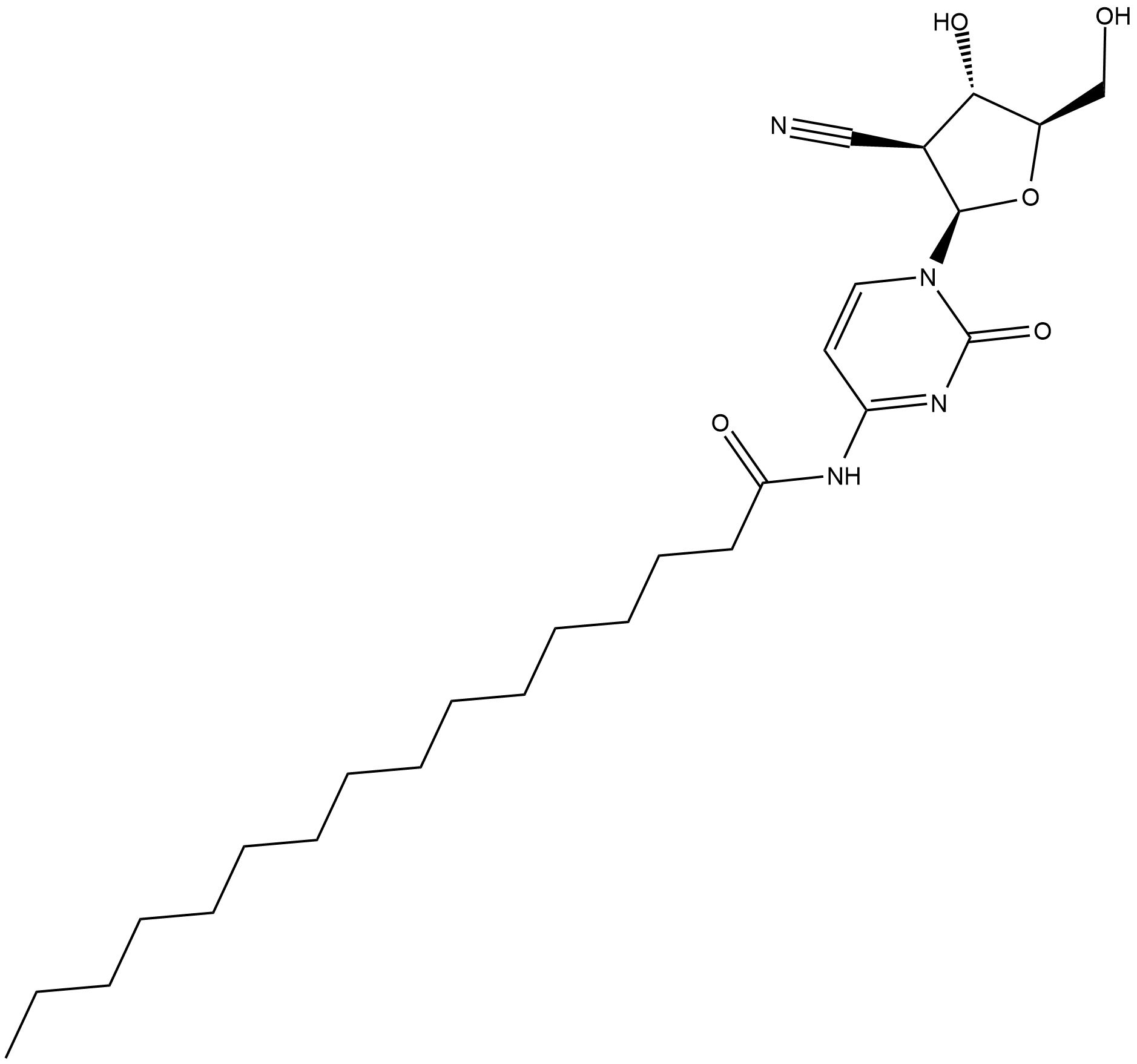
Sapacitabine is an orally available nucleoside analog prodrug that is structurally related to cytarabine.
Concentrations of Sapacitabine required to achieve an IC50 range from 3±0.6 uM for the colon cancer cell line HCT116 to 67±14 uM for the breast cancer cell line MDA-MB-435. Cell cycle analysis shows that 35% Sapacitabine-treated cells are arrested in late-S phase and 41% in G2/M phase. L1210 cells with deoxycytidine kinase (dCK) activity are sensitive to Sapacitabine, (IC50 20±6 uM). In the docetaxel/Sapacitabine combinations, synergistic effects (CI<1) are observed when docetaxel is given before Sapacitabine in both cell lines[1].
On Day 14, the Sapacitabine (5 mg/kg)+vorinostat (33 mg/kg) group has a mean tumour volume of 245 mm3 and a tumour growth inhibition (TGI) of 92%, whereas the Sapacitabine (15 mg/kg)+vorinostat (33 mg/kg) group has a mean tumour volume of 107 mm3 and a TGI of 112%[2].
References:
[1]. Serova M, et al. Antiproliferative effects of sapacitabine (CYC682), a novel 2'-deoxycytidine-derivative, in human cancer cells. Br J Cancer. 2007 Sep 3;97(5):628-36.
[2]. Green SR, et al. Combination of sapacitabine and HDAC inhibitors stimulates cell death in AML and other tumour types. Br J Cancer. 2010 Oct 26;103(9):1391-9.
Cell experiment: | A panel of colon (HT29, HCT116, COLO205, HCC2998), breast (MCF7, MDA-MB-435), lung (HOP62, HOP92), ovarian (OVCAR3, IGROV1) cancer cell lines are used in this study. The cell cycle stage and percentage of apoptotic cells are assessed by flow cytometry. In brief, cells are seeded in 25 cm3 flasks and are untreated or treated with various concentrations of Sapacitabine. At the indicated time points, adherent and non-adherent cells are collected, washed with PBS, fixed in 70% ethanol and stored at 4°C until use. Cells are rehydrated in PBS, incubated for 20 min at room temperature (25°C) with 250 μg/mL RNAse A with Triton X-100 and 20 min at 4°C with 50 μg/mL propidium iodide in the dark. The cell cycle distribution and percentage of apoptotic cells are determined with flow cytometer and analysed by FACS Calibur[1]. |
Animal experiment: | Female (nu/nu) mice are injected subcutaneously with 1×10⁷ MV4-11 cells resuspended in 50% Matrigel at a single site on their flanks. Once tumour volumes are 126 to 256 mm3 (16 days post-implantation) animals are pair matched by tumour size into treatment groups (minimum of six mice per group) with a mean tumour size of ~190 mm3. Tumour measurements are calculated using the formula: volume (mm3)=width2 (mm)×length (mm)×0.5. Sapacitabine is administered once a day orally (5 or 15 mg/kg) for 4 days, followed by a 3-day break before another 4 days of treatment; dosing starts on the same day as distribution to the treatment groups[2]. |
References: [1]. Serova M, et al. Antiproliferative effects of sapacitabine (CYC682), a novel 2'-deoxycytidine-derivative, in human cancer cells. Br J Cancer. 2007 Sep 3;97(5):628-36. | |
| Cas No. | 151823-14-2 | SDF | |
| Canonical SMILES | O=C(N=C(NC(CCCCCCCCCCCCCCC)=O)C=C1)N1[C@H]2[C@@H](C#N)[C@H](O)[C@@H](CO)O2 | ||
| Formula | C26H42N4O5 | M.Wt | 490.64 |
| الذوبان | DMSO : 25 mg/mL (50.95 mM) | Storage | Store at -20°C |
| General tips | Please select the appropriate solvent to prepare the stock solution according to the
solubility of the product in different solvents; once the solution is prepared, please store it in
separate packages to avoid product failure caused by repeated freezing and thawing.Storage method
and period of the stock solution: When stored at -80°C, please use it within 6 months; when stored
at -20°C, please use it within 1 month. To increase solubility, heat the tube to 37°C and then oscillate in an ultrasonic bath for some time. |
||
| Shipping Condition | Evaluation sample solution: shipped with blue ice. All other sizes available: with RT, or with Blue Ice upon request. | ||
| Prepare stock solution | |||

|
1 mg | 5 mg | 10 mg |
| 1 mM | 2.0382 mL | 10.1908 mL | 20.3815 mL |
| 5 mM | 407.6 μL | 2.0382 mL | 4.0763 mL |
| 10 mM | 203.8 μL | 1.0191 mL | 2.0382 mL |
Step 1: Enter information below (Recommended: An additional animal making an allowance for loss during the experiment)
 g
μL
g
μL
Step 2: Enter the in vivo formulation (This is only the calculator, not formulation. Please contact us first if there is no in vivo formulation at the solubility Section.)
Calculation results:
Working concentration: mg/ml;
Method for preparing DMSO master liquid: mg drug pre-dissolved in μL DMSO ( Master liquid concentration mg/mL, Please contact us first if the concentration exceeds the DMSO solubility of the batch of drug. )
Method for preparing in vivo formulation: Take μL DMSO master liquid, next addμL PEG300, mix and clarify, next addμL Tween 80, mix and clarify, next add μL saline, mix and clarify.
Method for preparing in vivo formulation: Take μL DMSO master liquid, next add μL Corn oil, mix and clarify.
Note: 1. Please make sure the liquid is clear before adding the next solvent.
2. Be sure to add the solvent(s) in order. You must ensure that the solution obtained, in the previous addition, is a clear solution before proceeding to add the next solvent. Physical methods such as vortex, ultrasound or hot water bath can be used to aid dissolving.
3. All of the above co-solvents are available for purchase on the GlpBio website.
Quality Control & SDS
- View current batch:
- Purity: >98.50% Appearance: A solid
- COA (Certificate of Analysis)
- SDS (Safety Data Sheet)
- Datasheet
Average Rating: 5 (Based on Reviews and 40 reference(s) in Google Scholar.)