

STF 083010 (Synonyms: IRE1 Inhibitor I) |
رقم الكتالوجGC12937
 One-Click Copy Product Info
|

STF 083010 هو مثبط محدد لـ IRE1α. يثبط STF 083010 نشاط نوكلياز Ire1 ، دون التأثير على نشاط كينازه ، بعد إجهاد الشبكة الإندوبلازمية.
Products are for research use only. Not for human use. We do not sell to patients.
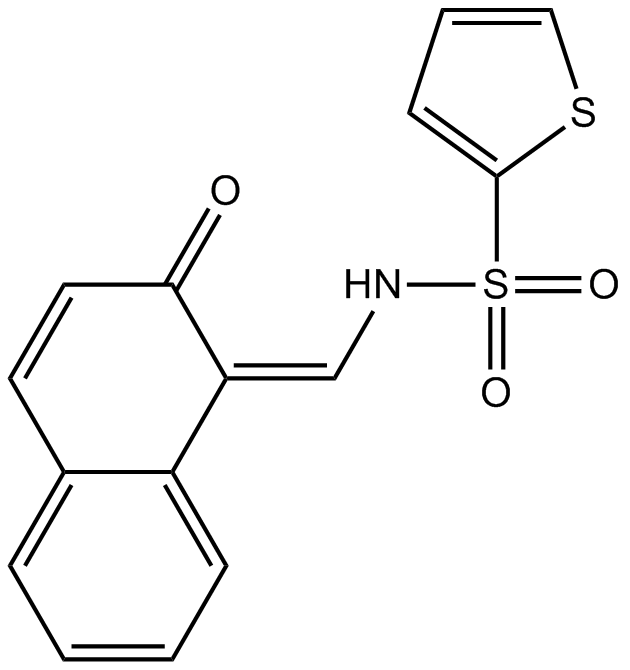
Cas No.: 307543-71-1
Sample solution is provided at 25 µL, 10mM.
STF 083010 is an inhibitor of endonuclease activity of Inositol requiring-enzyme 1α (IRE1α) with an IC50 value of 9.94µM for IRE-1 RNase[1]. STF 083010 specifically targets the IRE1-XBP1 axis, blocking the IRE1 activity after endoplasmic reticulum stress, interfering with the splicing of endogenous XBP1 mRNA and inhibiting the production of active sXBP1 protein[2]. STF 083010 has been widely used in cancer research to inhibit the growth of various cancer cells and reverse drug resistance[3].
In vitro, STF 083010 treatment (60µM) for 24 hours significantly reduced the maximum mitochondrial respiratory rate and reserve respiratory capacity of SH-SY5Y cells[4]. Treatment with 80µM STF 083010 for 24 hours alleviated the CdCl2-induced autophagy in GC-2spd cells, resulting in a significant decrease in the protein expression levels of autophagy-related proteins LC3-II/LC3-I and Beclin-1[5].
In vivo, a single intraperitoneal injection of STF 083010 (50mg/kg) 2 hours before thioacetamide (TAA) administration alleviated TAA-induced acute liver injury, attenuated oxidative stress, and reduced inflammation in mice within 24 hours[6]. Intraperitoneal injection of 30mg/kg dose of STF 083010, twice a week for 3 weeks, alleviated liver fibrosis induced by carbon tetrachloride in mice and promoted the upregulation of miR-122 expression[7]. Intraperitoneal injection of STF 083010 at a dose of 30mg/kg/day for 3 days alleviated the lung injury elicited by lipopolysaccharide (LPS) in mice and restored the expression of β-catenin in airway epithelial cells[8].
References:
[1] Ranatunga S, Tang C H A, Kang C W, et al. Synthesis of novel tricyclic chromenone-based inhibitors of IRE-1 RNase activity[J]. Journal of medicinal chemistry, 2014, 57(10): 4289.
[2] Papandreou I, Denko N C, Olson M, et al. Identification of an Ire1alpha endonuclease specific inhibitor with cytotoxic activity against human multiple myeloma[J]. Blood, The Journal of the American Society of Hematology, 2011, 117(4): 1311-1314.
[3] Ming J, Ruan S, Wang M, et al. A novel chemical, STF-083010, reverses tamoxifen-related drug resistance in breast cancer by inhibiting IRE1/XBP1[J]. Oncotarget, 2015, 6(38): 40692.
[4] Hatokova Z, Evinova A, Racay P. STF-083010 an inhibitor of IRE1α endonuclease activity affects mitochondrial respiration and generation of mitochondrial membrane potential[J]. Toxicology in Vitro, 2023, 92: 105652.
[5] Han Y, Dai J, Cheng J, et al. Cadmium induces autophagy via IRE1 signaling pathway activated by Ca2+ in GC-2spd cells[J]. Reproductive Toxicology, 2025, 135: 108950.
[6] Zhan F, Zhao G, Li X, et al. Inositol-requiring enzyme 1 alpha endoribonuclease specific inhibitor STF-083010 protects the liver from thioacetamide-induced oxidative stress, inflammation and injury by triggering hepatocyte autophagy[J]. International Immunopharmacology, 2019, 73: 261-269.
[7] Chen Q Q, Zhang C, Qin M Q, et al. Inositol-requiring enzyme 1 alpha endoribonuclease specific inhibitor STF-083010 alleviates carbon tetrachloride induced liver injury and liver fibrosis in mice[J]. Frontiers in Pharmacology, 2018, 9: 1344.
[8] Zhang H, Li J, Wang X, et al. IRE1α/XBP-1 promotes β-catenin signaling activation of airway epithelium in lipopolysaccharide-induced acute lung injury[J]. Pulmonary Pharmacology & Therapeutics, 2023, 83: 102263.
| Cell experiment [1]: | |
|
Cell lines |
L02 cells |
|
Preparation Method |
L02 cells were cultured in DMEM medium, supplemented with 10% fetal bovine serum (FBS), and 1% penicillin/streptomycin at 37°C in an incubator with 5% CO2. Cells were seeded in a 96-well plate at a density of 2×10³ cells/well overnight, and were pre-treated with or without Salidroside (10µM) or STF 083010 (50µM) for 6h, then followed by hypoxia. For experimental hypoxia, cells were incubated with the serum-free medium and placed in an airtight humidified chamber at 37°C, 5% CO2, and 95% N2. The corresponding normoxia control cells were cultured in a humidified incubator with 37°C, 5% CO2, and 21% O2. p-JNK, BAX, and cleaved caspase 12 and 9 protein expression levels were measured. |
|
Reaction Conditions |
50µM; 6h |
|
Applications |
STF 083010 treatment reversed the inhibitory effect of Salidroside on the protein expression of pJNK, BAX, cleaved caspase 12 and 9 in L02 cells under hypoxic conditions. |
| Animal experiment [2]: | |
|
Animal models |
Male BALB/c mice |
|
Preparation Method |
Male C57BL/6 mice (6 weeks old; 20-22g) were housed in a specific pathogen-free facility at controlled temperature/humidity (23°C±2°C/50%±10%) with a 12h dark/light cycle (lighting 7:00-19:00), with free access to water and food. After a week of acclimatization, a murine model of Acute lung injury (ALI) was established by intratracheal instillation of 5mg/kg LPS. Mice were randomly divided into the following 3 groups (n=10/group): control group, LPS group, LPS + STF 083010 group. STF 083010 (30mg/kg in 0.1% DMSO diluted with PBS), was injected intraperitoneally immediately after LPS instillation once a day for a consecutive of three days. Control mice were treated in a similar manner with the same volume of vehicle for comparison. The mice were sacrificed 72h after LPS instillation. Lung tissues of mice were collected for analysis. |
|
Dosage form |
30mg/kg/day; 3 days; i.p. |
|
Applications |
STF 083010 treatment significantly attenuated LPS-induced lung injury and inflammation in mice. |
References: [1] Xiong Y, Wang Y, Xiong Y, et al. Salidroside alleviated hypoxia-induced liver injury by inhibiting endoplasmic reticulum stress-mediated apoptosis via IRE1α/JNK pathway[J]. Biochemical and biophysical research communications, 2020, 529(2): 335-340. [2] Zhang H, Li J, Wang X, et al. IRE1α/XBP-1 promotes β-catenin signaling activation of airway epithelium in lipopolysaccharide-induced acute lung injury[J]. Pulmonary Pharmacology & Therapeutics, 2023, 83: 102263. | |
| Cas No. | 307543-71-1 | SDF | |
| المرادفات | IRE1 Inhibitor I | ||
| Chemical Name | (Z)-N-((2-oxonaphthalen-1(2H)-ylidene)methyl)thiophene-2-sulfonamide | ||
| Canonical SMILES | O=S(N/C=C1C2=CC=CC=C2C=CC/1=O)(C3=CC=CS3)=O | ||
| Formula | C15H11NO3S2 | M.Wt | 317.38 |
| الذوبان | ≥ 31.7mg/mL in DMSO | Storage | Store at -20°C |
| General tips | Please select the appropriate solvent to prepare the stock solution according to the
solubility of the product in different solvents; once the solution is prepared, please store it in
separate packages to avoid product failure caused by repeated freezing and thawing.Storage method
and period of the stock solution: When stored at -80°C, please use it within 6 months; when stored
at -20°C, please use it within 1 month. To increase solubility, heat the tube to 37°C and then oscillate in an ultrasonic bath for some time. |
||
| Shipping Condition | Evaluation sample solution: shipped with blue ice. All other sizes available: with RT, or with Blue Ice upon request. | ||
| Prepare stock solution | |||

|
1 mg | 5 mg | 10 mg |
| 1 mM | 3.1508 mL | 15.754 mL | 31.508 mL |
| 5 mM | 630.2 μL | 3.1508 mL | 6.3016 mL |
| 10 mM | 315.1 μL | 1.5754 mL | 3.1508 mL |
Step 1: Enter information below (Recommended: An additional animal making an allowance for loss during the experiment)
 g
μL
g
μL
Step 2: Enter the in vivo formulation (This is only the calculator, not formulation. Please contact us first if there is no in vivo formulation at the solubility Section.)
Calculation results:
Working concentration: mg/ml;
Method for preparing DMSO master liquid: mg drug pre-dissolved in μL DMSO ( Master liquid concentration mg/mL, Please contact us first if the concentration exceeds the DMSO solubility of the batch of drug. )
Method for preparing in vivo formulation: Take μL DMSO master liquid, next addμL PEG300, mix and clarify, next addμL Tween 80, mix and clarify, next add μL saline, mix and clarify.
Method for preparing in vivo formulation: Take μL DMSO master liquid, next add μL Corn oil, mix and clarify.
Note: 1. Please make sure the liquid is clear before adding the next solvent.
2. Be sure to add the solvent(s) in order. You must ensure that the solution obtained, in the previous addition, is a clear solution before proceeding to add the next solvent. Physical methods such as vortex, ultrasound or hot water bath can be used to aid dissolving.
3. All of the above co-solvents are available for purchase on the GlpBio website.
Quality Control & SDS
- View current batch:
- Purity: >98.00% Appearance: A solid
- COA (Certificate of Analysis)
- SDS (Safety Data Sheet)
- Datasheet
Average Rating: 5 (Based on Reviews and 29 reference(s) in Google Scholar.)