

TAK-220 |
رقم الكتالوجGC32135
 One-Click Copy Product Info
|

TAK-220 هو مضاد CCR5 انتقائي ومتوفر حيوياً عن طريق الفم ، مع IC50s من 3.5 نانومتر و 1.4 نانومتر لتثبيط ربط RANTES و MIP-1α بـ CCR5 ، على التوالي ، لكنه لا يظهر أي تأثير على الارتباط بـ CCR1 ، CCR2b ، CCR3 ، CCR4 أو CCR7 ؛ يثبط TAK-220 أيضًا بشكل انتقائي فيروس نقص المناعة البشرية -1 ، مع EC50s لـ 1.2 نانومتر (HIV-1 KK) ، 0.72 نانومتر (HIV-1 CTV) ، 1.7 نانومتر (HIV-1 HKW) ، 1.7 نانومتر (HIV-1 HNK) ، 0.93 نانومتر (HIV-1 HTN) ، و 0.55 نانومتر (HIV-1 HHA) ، و EC90s من 12 نانومتر (HIV-1 KK) ، 5 نانومتر (HIV-1 CTV) ، 12 نانومتر (HIV-1 HKW) ، 28 نانومتر (HIV-1 HNK) ، 15 نانومتر (HIV-1 HTN) ، و 4 نانومتر (HIV-1 HHA) في PBMCs
Products are for research use only. Not for human use. We do not sell to patients.
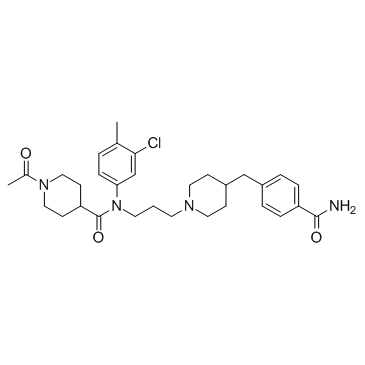
Cas No.: 333994-00-6
Sample solution is provided at 25 µL, 10mM.
_1-3.$$$39978408@51.jpg');)
_1-9.$$$38538795@65.jpg');)
_1-9.$$$39112701@51.jpg');)
_1-7.$$$37316672@70.jpg');)
_366-372.$$$36198801@70.jpg');)
.$$$38565142@65.jpg');)
_1867-1883.$$$33248023@67.jpg');)
_eads6055.$$$39977546@45.jpg');)
_eadm9805.$$$40080571@45.jpg');)
_eadj3020.$$$39666821@45.jpg');)
_1-20.$$$39757301@28.jpg');)
_1-24.$$$38898113@28.jpg');)
_273-287.$$$36806353@46.jpg');)
_1-16.$$$37156877@44.jpg');)
_1-19.$$$37460805@44.jpg');)
_1291-1307.$$$34518654@46.jpg');)
TAK-220 is a selective and orally bioavailable CCR5 antagonist, with IC50s of 3.5 nM and 1.4 nM for inhibition on the binding of RANTES and MIP-1α to CCR5, respectively, but shows no effect on the binding to CCR1, CCR2b, CCR3, CCR4, or CCR7; TAK-220 also selectively inhibits HIV-1, with EC50s of 1.2 nM (HIV-1 KK), 0.72 nM (HIV-1 CTV), 1.7 nM (HIV-1 HKW), 1.7 nM (HIV-1 HNK), 0.93 nM (HIV-1 HTN), and 0.55 nM (HIV-1 HHA), and EC90s of 12 nM (HIV-1 KK), 5 nM (HIV-1 CTV), 12 nM (HIV-1 HKW), 28 nM (HIV-1 HNK), 15 nM (HIV-1 HTN), and 4 nM (HIV-1 HHA) in PBMCs.
TAK-220 is a selective CCR5 antagonist, with IC50s of 3.5 nM and 1.4 nM for inhibition on the binding of RANTES and MIP-1α to CCR5 in CHO cells, respectively, but shows no effect on the binding to CCR1, CCR2b, CCR3, CCR4, or CCR7. TAK-220 (0-1000 nM) interacts with CCR5 but not with RANTES and inhibits the CCR5-mediated Casup>2+ signaling. TAK-220 inhibits R5 HIV-1 (JR-FL) envelope-mediated membrane fusion, with an IC50 value of 0.42 nM, but does not alter X4 HIV-1 (HXB2) envelope-mediated membrane fusion. TAK-220 also selectively inhibits HIV-1, with EC50s of 1.2 nM (HIV-1 KK), 0.72 nM (HIV-1 CTV), 1.7 nM (HIV-1 HKW), 1.7 nM (HIV-1 HNK), 0.93 nM (HIV-1 HTN), and 0.55 nM (HIV-1 HHA), and EC90s of 12 nM (HIV-1 KK), 5 nM (HIV-1 CTV), 12 nM (HIV-1 HKW), 28 nM (HIV-1 HNK), 15 nM (HIV-1 HTN), and 4 nM (HIV-1 HHA) in PBMCs[1]. TAK-220 shows potent inhibitory activity against the R5 isolates, with IC50s of 3.12 nM against HIV-1 R5-08, 13.47 nM against HIV-1 R5-06, and 2.26 nM against HIV-1 R5-18. TAK-220 (>100 nM) has no toxicity in uninfected PBMCs[2].
[1]. Takashima K, et al. Highly potent inhibition of human immunodeficiency virus type 1 replication by TAK-220, an orally bioavailable small-molecule CCR5 antagonist. Antimicrob Agents Chemother. 2005 Aug;49(8):3474-82. [2]. Tremblay CL, et al. TAK-220, a novel small-molecule CCR5 antagonist, has favorable anti-human immunodeficiency virus interactions with other antiretrovirals in vitro. Antimicrob Agents Chemother. 2005 Aug;49(8):3483-5.
Cell experiment: | PHA-stimulated PBMCs are inoculated with 1,000 to 1,400 CCID50s of R5 HIV-1 (JR-FL) or X4 HIV-1 (IIIB) or with 13 to 55 ng of p24 of HIV-1 clinical isolates per 4 × 10⁶ cells and incubated for 4 h. The cells are washed to remove unadsorbed viral particles and seeded into a 96-well plate (2 × 10⁵ cells/well) with culture medium containing various concentrations of TAK-220. The effects of high concentrations of human serum (HS) on the anti-HIV-1 activity of TAK-220 are examined with RPMI 1640 medium supplemented with either 20% FBS alone or 40% human type AB serum plus 10% FBS, 100 U/mL recombinant human interleukin 2, and antibiotics. On day 4 after infection, the cells are subcultured at 1:2 with culture medium containing the same concentrations of the test compounds. On day 7 after infection, the culture supernatants are collected and their p24 antigen levels are determined with a p24 antigen enzyme-linked immunosorbent assay kit[1]. |
References: [1]. Takashima K, et al. Highly potent inhibition of human immunodeficiency virus type 1 replication by TAK-220, an orally bioavailable small-molecule CCR5 antagonist. Antimicrob Agents Chemother. 2005 Aug;49(8):3474-82. | |
| Cas No. | 333994-00-6 | SDF | |
| Canonical SMILES | O=C(C1CCN(C(C)=O)CC1)N(CCCN2CCC(CC3=CC=C(C(N)=O)C=C3)CC2)C4=CC=C(C)C(Cl)=C4 | ||
| Formula | C31H41ClN4O3 | M.Wt | 553.14 |
| الذوبان | DMSO : ≥ 50 mg/mL (90.39 mM) | Storage | Store at -20°C |
| General tips | Please select the appropriate solvent to prepare the stock solution according to the
solubility of the product in different solvents; once the solution is prepared, please store it in
separate packages to avoid product failure caused by repeated freezing and thawing.Storage method
and period of the stock solution: When stored at -80°C, please use it within 6 months; when stored
at -20°C, please use it within 1 month. To increase solubility, heat the tube to 37°C and then oscillate in an ultrasonic bath for some time. |
||
| Shipping Condition | Evaluation sample solution: shipped with blue ice. All other sizes available: with RT, or with Blue Ice upon request. | ||
| Prepare stock solution | |||

|
1 mg | 5 mg | 10 mg |
| 1 mM | 1.8079 mL | 9.0393 mL | 18.0786 mL |
| 5 mM | 361.6 μL | 1.8079 mL | 3.6157 mL |
| 10 mM | 180.8 μL | 903.9 μL | 1.8079 mL |
Step 1: Enter information below (Recommended: An additional animal making an allowance for loss during the experiment)
 g
μL
g
μL
Step 2: Enter the in vivo formulation (This is only the calculator, not formulation. Please contact us first if there is no in vivo formulation at the solubility Section.)
Calculation results:
Working concentration: mg/ml;
Method for preparing DMSO master liquid: mg drug pre-dissolved in μL DMSO ( Master liquid concentration mg/mL, Please contact us first if the concentration exceeds the DMSO solubility of the batch of drug. )
Method for preparing in vivo formulation: Take μL DMSO master liquid, next addμL PEG300, mix and clarify, next addμL Tween 80, mix and clarify, next add μL saline, mix and clarify.
Method for preparing in vivo formulation: Take μL DMSO master liquid, next add μL Corn oil, mix and clarify.
Note: 1. Please make sure the liquid is clear before adding the next solvent.
2. Be sure to add the solvent(s) in order. You must ensure that the solution obtained, in the previous addition, is a clear solution before proceeding to add the next solvent. Physical methods such as vortex, ultrasound or hot water bath can be used to aid dissolving.
3. All of the above co-solvents are available for purchase on the GlpBio website.
Quality Control & SDS
- View current batch:
- Purity: >99.50% Appearance: A solid
- COA (Certificate of Analysis)
- SDS (Safety Data Sheet)
- Datasheet
Average Rating: 5 (Based on Reviews and 40 reference(s) in Google Scholar.)