

Brequinar (Synonyms: NSC 368390) |
Catalog No.GC19082
 One-Click Copy Product Info
|

Brequinar es un inhibidor específico de la dihidroorotato deshidrogenasa DHODH, con un valor de IC50 de aproximadamente 20nM in vitro.
Products are for research use only. Not for human use. We do not sell to patients.
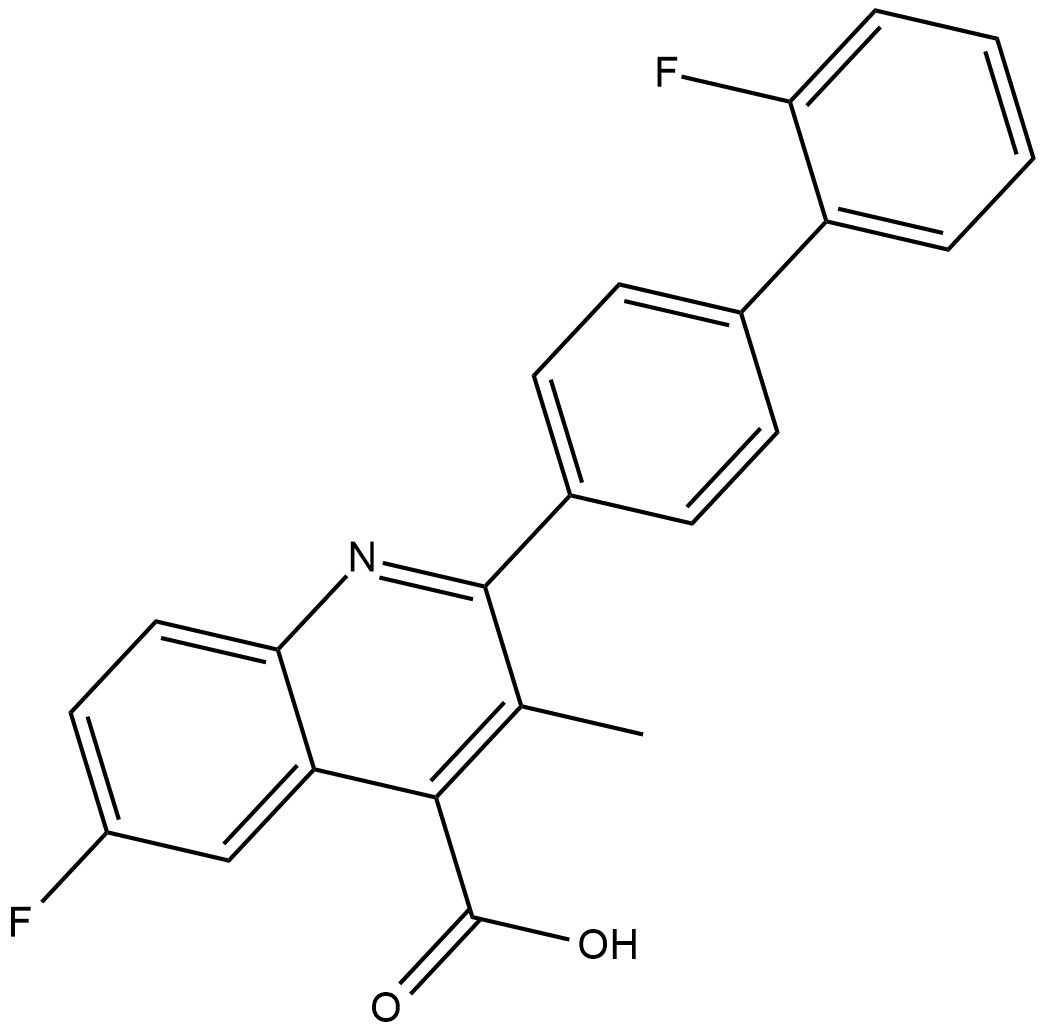
Cas No.: 96187-53-0
Sample solution is provided at 25 µL, 10mM.
Brequinar es un inhibidor específico de la dihidroorotato deshidrogenasa DHODH, con un valor de IC50 de aproximadamente 20nM in vitro [1]. DHODH es una enzima en la vía de biosíntesis de pirimidina de novo. El mecanismo de acción de Buquina es apuntar a la síntesis de DNA viral inhibiendo la actividad de DHODH y agotando el grupo celular de pirimidinas [2].
In vitro, Buquina (0-75μM) trató células BSC-40 infectadas con el virus CTGV durante 24 horas, inhibiendo significativamente la producción intracelular del virus CTGV de una manera dependiente de la dosis, con una EC50 de 0.017±0.05μM, y podría inhibirse a una alta concentración de 75μM. Asegúrese de que la viabilidad celular se mantenga en casi el 80%[2]. Buquina (0-25μM) trató células Vero infectadas con virus DENV-2, WNV, YFV, PWV y WEEV durante 42 horas, inhibiendo eficazmente todos los virus probados, y la actividad antiviral no fue causada por la toxicidad mediada por compuestos [3]. Buquinar (0-100 μM) trató a las células IBRS-2 infectadas con FMDV durante 8 horas e inhibió eficazmente la expresión de proteínas y ARNm de FMDV [4].
In vivo, Buquina (50 μg) trató a ratones suctantes infectados con FMDV (peso corporal 3-4 g) a través de inyección intraperitoneal, prolongando significativamente el tiempo de supervivencia de los ratones lactantes y reduciendo las lesiones del tejido cardíaco [4]. Buquina (10-20 mg/kg) se trató con ratones BALB/c a través de inyección intraperitoneal, causando una reducción del 31% en el porcentaje de acumulación de células sanguíneas, y una reducción del 30% y 25% en los niveles de UTP y CTP en células de médula ósea, respectivamente, lo que indica que el tratamiento con Buquina Quinal de ratones puede inducir anemia [5].
References:
[1] Sykes D B , Kfoury Y S , Mercier F ,et al.Inhibition of the Enzyme Dihydroorotate Dehydrogenase Overcomes Differentiation Blockade in Acute Myeloid Leukemia[J].Blood, 2016, 128(22):1656-1656.
[2] Schnellrath L C , Damaso C R .Potent antiviral activity of brequinar against the emerging Cantagalo virus in cell culture[J].International journal of antimicrobial agents, 2011, 38(5):435-441.
[3] Qing M , Zou G , Wang Q Y ,et al.Characterization of dengue virus resistance to brequinar in cell culture.[J].Antimicrobial Agents and Chemotherapy, 2010, 54(9):3686-3695.
[4] Li S F , Gong M J , Sun Y F ,et al.Antiviral activity of brequinar against foot-and-mouth disease virus infection in vitro and in vivo[J].Biomedicine & pharmacotherapy, 2019, 116:108982.
[5] Xu X , Williams J W , Shen J ,et al.In vitro and in vivo mechanisms of action of the antiproliferative and immunosuppressive agent, brequinar sodium.[J].Journal of Immunology, 1998, 160(2):846-53.
| Cas No. | 96187-53-0 | SDF | |
| Sinónimos | NSC 368390 | ||
| Canonical SMILES | O=C(C1=C(C)C(C2=CC=C(C3=CC=CC=C3F)C=C2)=NC4=CC=C(F)C=C14)O | ||
| Formula | C23H15F2NO2 | M.Wt | 375.37 |
| Solubility | DMSO : 35.71 mg/mL (95.13 mM);Water : < 0.1 mg/mL (insoluble) | Storage | Store at -20°C |
| General tips | Please select the appropriate solvent to prepare the stock solution according to the
solubility of the product in different solvents; once the solution is prepared, please store it in
separate packages to avoid product failure caused by repeated freezing and thawing.Storage method
and period of the stock solution: When stored at -80°C, please use it within 6 months; when stored
at -20°C, please use it within 1 month. To increase solubility, heat the tube to 37°C and then oscillate in an ultrasonic bath for some time. |
||
| Shipping Condition | Evaluation sample solution: shipped with blue ice. All other sizes available: with RT, or with Blue Ice upon request. | ||
| Prepare stock solution | |||

|
1 mg | 5 mg | 10 mg |
| 1 mM | 2.664 mL | 13.3202 mL | 26.6404 mL |
| 5 mM | 532.8 μL | 2.664 mL | 5.3281 mL |
| 10 mM | 266.4 μL | 1.332 mL | 2.664 mL |
Step 1: Enter information below (Recommended: An additional animal making an allowance for loss during the experiment)
 g
μL
g
μL
Step 2: Enter the in vivo formulation (This is only the calculator, not formulation. Please contact us first if there is no in vivo formulation at the solubility Section.)
Calculation results:
Working concentration: mg/ml;
Method for preparing DMSO master liquid: mg drug pre-dissolved in μL DMSO ( Master liquid concentration mg/mL, Please contact us first if the concentration exceeds the DMSO solubility of the batch of drug. )
Method for preparing in vivo formulation: Take μL DMSO master liquid, next addμL PEG300, mix and clarify, next addμL Tween 80, mix and clarify, next add μL saline, mix and clarify.
Method for preparing in vivo formulation: Take μL DMSO master liquid, next add μL Corn oil, mix and clarify.
Note: 1. Please make sure the liquid is clear before adding the next solvent.
2. Be sure to add the solvent(s) in order. You must ensure that the solution obtained, in the previous addition, is a clear solution before proceeding to add the next solvent. Physical methods such as vortex, ultrasound or hot water bath can be used to aid dissolving.
3. All of the above co-solvents are available for purchase on the GlpBio website.
Quality Control & SDS
- View current batch:
- Purity: >98.00% Appearance: A solid
- COA (Certificate of Analysis)
- SDS (Safety Data Sheet)
- Datasheet

Average Rating: 5 (Based on Reviews and 3 reference(s) in Google Scholar.)