

Bromothymol Blue |
Catalog No.GC30597
 One-Click Copy Product Info
|

El azul de bromotimol es un indicador de pH.
Products are for research use only. Not for human use. We do not sell to patients.
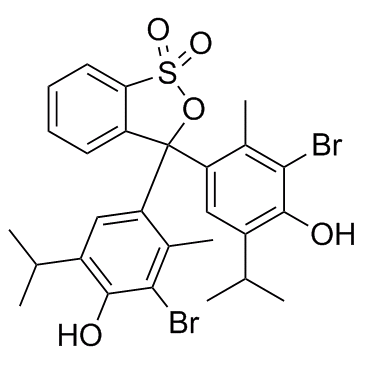
Cas No.: 76-59-5
Sample solution is provided at 25 µL, 10mM.
_1-3.$$$39978408@51.jpg');)
_1-9.$$$38538795@65.jpg');)
_1-9.$$$39112701@51.jpg');)
_1-7.$$$37316672@70.jpg');)
_366-372.$$$36198801@70.jpg');)
.$$$38565142@65.jpg');)
_1867-1883.$$$33248023@67.jpg');)
_eads6055.$$$39977546@45.jpg');)
_eadm9805.$$$40080571@45.jpg');)
_eadj3020.$$$39666821@45.jpg');)
_1-20.$$$39757301@28.jpg');)
_1-24.$$$38898113@28.jpg');)
_273-287.$$$36806353@46.jpg');)
_1-16.$$$37156877@44.jpg');)
_1-19.$$$37460805@44.jpg');)
_1291-1307.$$$34518654@46.jpg');)
Bromothymol Blue is a pH indicator.
A first characterization and comparison is done by developing an easy and direct measurement method based on a pH indicator system using Bromothymol Blue (BTB) as the indicator and potassium phosphate as the buffer. A pH-shift assay is developed on the basis of BTB as the pH indicator and potassium phosphate as the buffer component[1]. Three pH indicators are tested for the direct determination of 2- 2-keto-L-gulonic acid (2-KLG) production on a plate. The results show that Bromothymol Blue is superior to the other two indicators in terms of the obvious color change and a suitable pH range (blue to yellow at pH 6.5-7.5). Upon the addition of a Bromothymol Blue solution (0.1%, w/v) to an agar plate, zones surrounding colonies of K. vulgare 07 mutants change their color from blue to yellow because K. vulgare 07 mutants release 2-KLG on agar plates, thereby acidifying surrounding areas around colonies[2].
[1]. Pick A, et al. Identification and characterization of two new 5-keto-4-deoxy-D-Glucarate Dehydratases/Decarboxylases. BMC Biotechnol. 2016 Nov 17;16(1):80. [2]. Yang W, et al. A plate method for rapid screening of Ketogulonicigenium vulgare mutants for enhanced 2-keto-l-gulonic acid production. Braz J Microbiol. 2017 Jul - Sep;48(3):397-402.
|
Kinase experiment: |
For all three enzymes, an expression in the 96-deep well scale is performed. Therefore, electrocompetent E. coli ArcticExpress(DE3) cells are transformed with the corresponding plasmid. Single clones are picked using the CP7200 Colony Picker and transferred to 96-deep well plates filled with 1.2 mL autoinduction media by a MicroFlo Select dispenser. After incubation (36 h, 37°C at 1,000 rpm), further processing is done manually. First, 100 μL of cell culture is transferred into a 96-well plate (U-shaped bottom) and harvested by centrifugation (4,570 rpm, 10 min at RT) while the supernatant is discarded. The frozen pellets (1 h at -20°C) are thawed at room temperature for one hour to improve cell lysis. Lysis is continued by the addition of 30 μL lysis buffer (3 h, 1,000 rpm, 37°C) containing 2 mM KPi, pH 7.0, 2 mM MgCl2, 10 μg/mL DNaseI, 100 μg/mL lysozyme. Next, 120 μL buffer (2 mM KPi, pH 7.0) is added followed by centrifugation (3,000 rpm, 15 min at RT). For the photometric measurement, 20 μL of the crude extract is transferred to a 96-well plate (F-shaped bottom) and the reaction is started by adding 180 μL master mix to give a final volume of 200 μL (2.5 mM KPi, pH 7.0, 2 mM MgCl2, 25 μg/mL BTB and 5 mM keto-deoxy-D-glucarate). The measurements are carried out for 60 min at 2-min intervals. Depending on the enzyme, different time windows are used for the activity calculation[1]. |
|
References: [1]. Pick A, et al. Identification and characterization of two new 5-keto-4-deoxy-D-Glucarate Dehydratases/Decarboxylases. BMC Biotechnol. 2016 Nov 17;16(1):80. |
|
| Cas No. | 76-59-5 | SDF | |
| Canonical SMILES | O=S1(OC(C2=CC(C(C)C)=C(O)C(Br)=C2C)(C3=CC(C(C)C)=C(O)C(Br)=C3C)C4=CC=CC=C41)=O | ||
| Formula | C27H28Br2O5S | M.Wt | 624.38 |
| Solubility | DMSO: 100 mg/mL (160.16 mM); Water: < 0.1 mg/mL (insoluble) | Storage | Store at -20°C, protect from light |
| General tips | Please select the appropriate solvent to prepare the stock solution according to the
solubility of the product in different solvents; once the solution is prepared, please store it in
separate packages to avoid product failure caused by repeated freezing and thawing.Storage method
and period of the stock solution: When stored at -80°C, please use it within 6 months; when stored
at -20°C, please use it within 1 month. To increase solubility, heat the tube to 37°C and then oscillate in an ultrasonic bath for some time. |
||
| Shipping Condition | Evaluation sample solution: shipped with blue ice. All other sizes available: with RT, or with Blue Ice upon request. | ||
| Prepare stock solution | |||

|
1 mg | 5 mg | 10 mg |
| 1 mM | 1.6016 mL | 8.0079 mL | 16.0159 mL |
| 5 mM | 320.3 μL | 1.6016 mL | 3.2032 mL |
| 10 mM | 160.2 μL | 800.8 μL | 1.6016 mL |
Step 1: Enter information below (Recommended: An additional animal making an allowance for loss during the experiment)
 g
μL
g
μL
Step 2: Enter the in vivo formulation (This is only the calculator, not formulation. Please contact us first if there is no in vivo formulation at the solubility Section.)
Calculation results:
Working concentration: mg/ml;
Method for preparing DMSO master liquid: mg drug pre-dissolved in μL DMSO ( Master liquid concentration mg/mL, Please contact us first if the concentration exceeds the DMSO solubility of the batch of drug. )
Method for preparing in vivo formulation: Take μL DMSO master liquid, next addμL PEG300, mix and clarify, next addμL Tween 80, mix and clarify, next add μL saline, mix and clarify.
Method for preparing in vivo formulation: Take μL DMSO master liquid, next add μL Corn oil, mix and clarify.
Note: 1. Please make sure the liquid is clear before adding the next solvent.
2. Be sure to add the solvent(s) in order. You must ensure that the solution obtained, in the previous addition, is a clear solution before proceeding to add the next solvent. Physical methods such as vortex, ultrasound or hot water bath can be used to aid dissolving.
3. All of the above co-solvents are available for purchase on the GlpBio website.
Quality Control & SDS
- View current batch:
- Appearance: A solid
- COA (Certificate of Analysis)
- SDS (Safety Data Sheet)
- Datasheet
Average Rating: 5 (Based on Reviews and 36 reference(s) in Google Scholar.)