

Endothelin 3 (human, rat) |
Catalog No.GC13924
 One-Click Copy Product Info
|

La endotelina 3 (humana, rata) es un péptido vasoactivo de 21 aminoÁcidos que se une a los receptores transmembrana ligados a proteÍna G, ET-RA y ET-RB.
Products are for research use only. Not for human use. We do not sell to patients.
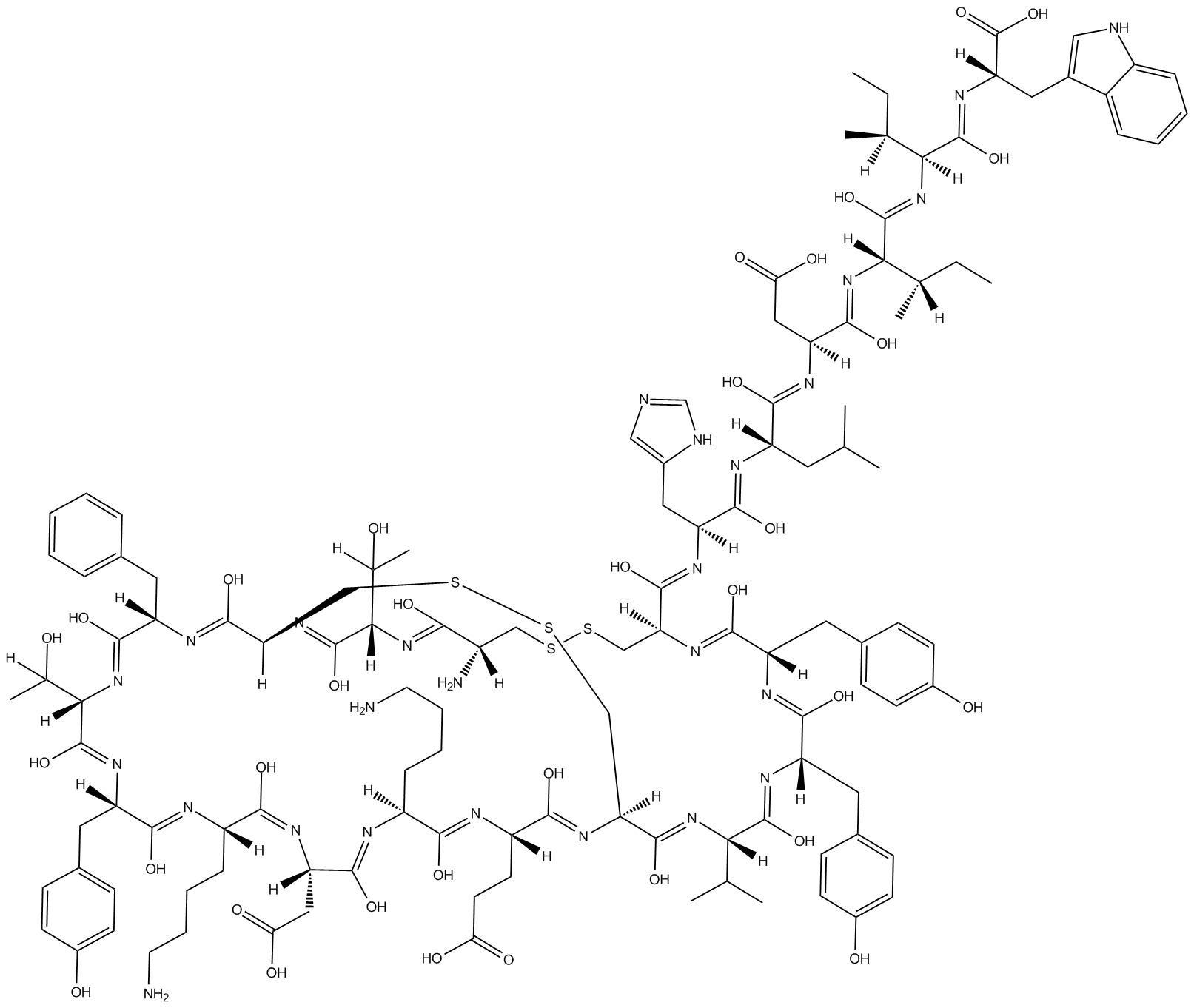
Cas No.: 117399-93-6
Sample solution is provided at 25 µL, 10mM.
_1-3.$$$39978408@51.jpg');)
_1-9.$$$38538795@65.jpg');)
_1-9.$$$39112701@51.jpg');)
_1-7.$$$37316672@70.jpg');)
_366-372.$$$36198801@70.jpg');)
.$$$38565142@65.jpg');)
_1867-1883.$$$33248023@67.jpg');)
_eads6055.$$$39977546@45.jpg');)
_eadm9805.$$$40080571@45.jpg');)
_eadj3020.$$$39666821@45.jpg');)
_1-20.$$$39757301@28.jpg');)
_1-24.$$$38898113@28.jpg');)
_273-287.$$$36806353@46.jpg');)
_1-16.$$$37156877@44.jpg');)
_1-19.$$$37460805@44.jpg');)
_1291-1307.$$$34518654@46.jpg');)
Endothelin-3, human, mouse, rabbit, rat is a 21-amino acid vasoactive peptide that binds to G-protein-linked transmembrane receptors, ET-RA and ET-RB.
The endothelins (ETs) are a family of 21-amino-acid vasoconstrictor peptides comprising three distinct isoforms: ET-1, ET2 and Endothelin-3. Endothelin-3 is detected in plasma, heart, brain and vascular smooth muscle cells (VSMCs). The surface enzymes of VSMCs break down big Endothelin-3 to the corresponding mature peptide, Endothelin-3. Endothelin-3 down-regulate endothelin ETA receptor expression in coronary artery VSMCs without affecting receptor density or functional ETA receptor responses. By contrast, high concentrations of Endothelin-3 (100 nM) increase the expression of ETB receptors but abolish the vasoconstrictor response of the receptors, possibly due to the desensitizing effect of Endothelin-3[1]. Endothelin-3 stimulates ENCC adhesion to various ECM components. Endothelin-3 induces rapid changes in ENCC shape and protrusion dynamics favouring sustained growth and stabilization of lamellipodia, a process coincident with the increase in the number of focal adhesions and activated β1-integrins[2].
Endothelin-3 at low concentrations may attenuate inflammatory responses via ETB2 activation and NO production. Endothelin-3, which acts mainly on ETB, at low concentrations specifically inhibited platelet-activating factor (PAF)-induced paw oedema, whereas neither ET-1 nor Endothelin-2, both of which act on ETA and ETB, showed inhibitory activity. The inhibition by ET-1 and Endothelin-3 (each 0.5 pmol/paw) in the presence of BQ-123 (66.4 ± 6.7 % and 65.4 ± 22.6 %, respectively), is comparable to that by Endothelin-3 (0.5 pmol/paw) alone (65.4 ± 10.9 %), whereas neither ET-1 nor Endothelin-3 in the presence of BQ-788 showed inhibitory activity[3].
References:
[1]. Skovsted GF, et al. Endothelin-1 and Endothelin-3 Regulate Endothelin Receptor Expression in Rat Coronary Arteries. Basic Clin Pharmacol Toxicol. 2015 Nov;117(5):297-305.
[2]. Gazquez E, et al. Endothelin-3 stimulates cell adhesion and cooperates with β1-integrins during enteric nervous system ontogenesis. Sci Rep. 2016 Dec 1;6:37877. doi: 10.1038/srep37877.
[3]. Sato A, et al. Endothelin-3 at low concentrations attenuates inflammatory responses via the endothelin B2 receptor. Inflamm Res. 2013 Apr;62(4):417-24.
| Cas No. | 117399-93-6 | SDF | |
| Chemical Name | (1Z,3S,4Z,6S,7Z,9S,10Z,12S,13Z,15S,16Z,18S)-3-((1H-imidazol-5-yl)methyl)-18-((1H-indol-3-yl)methyl)-1-((1R,2Z,4S,5Z,7S,8Z,10S,11E,13S,14Z,16S,17Z,19S,20Z,22S,23Z,25R,26Z,28S,29Z,31R,36R,37Z,39S,40Z,42S,43Z,45S,46Z)-31-amino-7,13-bis(4-aminobutyl)-22-benzy | ||
| Canonical SMILES | CC[C@]([C@@](/N=C(O)/[C@](/N=C(O)/[C@](/N=C(O)/[C@](/N=C(O)/[C@](/N=C(O)/[C@]1([H])CSSC[C@@](N)([H])/C(O)=N/[C@@](/C(O)=N/[C@@](/C(O)=N/[C@@](/C(O)=N/[C@@](/C(O)=N/[C@@](/C(O)=N/[C@@](/C(O)=N\[C@@](/C(O)=N/[C@@](/C(O)=N/[C@@](/C(O)=N/2)([H])CCC(O)=O)([H]) | ||
| Formula | C121H168N26O33S4 | M.Wt | 2643.04 |
| Solubility | Soluble to 1 mg/ml in Water | Storage | Desiccate at -20°C |
| General tips | Please select the appropriate solvent to prepare the stock solution according to the
solubility of the product in different solvents; once the solution is prepared, please store it in
separate packages to avoid product failure caused by repeated freezing and thawing.Storage method
and period of the stock solution: When stored at -80°C, please use it within 6 months; when stored
at -20°C, please use it within 1 month. To increase solubility, heat the tube to 37°C and then oscillate in an ultrasonic bath for some time. |
||
| Shipping Condition | Evaluation sample solution: shipped with blue ice. All other sizes available: with RT, or with Blue Ice upon request. | ||
| Prepare stock solution | |||

|
1 mg | 5 mg | 10 mg |
| 1 mM | 378.4 μL | 1.8918 mL | 3.7835 mL |
| 5 mM | 75.7 μL | 378.4 μL | 756.7 μL |
| 10 mM | 37.8 μL | 189.2 μL | 378.4 μL |
Step 1: Enter information below (Recommended: An additional animal making an allowance for loss during the experiment)
 g
μL
g
μL
Step 2: Enter the in vivo formulation (This is only the calculator, not formulation. Please contact us first if there is no in vivo formulation at the solubility Section.)
Calculation results:
Working concentration: mg/ml;
Method for preparing DMSO master liquid: mg drug pre-dissolved in μL DMSO ( Master liquid concentration mg/mL, Please contact us first if the concentration exceeds the DMSO solubility of the batch of drug. )
Method for preparing in vivo formulation: Take μL DMSO master liquid, next addμL PEG300, mix and clarify, next addμL Tween 80, mix and clarify, next add μL saline, mix and clarify.
Method for preparing in vivo formulation: Take μL DMSO master liquid, next add μL Corn oil, mix and clarify.
Note: 1. Please make sure the liquid is clear before adding the next solvent.
2. Be sure to add the solvent(s) in order. You must ensure that the solution obtained, in the previous addition, is a clear solution before proceeding to add the next solvent. Physical methods such as vortex, ultrasound or hot water bath can be used to aid dissolving.
3. All of the above co-solvents are available for purchase on the GlpBio website.
Quality Control & SDS
- View current batch:
- Purity: >95.00% Appearance: A solid
- COA (Certificate of Analysis)
- SDS (Safety Data Sheet)
- Datasheet
Average Rating: 5 (Based on Reviews and 38 reference(s) in Google Scholar.)