

Ethacrynic Acid (Synonyms: MK 595,NSC 85791,NSC 624008) |
Catalog No.GC14041
 One-Click Copy Product Info
|

El Ácido etacrÍnico (Etacrynic acid) es un diurético.
Products are for research use only. Not for human use. We do not sell to patients.
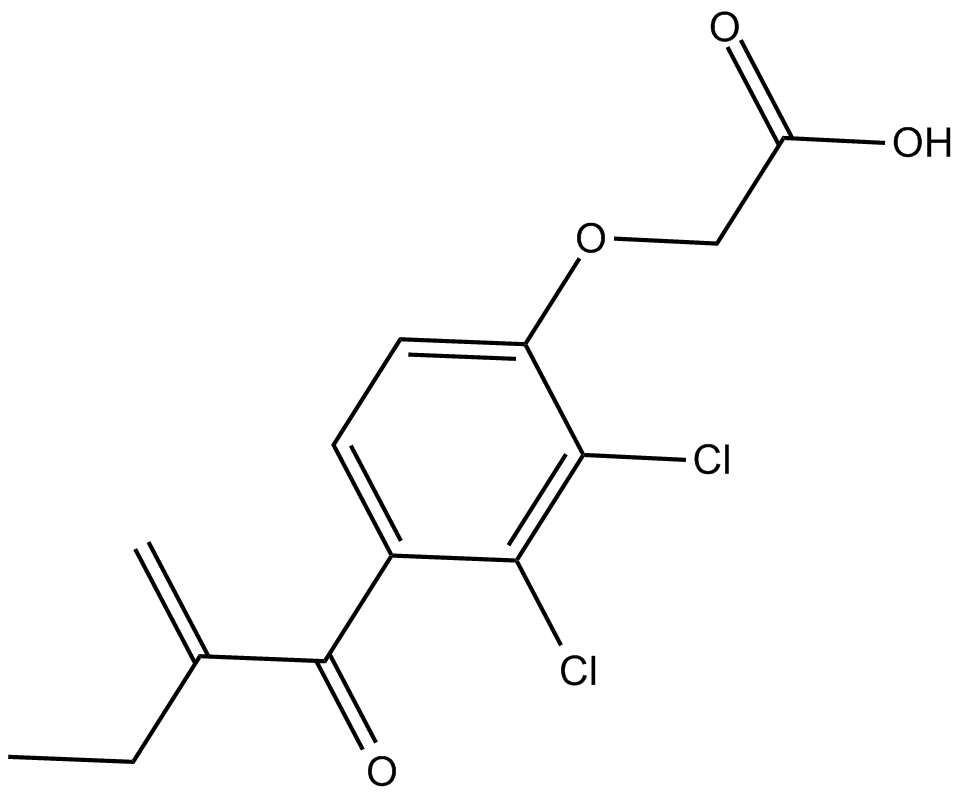
Cas No.: 58-54-8
Sample solution is provided at 25 µL, 10mM.
_1-3.$$$39978408@51.jpg');)
_1-9.$$$38538795@65.jpg');)
_1-9.$$$39112701@51.jpg');)
_1-7.$$$37316672@70.jpg');)
_366-372.$$$36198801@70.jpg');)
.$$$38565142@65.jpg');)
_1867-1883.$$$33248023@67.jpg');)
_eads6055.$$$39977546@45.jpg');)
_eadm9805.$$$40080571@45.jpg');)
_eadj3020.$$$39666821@45.jpg');)
_1-20.$$$39757301@28.jpg');)
_1-24.$$$38898113@28.jpg');)
_273-287.$$$36806353@46.jpg');)
_1-16.$$$37156877@44.jpg');)
_1-19.$$$37460805@44.jpg');)
_1291-1307.$$$34518654@46.jpg');)
Ethacrynic Acid is a potent, orally effective loop diuretic. Ethacrynic Acid reduces sodium and chloride reabsorption by inhibiting the Na+-K+-2Cl- cotransporter (NKCC2) in the thick ascending limb of the loop of Henle in renal tubules, thereby increasing urine output. Ethacrynic Acid can be used for the treatment of edematous conditions such as congestive heart failure, acute pulmonary edema, renal edema, and cirrhotic ascites[1-4].
In vitro, Ethacrynic Acid (0-80μM) was used to treat MCF7, MDA-MB-231, and 4T1 breast cancer cells for 24 hours. Ethacrynic Acid significantly inhibited cell proliferation in a concentration-dependent manner[5]. Ethacrynic Acid (75–100μM) was combined with Afatinib (2–6μM) to treat H1975 (EGFR L858R/T790M mutant) non-small cell lung cancer cells for 48 hours. Ethacrynic Acid significantly inhibited cell proliferation, arrested the cell cycle at the G2/M phase, induced apoptosis, and suppressed the activation of the WNT/β-catenin pathway[6].
In vivo, Ethacrynic Acid (1mg/kg or 10mg/kg) was intraperitoneally injected into male C57Bl/6 mice undergoing laparotomy at 6 hours and 0.5 hours before surgery, and at 6 hours and 12 hours after surgery. Ethacrynic Acid improved postoperative intestinal transit and reduced the expression of proinflammatory cytokines IL-6 and iNOS mRNA in the small intestinal wall[7]. Ethacrynic Acid (5mg/kg/day) was intraperitoneally injected daily into high-fat diet-induced obese (DIO) C57BL/6J mice for 8 weeks. Ethacrynic Acid significantly reduced body weight and adipose tissue, improved glucose tolerance and insulin sensitivity, increased energy expenditure, and promoted the browning of inguinal white adipose tissue[8].
References:
[1] Hinchcliff KW, Mitten LA. Furosemide, bumetanide, and ethacrynic acid. Vet Clin North Am Equine Pract. 1993 Dec;9(3):511-22.
[2] Cannon PJ, Kilcoyne MM. Ethacrynic acid and furosemide: renal pharmacology and clinical use. Prog Cardiovasc Dis. 1969 Jul;12(1):99-118.
[3] Kim KE, Onesti G, Moyer JH, et al. Ethacrynic acid and furosemide. Diuretic and hemodynamic effects and clinical uses. Am J Cardiol. 1971 Apr;27(4):407-15.
[4] Koechel DA. Ethacrynic acid and related diuretics: relationship of structure to beneficial and detrimental actions. Annu Rev Pharmacol Toxicol. 1981;21:265-93.
[5] Liu B, Huang X, Hu Y, et al. Ethacrynic acid improves the antitumor effects of irreversible epidermal growth factor receptor tyrosine kinase inhibitors in breast cancer. Oncotarget. 2016 Sep 6;7(36):58038-58050.
[6] Zhang X, Huang C, Cui B, et al. Ethacrynic Acid Enhances the Antitumor Effects of Afatinib in EGFR/T790M-Mutated NSCLC by Inhibiting WNT/Beta-Catenin Pathway Activation. Dis Markers. 2021 Apr 27;2021:5530673.
[7] Harada T, Fink M, Cruz RJ Jr, et al. Ethacrynic acid decreases expression of proinflammatory intestinal wall cytokines and ameliorates gastrointestinal stasis in murine postoperative ileus. Clinics (Sao Paulo). 2018 Oct 18;73:e332.
[8] Cui Z, Liu Y, Wan W, et al. Ethacrynic acid targets GSTM1 to ameliorate obesity by promoting browning of white adipocytes. Protein Cell. 2021 Jun;12(6):493-501.
| Cell experiment [1]: | |
Cell lines | MCF7, MDA-MB-231 (human breast cancer cell lines) and 4T1 (mouse breast cancer cell line) |
Preparation Method | Cells were maintained in RPMI 1640 medium supplemented with 10% fetal bovine serum (FBS) in a humidified atmosphere containing 5% CO₂ at 37°C. Cells were treated with Ethacrynic Acid(0-80μM). |
Reaction Conditions | 0-80μM; 24h |
Applications | Ethacrynic Acid significantly inhibited cell proliferation and exhibited a concentration-dependent effect. Ethacrynic Acid (20μM) synergistically enhanced the antitumor effects of irreversible EGFR TKIs (afatinib and neratinib) in breast cancer cells. The combination treatment significantly reduced cell viability, induced necrosis, and caused cell cycle arrest at G2/M or S phase. It also repressed WNT/β-catenin and MAPK-ERK1/2 signaling pathways. |
| Animal experiment [2]: | |
Animal models | C57BL/6 mice (high-fat diet (HFD)-fed) |
Preparation Method | Mice were maintained on high-fat diet (HFD; 60% calories from fat) and treated with Ethacrynic Acid (5mg/kg/day) by intraperitoneal injection for 8 weeks. |
Dosage form | 5mg/kg; i.p.; daily injection for 8 weeks |
Applications | Ethacrynic Acid administration led to a significant decrease in body weight and fat tissues, improved glucose tolerance and insulin sensitivity, increased energy expenditure, promoted browning of inguinal white adipose tissue (iWAT), and upregulated UCP1 expression. |
References: | |
| Cas No. | 58-54-8 | SDF | |
| Sinónimos | MK 595,NSC 85791,NSC 624008 | ||
| Chemical Name | 2-(2,3-dichloro-4-(2-methylenebutanoyl)phenoxy)acetic acid | ||
| Canonical SMILES | O=C(O)COC1=CC=C(C(C(CC)=C)=O)C(Cl)=C1Cl | ||
| Formula | C13H12Cl2O4 | M.Wt | 303.14 |
| Solubility | 30mg/mL in DMF; 30mg/mL in DMSO; 30mg/mL in ethanol | Storage | Store at -20°C |
| General tips | Please select the appropriate solvent to prepare the stock solution according to the
solubility of the product in different solvents; once the solution is prepared, please store it in
separate packages to avoid product failure caused by repeated freezing and thawing.Storage method
and period of the stock solution: When stored at -80°C, please use it within 6 months; when stored
at -20°C, please use it within 1 month. To increase solubility, heat the tube to 37°C and then oscillate in an ultrasonic bath for some time. |
||
| Shipping Condition | Evaluation sample solution: shipped with blue ice. All other sizes available: with RT, or with Blue Ice upon request. | ||
| Prepare stock solution | |||

|
1 mg | 5 mg | 10 mg |
| 1 mM | 3.2988 mL | 16.494 mL | 32.9881 mL |
| 5 mM | 659.8 μL | 3.2988 mL | 6.5976 mL |
| 10 mM | 329.9 μL | 1.6494 mL | 3.2988 mL |
Step 1: Enter information below (Recommended: An additional animal making an allowance for loss during the experiment)
 g
μL
g
μL
Step 2: Enter the in vivo formulation (This is only the calculator, not formulation. Please contact us first if there is no in vivo formulation at the solubility Section.)
Calculation results:
Working concentration: mg/ml;
Method for preparing DMSO master liquid: mg drug pre-dissolved in μL DMSO ( Master liquid concentration mg/mL, Please contact us first if the concentration exceeds the DMSO solubility of the batch of drug. )
Method for preparing in vivo formulation: Take μL DMSO master liquid, next addμL PEG300, mix and clarify, next addμL Tween 80, mix and clarify, next add μL saline, mix and clarify.
Method for preparing in vivo formulation: Take μL DMSO master liquid, next add μL Corn oil, mix and clarify.
Note: 1. Please make sure the liquid is clear before adding the next solvent.
2. Be sure to add the solvent(s) in order. You must ensure that the solution obtained, in the previous addition, is a clear solution before proceeding to add the next solvent. Physical methods such as vortex, ultrasound or hot water bath can be used to aid dissolving.
3. All of the above co-solvents are available for purchase on the GlpBio website.
Quality Control & SDS
- View current batch:
- Purity: >98.00% Appearance: A solid
- COA (Certificate of Analysis)
- SDS (Safety Data Sheet)
- Datasheet
Average Rating: 5 (Based on Reviews and 18 reference(s) in Google Scholar.)